All species › Kingfishers, bee-eaters and rollers › Motmots › Trinidad Motmot
Trinidad Motmot | Momotus bahamensis
Trinidadmotmot | Momoto de Trinidad
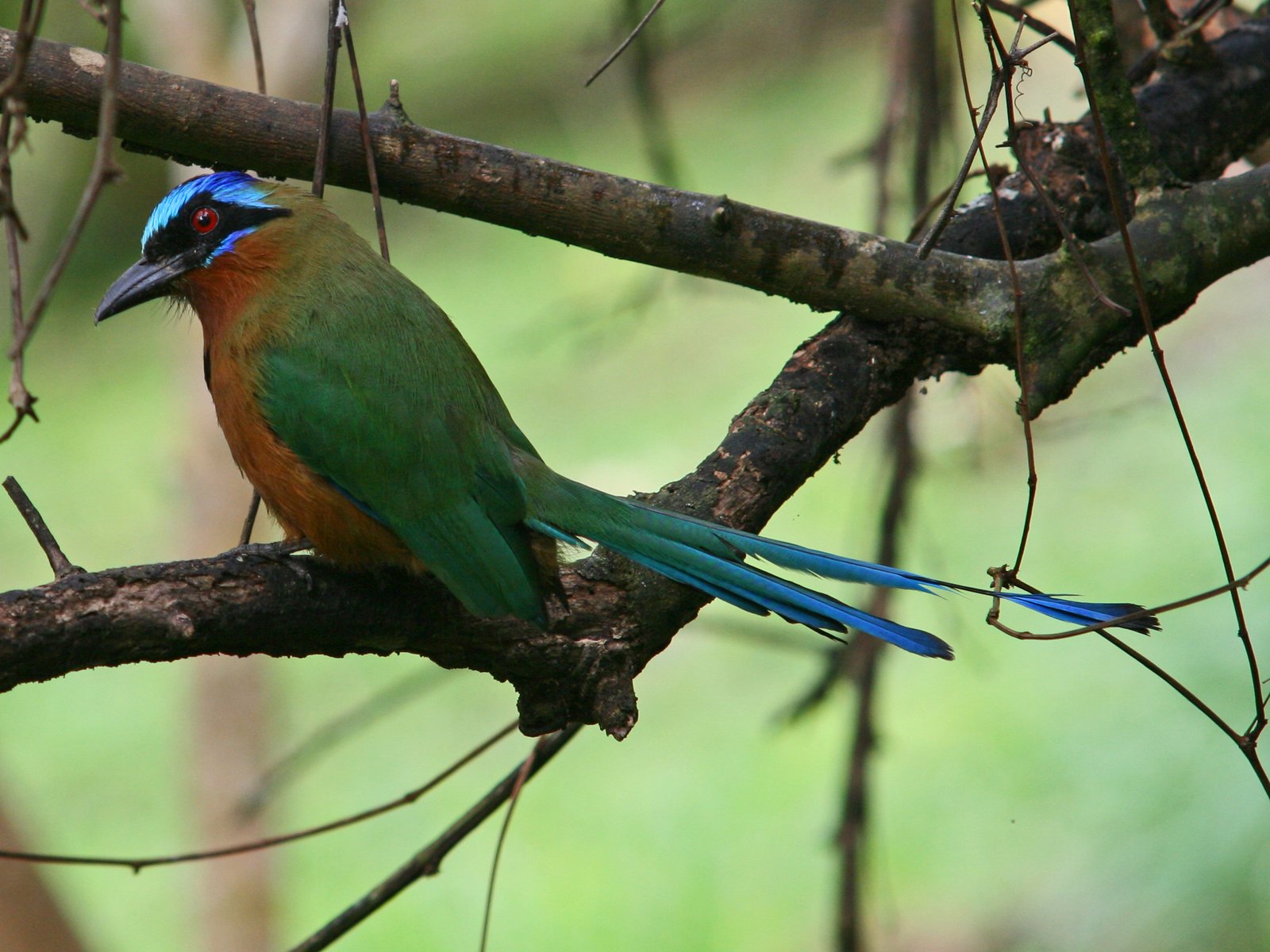
The Trinidad Motmot is the only motmot in the region and occurs only on Trinidad and Tobago. Long treated as part of Blue-crowned Motmot Momotus momota, it is now regarded as a separate species. It sits motionless for long periods on a shaded branch, then slowly swings its tail from side to side like a pendulum. It is more numerous on Tobago than on Trinidad and one of that island's best-known forest birds.
Voice
A low, hollow, owl-like two-note hoot-hoot or coot-coot, the first note shorter and lower than the second. Heard mostly at dawn and dusk.
Recording: Alvaro Jaramillo — CC BY-NC-SA 3.0 · shortened to the first 60 s, mono · xeno-canto
Identification
About 46 cm, much of it tail; one of the largest motmots. The upperparts are green, the wings palest. The crown has a turquoise-blue ring around a black centre, becoming dark blue on the nape. A broad black mask runs through the eye, bordered with blue. Throat and breast are deep rufous, the belly rufous washed olive-green. The two long central tail feathers have bare shafts ending in blue-black rackets. The bill is black, stout and serrated along the edges; the legs are grey. The sexes are alike; juveniles are duller and lack rackets.
Confusion species
No other motmot occurs in the region. The green upperparts, black mask and racket tail are diagnostic. Trogons have a short, broad bill, a square-ended tail without rackets and a red or yellow belly.
Habitat
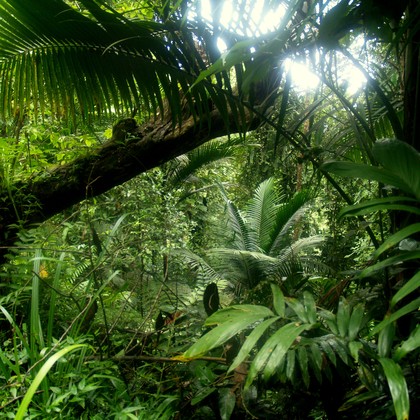
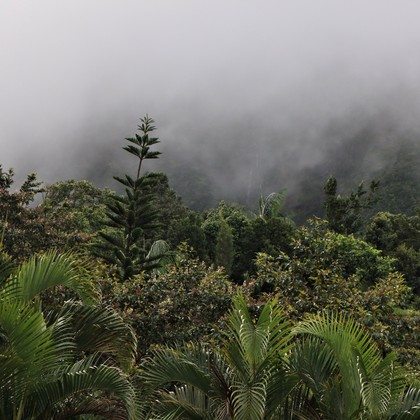
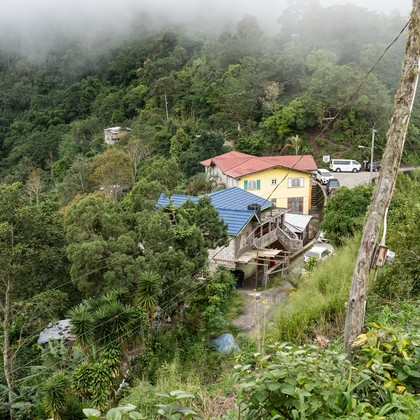
Lowland and moist forest, on Trinidad mainly evergreen forest in the interior. On Tobago also cacao plantations, gardens and pastures with large trees. It hunts from a low perch for large insects, spiders, snails and earthworms, sometimes small lizards; snail shells are broken on a stone. It nests in a burrow in an earth bank or the side of a hollow, often using an existing hole.
Where the bird is most at home, classified by the vegetation types of the Caribbean.


Range and movements
Only on Trinidad and Tobago: throughout Tobago, and in the forested parts of Trinidad. It does not occur outside these islands; the related mainland motmots are absent from the region.
- Resident
- dark = core range, pale = thinly spread
How and when to look
On Tobago almost anywhere with large trees, including the forest trails of the Main Ridge and gardens; on Trinidad in the forests of the Northern Range. The bird often sits completely still and is noticed only by its swinging tail or its low call at dawn and dusk.
Conservation status
Not threatened. The range is small, but the species is common, especially on Tobago, and adapts to plantations, gardens and semi-open land.
Scientific name
Momotus bahamensis | (Swainson, 1838)
Swainson described the species in 1838 as Prionites Bahamensis; because it was later moved to another genus, the author and year stand in brackets. The genus Momotus was introduced in 1760 by Brisson. Momotus comes from 'momot', a corruption (Nieremberg, 1635) of an onomatopoeic Nahuatl (Aztec) word for a blue-capped tropical bird. bahamensis means 'of the Bahamas', a mistake: the type came from Trinidad. The specimen the first description was based on came from Trinidad (originally given in error as the Bahamas).