All species › Kingfishers, bee-eaters and rollers › Todies › Puerto Rican Tody
Puerto Rican Tody | Todus mexicanus
Puerto Ricaanse todie | San Pedrito
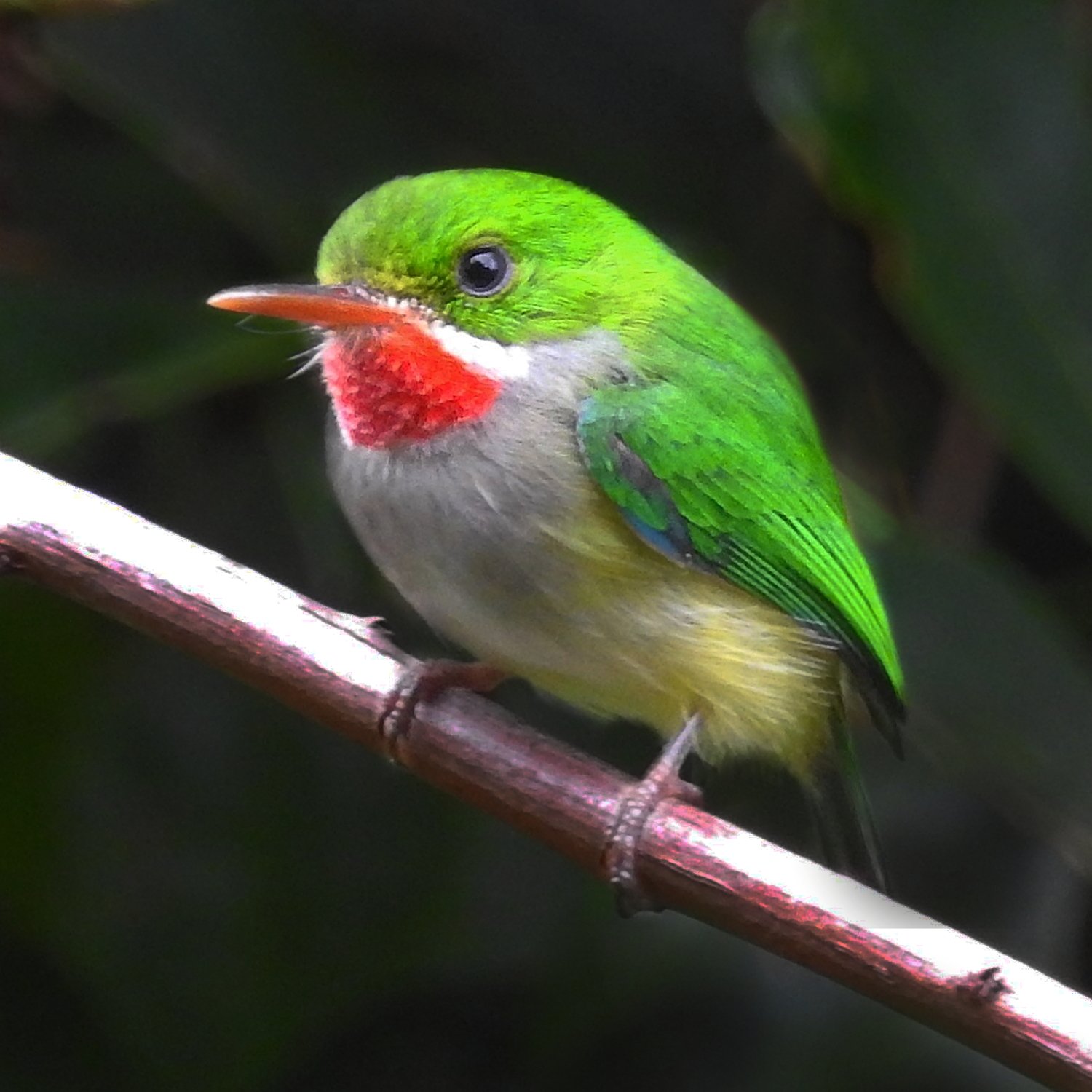
The Puerto Rican Tody, known on the island as San Pedrito or medio peso, is the only tody in Puerto Rico. It occurs in almost every forest on the main island, from the dry forest of the south to the rainforest in the mountains. Like all todies it sits still for long spells, then darts at an insect on the underside of a leaf.
Voice
A loud, buzzy, nasal bzeep or zhip, zhip, usually the first sign of the bird.
Recording: Eric DeFonso — CC BY-NC-SA 4.0 · shortened to the first 60 s, mono · xeno-canto
Identification
11 cm, compact, with a large head, short tail and a long, broad, flat bill about as long as the head. The upper mandible is black, the lower mandible red. The upperparts are emerald green, the throat red, breast and belly white. The flanks and undertail coverts are pale yellow, not pink as in the other todies. Legs brownish. The sexes share the same plumage; the male has a grey eye, the female a white one.
Confusion species
No other tody occurs in Puerto Rico. Puerto Rican Emerald Riccordia maugaeus and Green Mango Anthracothorax viridis are also green, but have thin bills and hover at flowers.
Habitat
Forest in all its forms: dry forest and dense thickets, as at Guánica, semi-evergreen and moist forest on limestone, montane rainforest and cloud forest, and shade coffee; most numerous in moist forest at higher elevations. It hunts insects from low and mid-level perches. Between February and June it digs a narrow tunnel of 25–35 cm with a right-angled bend in an earth bank; the clutch is one to four white eggs, incubated for about 21 days.
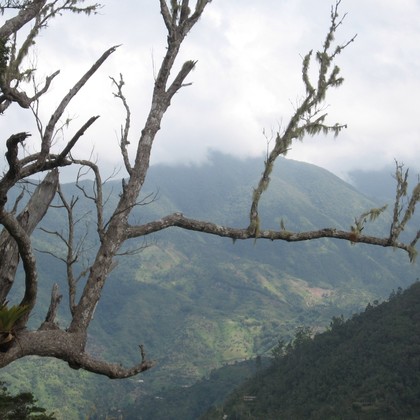
Where the bird is most at home, classified by the vegetation types of the Caribbean.





Range and movements
Endemic to the main island of Puerto Rico, across the whole island wherever there is forest. The species does not occur outside Puerto Rico.
- Resident
- dark = core range, pale = thinly spread
How and when to look
In any larger forest, including El Yunque, Maricao and the dry forest of Guánica. The buzzy call is the first lead. After a shower, when the sun breaks through, the bird is often seen.
Conservation status
Not threatened. The species is common and also occurs in secondary forest and coffee plantations.
Scientific name
Todus mexicanus | Lesson, 1838
Lesson described the species in 1838 and placed it straight away in the genus where it still stands. The genus Todus was introduced in 1760 by Brisson. Todus is a Latin word for a small bird, mentioned by the playwright Plautus and the grammarian Festus. mexicanus means 'of Mexico', a mistake: the species occurs only on Puerto Rico. The specimen the first description was based on came from Puerto Rico (originally given in error as Tampico, Mexico).