All species › Passerines › New World warblers › Tennessee Warbler
Tennessee Warbler | Leiothlypis peregrina
Tennesseezanger | Reinita verdillo
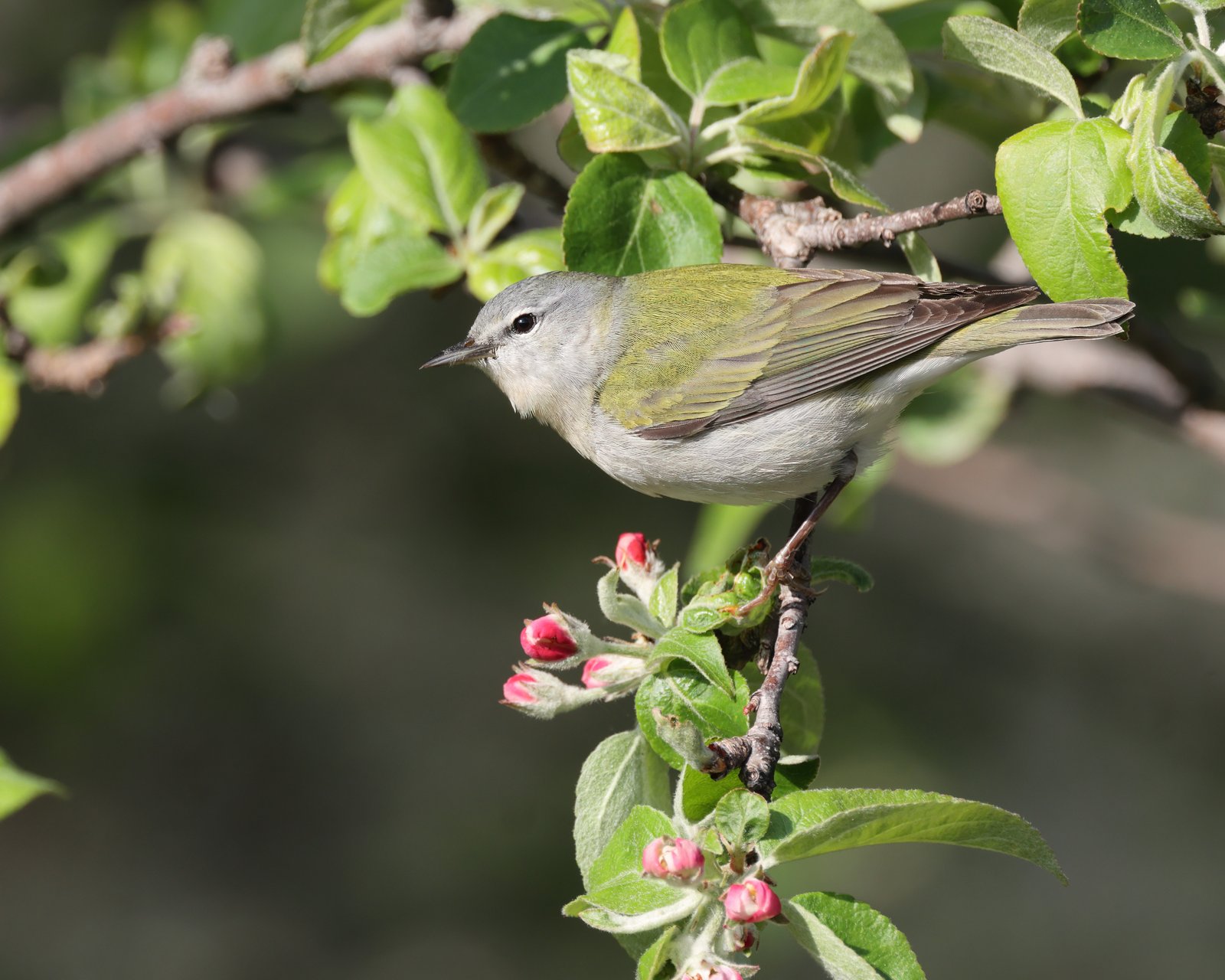
The Tennessee Warbler is a small, plain green wood-warbler with a short tail, breeding in the boreal forest of Canada. It winters from southern Mexico to northern South America and passes through the western Caribbean in varying numbers. Outside the breeding season it eats much nectar and fruit besides insects. The name refers to the place where the first bird was collected on migration, not to the breeding range.
Voice
The call is a sharp tsit or chip; the flight call a thin see. The song, sometimes heard on spring migration, is loud and staccato, in three parts that accelerate: chip-chip-chip-chip, chet-chet-chet, tititititi.
Recording: Jimmy Enfru — CC BY-NC-SA 4.0 · converted to mono · xeno-canto
Identification
11–12 cm, with a fine, pointed bill and a short tail. The breeding male has a grey head with a white supercilium and a dark eye-line, an olive-green back and white underparts. Females and non-breeding birds are olive-green above, with a yellowish supercilium and a yellowish-green throat and breast; the undertail coverts are white. Immatures are the yellowest and sometimes show a faint pale wing bar.
Confusion species
Orange-crowned Warbler Leiothlypis celata has yellow undertail coverts, a longer tail, blurry streaks on the breast and a broken pale eye-ring. Philadelphia Vireo Vireo philadelphicus and Red-eyed Vireo Vireo olivaceus are larger and slower, with a thicker, hooked bill. American Yellow Warbler Setophaga aestiva is more uniformly yellow, with a dark eye in a plain face and yellow tail spots.
Habitat
Forest edges, open woodland, coastal woodland, gardens, parks and shade-coffee plantations, especially around flowering trees. It forages high in the foliage for insects and caterpillars and visits flowers for nectar; in winter often in small groups or with mixed flocks.
Where the bird is most at home, classified by the vegetation types of the Caribbean.





Range and movements
A passage migrant in western Cuba, in some years in good numbers; a rare winter visitor in Cuba, the Bahamas, Jamaica and the Cayman Islands. Very rare on Hispaniola, Puerto Rico and the Virgin Islands; a vagrant in the Lesser Antilles, on the ABC Islands and on Trinidad. Breeds in Canada and the extreme northern United States, and winters from southern Mexico to northern Colombia and Venezuela.
- Summer visitor (c. Oct–Mar)
- Winter visitor (c. Apr–Sep)
- Passage (Mar–Apr, Oct–Nov)
- dark = core range, pale = thinly spread
How and when to look
The best chance is in western Cuba in October and late April–May, at flowering trees along forest edges and in gardens. A small, plain green warbler with white undertail coverts and a short tail is likely this species; the undertail is the main difference from Orange-crowned Warbler.
Conservation status
Not threatened. Numbers fluctuate strongly with spruce budworm outbreaks in the boreal forest, where the species is abundant in good years. In the wintering range it benefits from forest edges and shade coffee.
Scientific name
Leiothlypis peregrina | (Wilson, 1811)
Wilson described the species in 1811 as Sylvia peregrina; because it was later moved to another genus, the author and year stand in brackets. The genus Leiothlypis was introduced in 2008 by Sangster. Leiothlypis is Ancient Greek, from leios 'plain, smooth' and thlypis, an unidentified small bird mentioned by Aristotle. peregrina is from Latin peregrinus 'wanderer, foreigner'. The specimen the first description was based on came from the Cumberland River, Tennessee.