All species › Waders, gulls and terns › Sandpipers and snipes › Semipalmated Sandpiper
Semipalmated Sandpiper | Calidris pusilla
Grijze strandloper | Correlimos semipalmeado
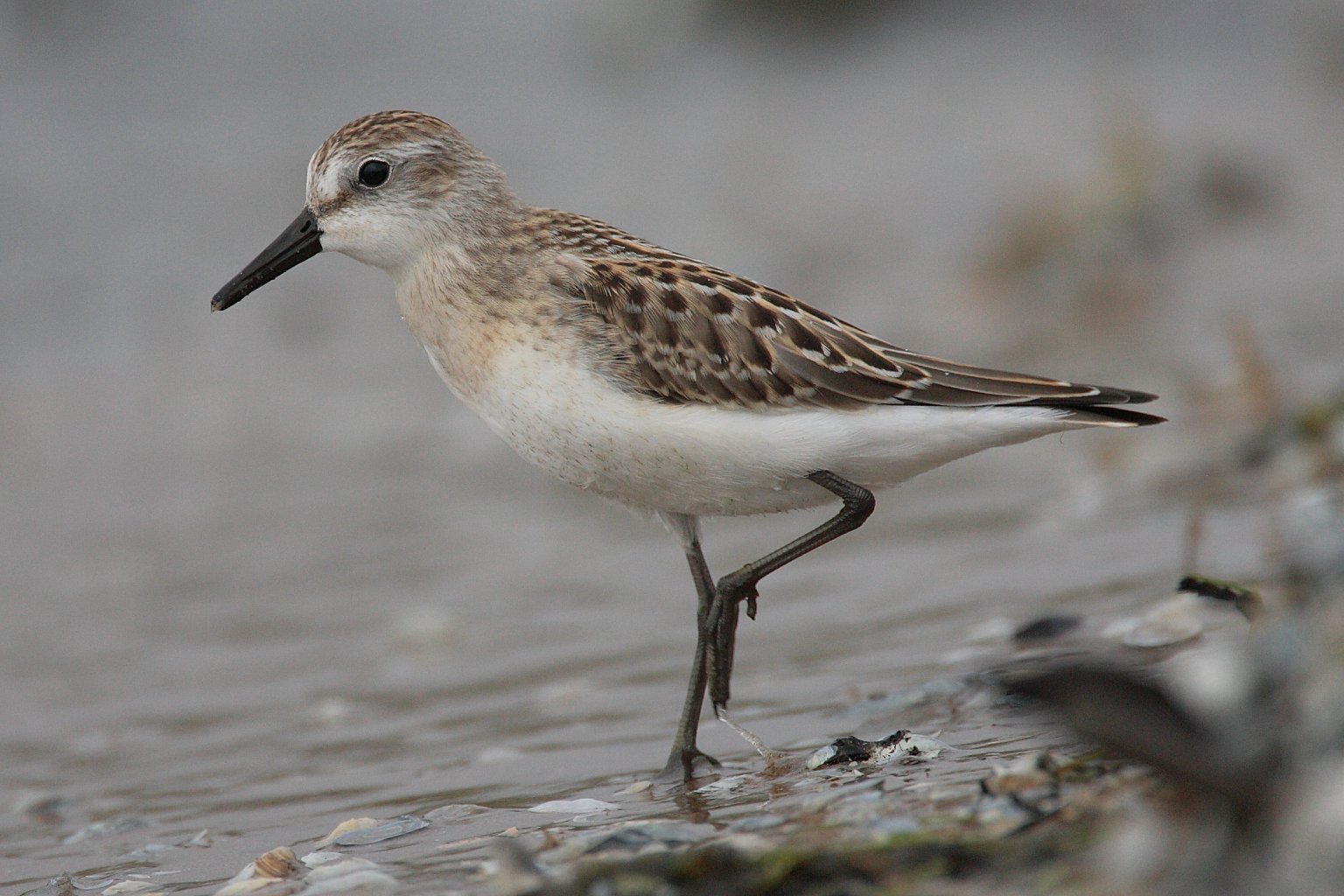
The Semipalmated Sandpiper is one of the smallest and most numerous sandpipers in the Americas. It breeds on the tundra of Alaska and Arctic Canada and winters mainly along the north coast of South America. The Caribbean lies on its migration route; in autumn thousands may stop over on salt pans and mudflats. Its name refers to the small webs between the toes.
Voice
A short, hoarse chrrk or chet; flocks give a soft twittering.
Recording: AUDEVARD Aurélien — CC BY-NC-SA 4.0 · converted to mono · xeno-canto
Identification
14–17 cm, compact, with a short, straight, black bill with a blunt tip, and black legs. Small webs between the front toes are only visible at close range. In winter plumage plain grey-brown above, with white underparts and a faint grey wash on the breast sides. Juveniles have a scaly back with pale fringes and a dark 'cap' and cheek patch. Breeding adults are browner, with fine breast streaks and little rufous.
Confusion species
Western Sandpiper Calidris mauri is very similar, but has a longer bill that droops slightly at the tip, rufous on the scapulars in juveniles and adults in early autumn, and moults into winter plumage earlier. Least Sandpiper Calidris minutilla is browner, with yellow legs and a fine, pointed bill. Sanderling Calidris alba is larger and paler, with a white wing bar. White-rumped Sandpiper Calidris fuscicollis has longer wings and a white band above the tail.
Habitat
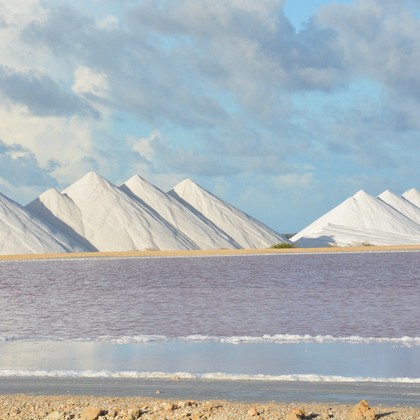
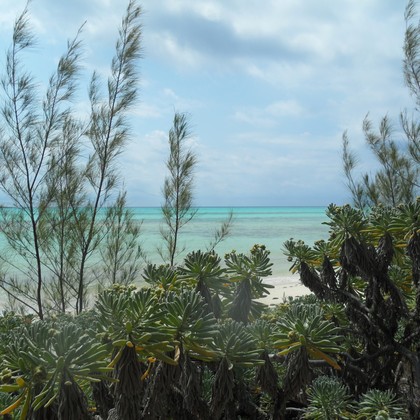
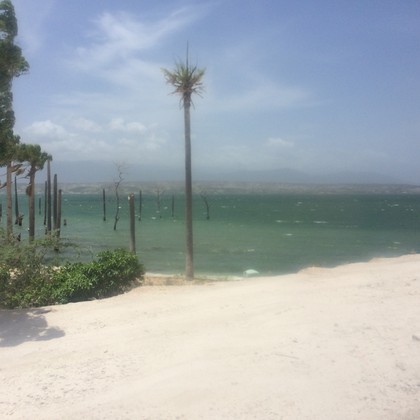
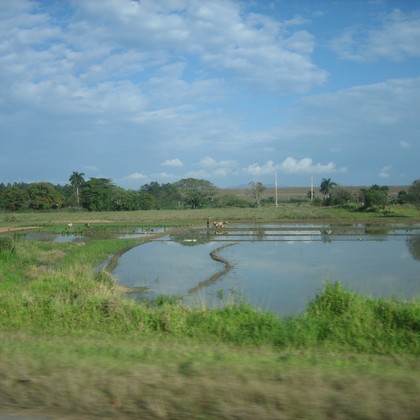
Mudflats, tidal flats, shallow salt pans and lagoons, also sandy beaches, sewage ponds, rice fields and muddy pond edges. It feeds in dense flocks with quick pecks in wet mud and shallow water.
Where the bird is most at home, classified by the vegetation types of the Caribbean.


Range and movements
Passage migrant and winter visitor throughout the region: the Bahamas, the Turks and Caicos Islands, Cuba, the Cayman Islands, Jamaica, Hispaniola (Haiti and the Dominican Republic), Puerto Rico, the Virgin Islands, the Lesser Antilles, the ABC Islands, San Andrés and Trinidad and Tobago. Most numerous in autumn; large numbers stop over in Puerto Rico, Guadeloupe, Barbados, Bonaire and Trinidad, among others. In winter birds remain mainly in the south of the region. Beyond the region it breeds in Alaska and Arctic Canada and winters on the coasts of northern South America, especially Suriname and French Guiana, and further south to Brazil and Peru.
- Resident
- Summer visitor (c. Oct–Mar)
- Winter visitor (c. Apr–Sep)
- Passage (Mar–Apr, Oct–Nov)
- dark = core range, pale = thinly spread
How and when to look
In August and September, salt pans and mudflats holding a large flock of small sandpipers are the best places. Separating it from Western Sandpiper needs a good view of bill length and shape; leg colour separates both from Least Sandpiper.
Conservation status
Near Threatened. The population has declined sharply, especially in the eastern part of the breeding range. On the wintering grounds in northern South America small shorebirds are shot and coastal habitat is being lost. In the Caribbean shorebirds were formerly shot in large numbers on Barbados and in the French Antilles; restrictions now apply there.
Scientific name
Calidris pusilla | (Linnaeus, 1766)
Linnaeus described the species in 1766 as Tringa pusilla; because it was later moved to another genus, the author and year stand in brackets. The genus Calidris was introduced in 1804 by Merrem. Calidris goes back to Ancient Greek kalidris or skalidris, a name Aristotle used for an unidentified grey waterside bird. pusilla is Latin for 'very small'. The specimen the first description was based on came from Santo Domingo.