All species › Tubenoses › Petrels and shearwaters › Scopoli's Shearwater
Scopoli's Shearwater | Calonectris diomedea
Scopoli's pijlstormvogel | Pardela cenicienta mediterránea
Scopoli's Shearwater breeds in the Mediterranean and was long treated as a subspecies of Cory's Shearwater Calonectris borealis. After breeding it moves into the Atlantic, where some birds reach the east coast of North America in summer. Only a handful of records are known from the Caribbean; because the two species closely resemble each other at sea, its true status is unclear.
Voice
Almost silent at sea. At the colony, loud, nasal, wailing calls at night, higher and clearer in the male than in the female.
Recording: Pere Josa — CC BY-NC-SA 4.0 · converted to mono · xeno-canto
Identification
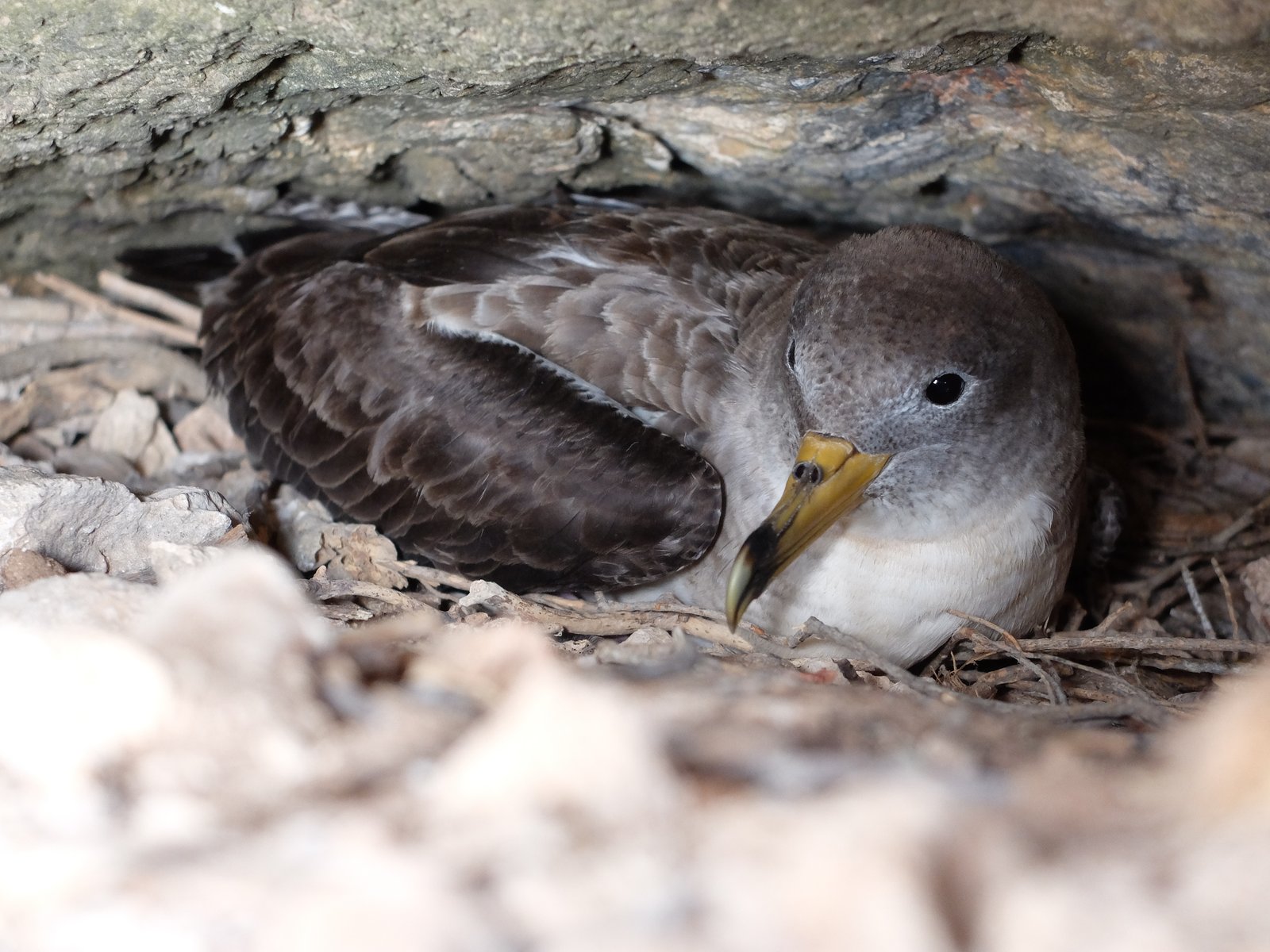
45–52 cm. A large, slender shearwater with long, slightly angled wings and a relaxed, gliding flight with slow wingbeats. Upperparts grey-brown with paler fringes to the coverts. Head and sides of neck grey-brown, merging gradually into the white throat, without a sharply defined cap. Underparts and underwing white, with a narrow dark trailing edge and a dark wingtip. The bill is stout and yellow, with a dark band near the tip. The underwing is the best distinction from Cory's: in Scopoli's the white extends as long tongues far into the primaries, including the outermost one. The bill averages slightly slimmer and the bird slightly smaller. The sexes are alike.
Confusion species
Cory's Shearwater Calonectris borealis, the more expected member of the genus in the western Atlantic, averages larger with a heavier bill and has dark undersides to the primaries, without long white tongues. Great Shearwater Ardenna gravis has a sharply defined dark cap, a white collar, a white band across the rump, a dark bill and a dusky belly patch.
Habitat
Open sea, often over deep water and where shoals of fish are driven to the surface by predatory fish or dolphins. It eats fish, squid and crustaceans, picked from the surface or caught in short dives, and sometimes follows fishing boats. It breeds in burrows and rock crevices on Mediterranean islands and cliffs.
Where the bird is most at home, classified by the vegetation types of the Caribbean.

Range and movements
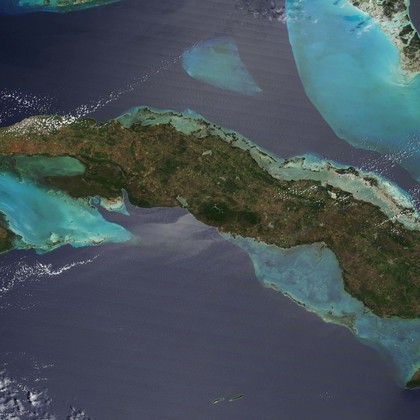
In the Caribbean a very rare vagrant at sea, with only a few documented records; there are no records from most islands. Older reports of Cory's Shearwater did not separate the two species. Beyond the region it breeds on the coasts and islands of the Mediterranean and winters in the Atlantic, mainly off West Africa and south to Namibia and South Africa. In the northern summer it is seen regularly off the east coast of the United States.
How and when to look
A chance exists almost only on pelagic trips. Any large grey-brown shearwater with a yellow bill needs a photograph of the spread underwing, as only this reliably separates Scopoli's from Cory's.
Conservation status
Not threatened. At the colonies introduced rats and cats and disturbance play a part, at sea bycatch in longline fisheries. No regular presence in the Caribbean.
Scientific name
Calonectris diomedea | (Scopoli, 1769)
Scopoli described the species in 1769 as Procellaria diomedea; because it was later moved to another genus, the author and year stand in brackets. The genus Calonectris was introduced in 1915 by Mathews & Iredale. Calonectris combines the Ancient Greek kalos 'good, noble' with the genus name Nectris, used for shearwaters by the German naturalist Heinrich Kuhl in 1820. diomedea refers to the Greek hero Diomedes, whose grieving companions were turned into white seabirds after his death. The specimen the first description was based on came from the Tremiti Islands, Italy.