All species › Passerines › Tyrant flycatchers › Scissor-tailed Flycatcher
Scissor-tailed Flycatcher | Tyrannus forficatus
Zwaluwstaartkoningstiran | Tijereta rosada
The Scissor-tailed Flycatcher breeds on the prairies and in open farmland of the southern United States and northern Mexico, and winters from southern Mexico to Panama. Its migration route runs west of the Gulf of Mexico, but strays occasionally reach Florida and the north-western Caribbean.
Voice
Usually silent on migration and in winter. Calls are a sharp pik or kek and a rapid, dry chatter.
Recording: Terry Davis — CC BY-NC-SA 4.0 · shortened to the first 60 s, mono · xeno-canto
Identification
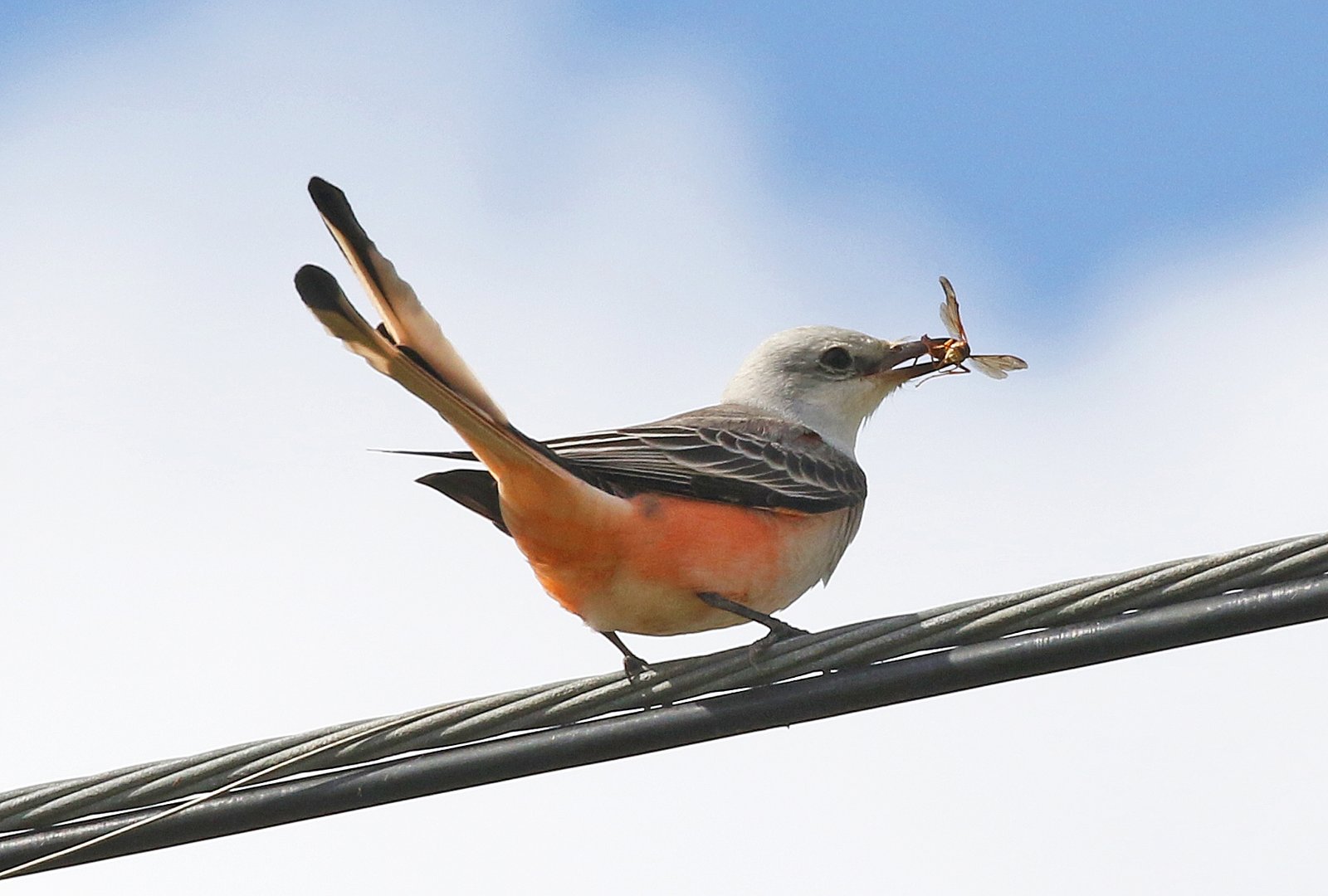
22–37 cm, much of it tail; the male has the longest tail, the female's being up to about a third shorter. Head, back and breast pale grey, the wings dark grey with pale edges. Flanks and undertail coverts salmon-pink, brightest in the male; in flight the salmon to red axillaries stand out. The very long, deeply forked tail is black above and white below. Juveniles have a much shorter tail and largely lack the pink; they are pale grey with at most a yellowish or pink tinge to the belly.
Confusion species
Fork-tailed Flycatcher Tyrannus savana, which occurs mainly in the south of the region, has a black cap, an all-black tail and pure white underparts without pink. Short-tailed young Scissor-tailed Flycatchers resemble Western Kingbird Tyrannus verticalis, but lack the yellow belly and already show a forked tail with a white base.
Habitat
Open country with scattered trees, wires or fences: pasture, field edges, airports, golf courses and parks. It hunts flying insects from an open perch and also takes prey from the ground.
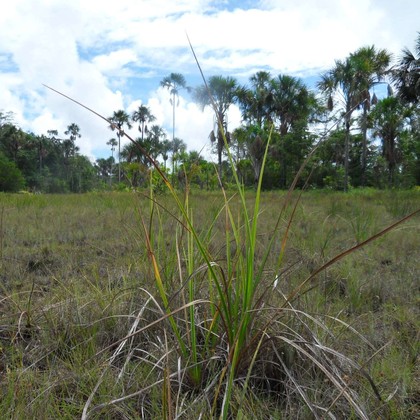
Where the bird is most at home, classified by the vegetation types of the Caribbean.


Range and movements
Vagrant to Cuba, where a few birds are reported each year, and to the Bahamas, the Cayman Islands and Puerto Rico; very rare elsewhere in the region. Most records fall in October and November. Outside the region it breeds from Nebraska to north-eastern Mexico and winters from southern Mexico to Panama; small numbers winter in southern Florida.
How and when to look
The best chance is in Cuba and the northern Bahamas in late autumn, on wires and fences beside open ground. A short-tailed bird deserves a look at the underparts and the tail base to avoid confusion with other kingbirds.
Conservation status
Not threatened. The species is common in its breeding range, although numbers have clearly declined since the 1960s.
Scientific name
Tyrannus forficatus | (Gmelin, 1789)
Gmelin described the species in 1789 as M[uscicapa] forficata; because it was later moved to another genus, the author and year stand in brackets. The genus Tyrannus was introduced in 1799 by De Lacépède. Tyrannus is Latin (from Greek turannos) for 'tyrant, despot', after the aggressive way these birds drive off even raptors. forficatus is Latin for 'forked like scissors', from forfex 'scissors', after the very long forked tail. The specimen the first description was based on came from Mexico (not further specified).