All species › Passerines › Tanagers › Puerto Rican Bullfinch
Puerto Rican Bullfinch | Melopyrrha portoricensis
Puerto Ricaans dikbekje | Comeñame
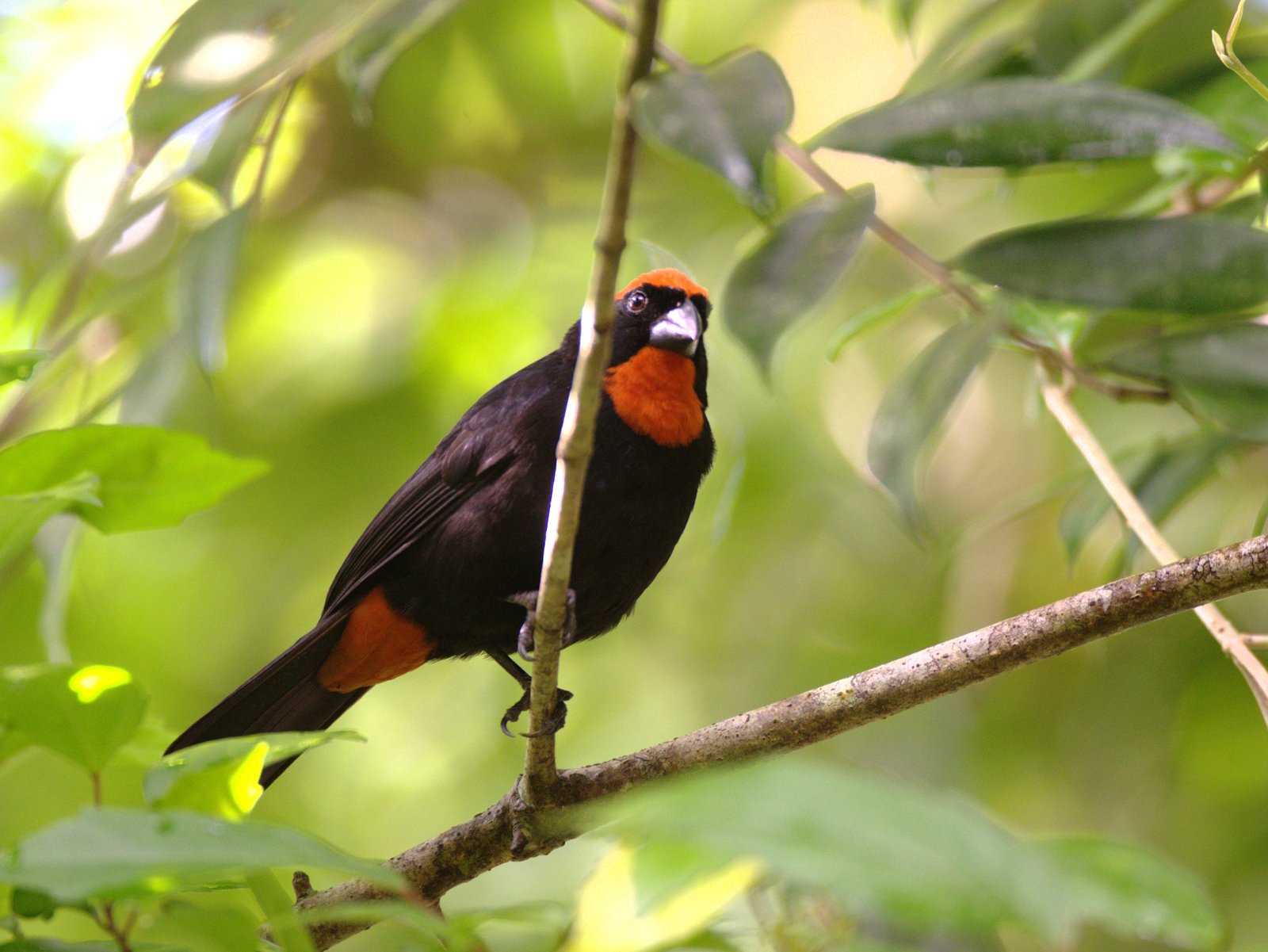
The Puerto Rican Bullfinch is a large, black seed- and fruit-eater with a heavy bill, endemic to Puerto Rico. It was long lumped with the birds of St Kitts, now treated as a separate species, St. Kitts Bullfinch Melopyrrha grandis. In Puerto Rico it is called comeñame. It usually keeps to dense thickets and is heard more often than seen.
Voice
The song is a series of a few clear whistles rising in pitch. There is also a soft, thin tseep contact call.
Recording: Rainforest Connection — CC BY-NC-SA 4.0 · converted to mono · xeno-canto
Identification
16.5–19 cm, with a heavy, conical black bill. Adults are black, with an orange-red stripe above the eye, an orange-red throat and orange-red undertail coverts. The sexes are alike. Juveniles are olive-green with rusty undertail coverts.
Confusion species
No other bullfinch occurs in Puerto Rico. The male Shiny Cowbird Molothrus bonariensis is also black, but glossed purple-blue, with no red, a more pointed bill and a longer tail. Lesser Antillean Bullfinch Loxigilla noctis and Greater Antillean Bullfinch Melopyrrha violacea, which are very similar, do not occur in Puerto Rico or only as rare vagrants.
Habitat
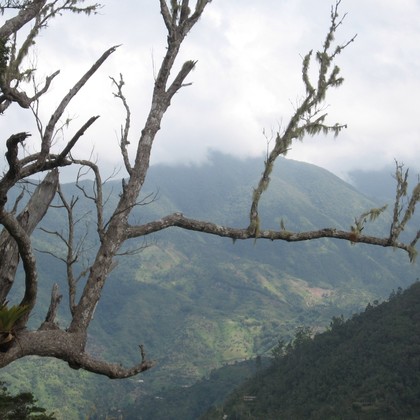
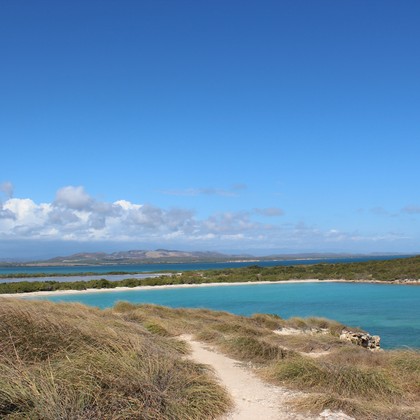
Dense forest with plenty of undergrowth: moist montane and cloud forest, lowland forest with a dense shrub layer, dry forest and scrub in the south-west, coffee plantations, brushy areas and coastal thickets, rarely mangroves. It is a bird of forest edges and places with an open canopy. It feeds mainly on fruit, as well as seeds, flower buds, insects and spiders. The nest is a sphere with a side entrance, usually low in a tree, shrub or grass clump. Breeding in moist forest runs from March to June, in the dry south-west mainly from late April to July, sometimes with a second attempt in September and October. The clutch is two or three eggs, incubated by the female for about 14 days.
Where the bird is most at home, classified by the vegetation types of the Caribbean.




Range and movements
Only in Puerto Rico, widespread over most of the island but absent from the easternmost tip. The species does not occur outside Puerto Rico.
- Resident
- dark = core range, pale = thinly spread
How and when to look
The dry forest of Guánica in the south-west and the montane forest around Maricao in the west are the best-known sites. The song is the best lead; the bird itself often sits low and quiet in dense cover and is most often seen at fruiting shrubs.
Conservation status
Vulnerable. Both its range and population are suspected to be shrinking. Most nests fail through predation, at Guánica mainly by Pearly-eyed Thrasher Margarops fuscatus; introduced mongooses, cats and rats are also potential nest predators. Nest success is higher in years with plenty of fruit and rain.
Scientific name
Melopyrrha portoricensis | (Daudin, 1800)
Daudin described the species in 1800 as Loxia portoricensis; because it was later moved to another genus, the author and year stand in brackets. The genus Melopyrrha was introduced in 1853 by Bonaparte. Melopyrrha combines Greek melas 'black' with Pyrrhula, the bullfinch genus: a 'black bullfinch'. portoricensis is Latin for 'of Puerto Rico', the island where the species lives. The specimen the first description was based on came from Puerto Rico.