All species › Passerines › Typical antbirds › Plain Antvireo
Plain Antvireo | Dysithamnus mentalis
Bosmiervireo | Batarito cabecigrís
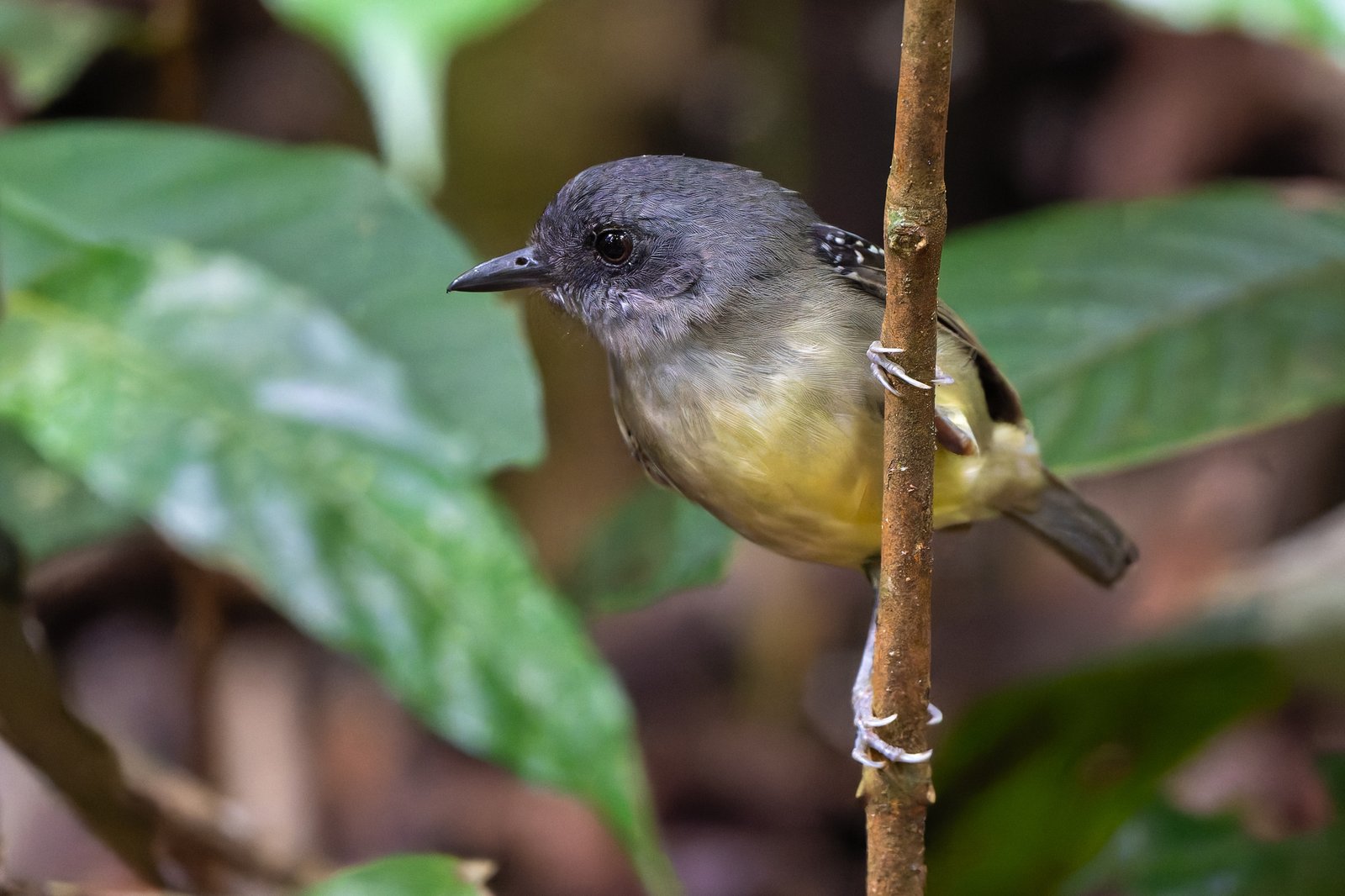
The Plain Antvireo is a compact, big-headed antbird whose deliberate movements and heavy bill recall a vireo more than an antwren. It lives in the understorey of humid forest in both Trinidad and Tobago, each island having its own subspecies, and often joins mixed flocks.
Voice
The song begins with a few evenly paced, countable notes at one pitch, which then become shorter, drop in pitch and run into an accelerating roll. Calls include a nasal, musical note and short rising series.
Recording: Juan Freile — CC BY-NC-SA 4.0 · shortened to the first 60 s, mono · xeno-canto
Identification
11–12 cm, with a large head, short tail and a fairly heavy, slightly hooked bill. The male has a grey crown and a dark, almost black ear patch that stands out as a mask; the upperparts are greyish olive, with a hidden white patch between the shoulders. The wing-coverts have narrow pale tips. The underparts are whitish to pale grey, with yellow on the belly. The female has a cinnamon crown, a pale eye-ring and more olive upperparts, and more yellow below.
Confusion species
Red-eyed Vireo Vireo olivaceus is slimmer, with a bold supercilium and no mask. Scrub Greenlet Hylophilus flavipes is yellowish green, with a pale iris and a pink bill. The female White-flanked Antwren Myrmotherula axillaris is smaller and buff, with white flanks.
Habitat
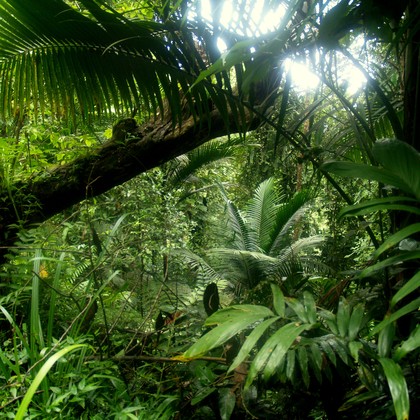
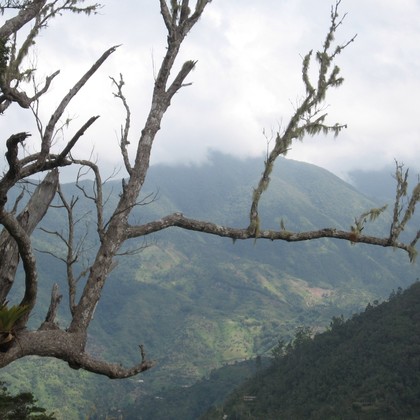
The understorey of humid forest, montane rainforest and older secondary forest, in Tobago also in the misty forest of the Main Ridge. It forages from just above the ground to 4–5 metres for insects and spiders, picked from leaves and twigs after a short pause.
Where the bird is most at home, classified by the vegetation types of the Caribbean.


Range and movements
Resident in Trinidad, mainly in the forests of the Northern Range, and in Tobago, mainly in the Main Ridge forest. Unknown elsewhere in the region. Outside the region from southern Mexico through Central America and the northern Andes to south-eastern Brazil, Paraguay and north-eastern Argentina.
- Resident
- dark = core range, pale = thinly spread
How and when to look
In Tobago along trails in the Main Ridge forest, such as the Gilpin Trace, and in Trinidad along forest trails in the Northern Range. With mixed flocks it pays to search low in the vegetation for a quietly perched grey bird with a dark mask.
Conservation status
Not threatened. The species is common over much of its range, but on both islands it depends on humid forest.
Scientific name
Dysithamnus mentalis | (Temminck, 1823)
Temminck described the species in 1823 as Myothera mentalis; because it was later moved to another genus, the author and year stand in brackets. The genus Dysithamnus was introduced in 1847 by Cabanis. Dysithamnus is Greek, from duō 'to plunge into' and thamnos 'bush', after its life in dense undergrowth. mentalis is Latin, from mentum 'chin', after the pale chin and throat. The specimen the first description was based on came from Curitiba, Paraná, Brazil.