All species › Birds of prey › Hawks, eagles and kites › Pearl Kite
Pearl Kite | Gampsonyx swainsonii
Parelwouw | Elanio perla
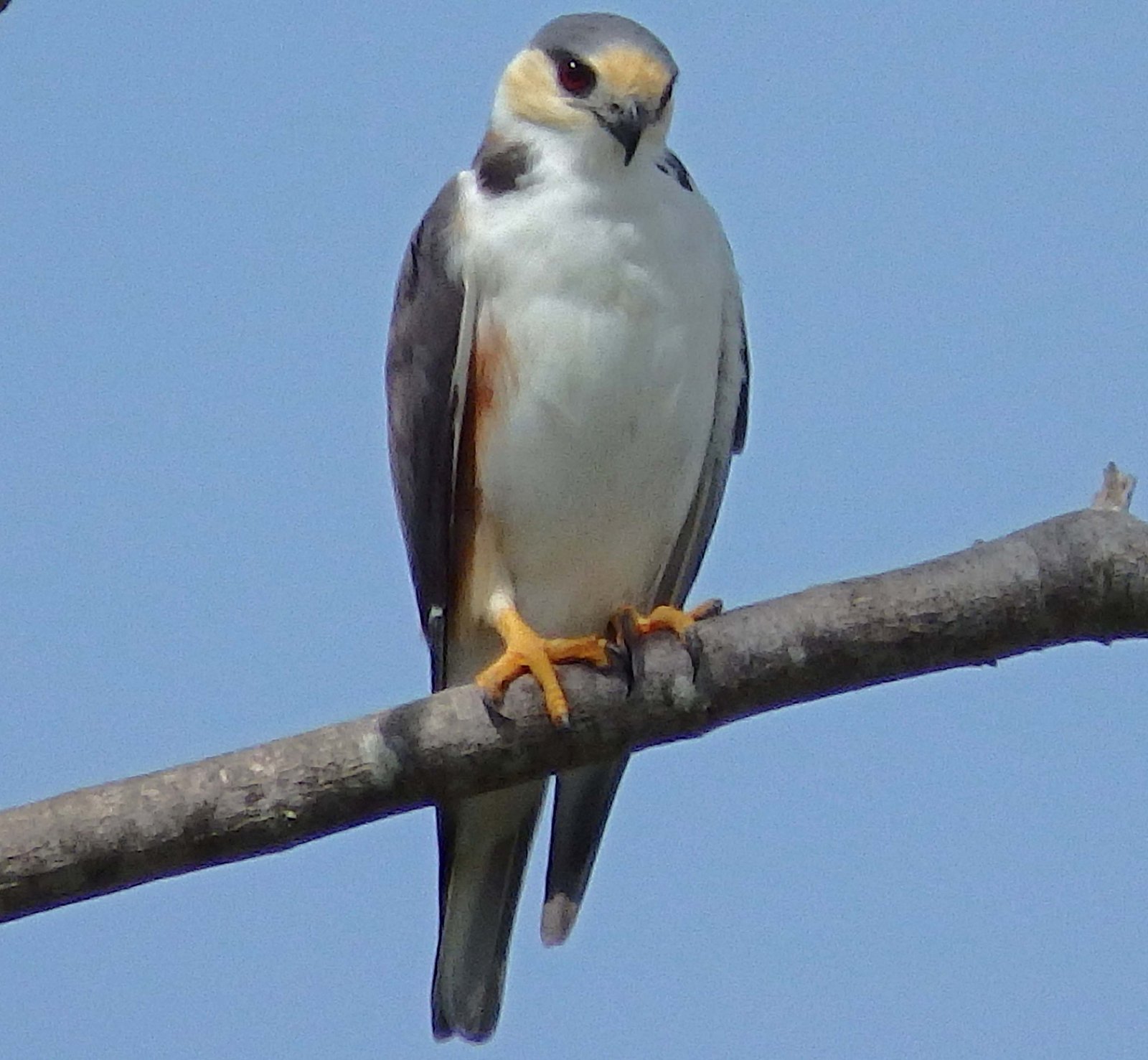
The Pearl Kite is the smallest raptor in the Americas, barely larger than a starling. It often sits for long spells on a high, open perch such as a bare treetop or a power line, dropping from there onto lizards and large insects. It colonised Trinidad from the South American mainland around 1970 and has since become an established resident of open country.
Voice
Usually silent. Near the nest a high, musical series pip-pip-pip-pip or kitty-kitty-kitty.
Recording: Francisco contreras — CC BY-NC-SA 4.0 · converted to mono · xeno-canto
Identification
20–23 cm, compact, with a small head, pointed wings and a fairly long, square-ended tail; perched it looks more like a small falcon than a kite. Crown, upperparts, wings and tail are blackish grey, with a white hindcollar edged rufous. The forehead and cheeks are yellowish to ochre and the underparts white; birds from the northern part of the range, including Trinidad, have rufous flanks and thighs. The legs are yellow. In flight it looks dark above and mostly white below. The sexes are alike. Juveniles have pale, rufous-tipped edges to the upperpart feathers and a paler, buffier face and collar.
Confusion species
American Kestrel Falco sparverius is slightly larger, with a rufous back and tail and two black stripes on the white cheeks, and pumps its tail. Bat Falcon Falco rufigularis is equally dark above but has a black head without yellow on the face, a barred black breast and a rufous belly; it hunts mainly at dusk, taking bats and birds in flight.
Habitat
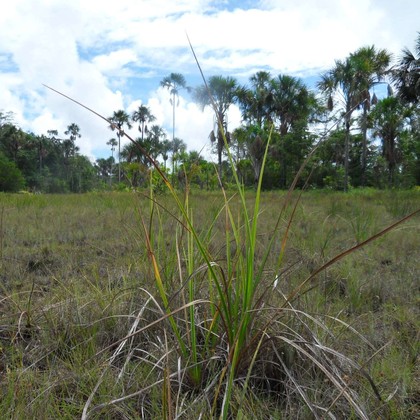
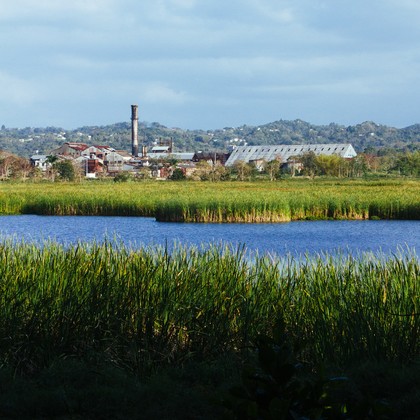
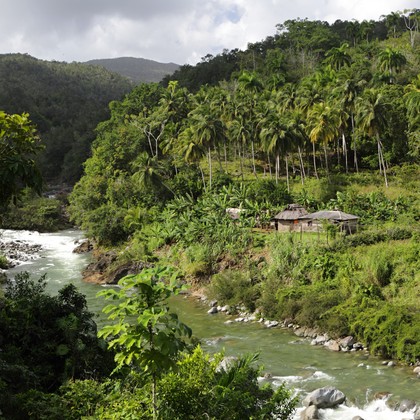
Open and semi-open country with scattered trees: savanna, pasture, rough ground, fields and plantations, the edges of dry forest and villages. It feeds mainly on lizards, supplemented by large insects, small birds and frogs. The nest is a deep cup of twigs high in a tree, sometimes in the old nest of another bird; there may be two broods a season.
Where the bird is most at home, classified by the vegetation types of the Caribbean.


Range and movements
In the region only on Trinidad, mainly in the open country of the west, centre and south. Not known from Tobago or the other islands. Outside the region from Nicaragua and Panama through Colombia and Venezuela to Bolivia, northern Argentina and southern Brazil; the range is expanding northwards in Central America.
- Resident
- dark = core range, pale = thinly spread
How and when to look
Power lines and bare treetops along country roads through pasture and farmland on Trinidad are the places to check. The small perched bird is recognisable by its pale face and white breast against the black upperparts; its small size means it is often overlooked.
Conservation status
Not threatened. The species benefits from forest clearance and the spread of open farmland, and its range has grown over recent decades.
Scientific name
Gampsonyx swainsonii | Vigors, 1825
Vigors described the species in 1825 and placed it straight away in the genus where it still stands. He introduced the genus Gampsonyx in that same work. Gampsonyx is Greek, from gampsos 'curved' and onux 'claw': 'curved claw'. swainsonii honours the English naturalist William Swainson (1789–1855). The specimen the first description was based on came from tableland of Bahia, Brazil.