All species › Potoos › Potoos › Northern Potoo
Northern Potoo | Nyctibius jamaicensis
Noordelijke reuzennachtzwaluw | Nictibio norteño
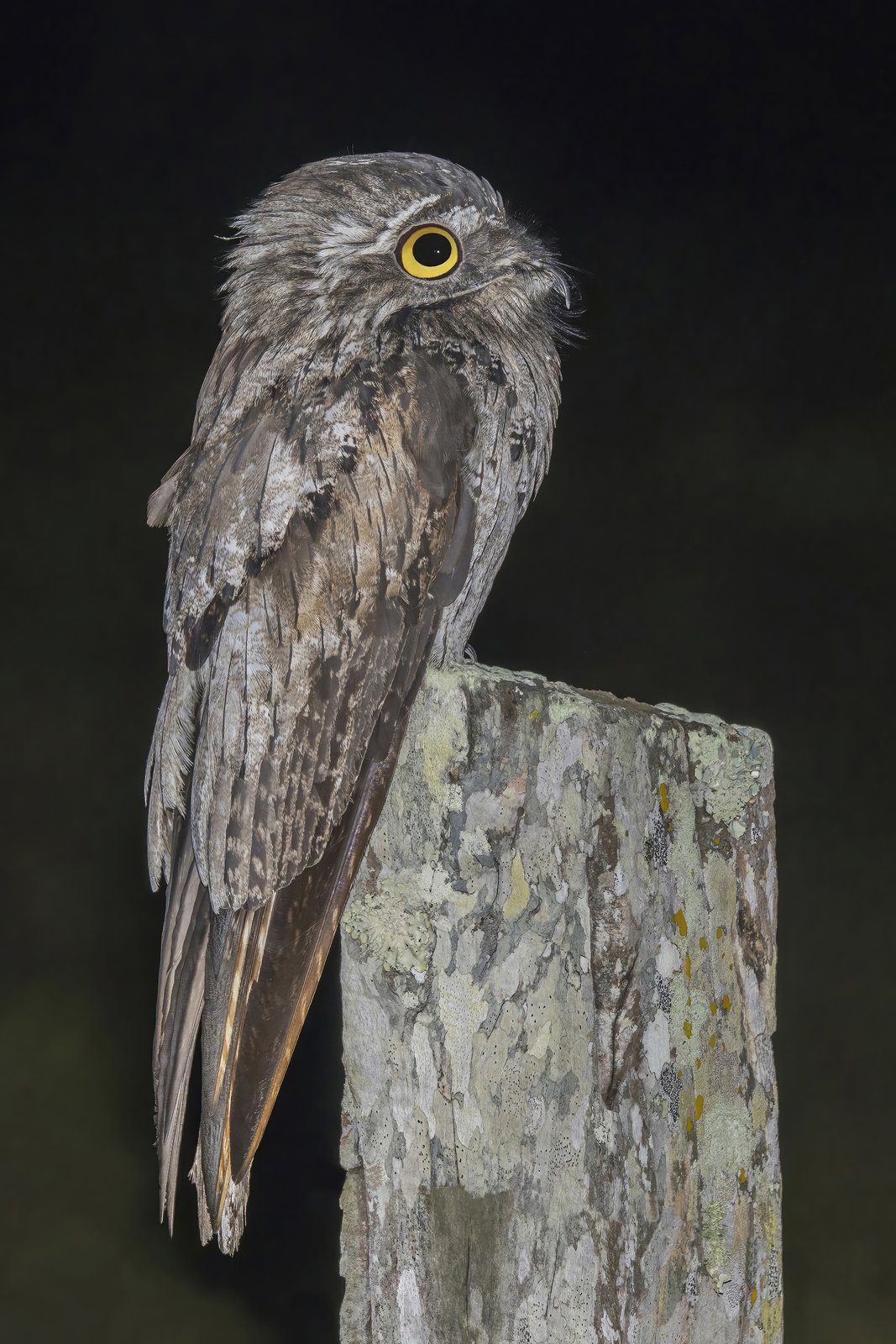
The Northern Potoo is the potoo of the Greater Antilles, where it lives only in Jamaica and Hispaniola. Long treated as a subspecies of Common Potoo, it has usually been regarded as a separate species since 1995, mainly because of its different voice. By day it perches motionless and upright on a broken branch or post and then blends in with the wood.
Voice
A rough, croaking kwaaah, kwa-kwa-kwa, hoarse and guttural, unlike the plaintive whistles of Common Potoo. Also emphatic, barking alarm calls. Sings at night, especially in moonlight.
Recording: Paul Driver — CC BY-NC-SA 4.0 · converted to mono · xeno-canto
Identification
38–46 cm, somewhat larger and heavier than Common Potoo, with a large head, a tiny bill with a very wide gape, long pointed wings, a long tail and very short legs. The plumage is grey-brown with an intricate pattern of black, grey and cream mottling and streaks; the cheeks are pale with a dark malar stripe below. The eyes are large and yellow and shine red in a torch beam at night. The sexes are alike.
Confusion species
No other potoo occurs in Jamaica or Hispaniola. Nightjars such as Antillean Nighthawk Chordeiles gundlachii, Hispaniolan Nightjar Antrostomus ekmani and Least Poorwill Siphonorhis brewsteri are smaller and rest lying flat on the ground or lengthwise on a branch. Jamaican Owl Asio grammicus and Ashy-faced Owl Tyto glaucops have a facial disc and a hooked bill. Common Potoo Nyctibius griseus of Trinidad and Tobago is slightly smaller and has a whistled, descending song.
Habitat
Mainly the lowlands and lower hills: dry and semi-evergreen forest, limestone forest, open woodland with clearings, and farmland and pasture with scattered trees; also golf courses, parks and the edges of built-up areas. At night it sallies from a regular lookout after large flying insects and returns to the same perch. It lays a single egg without nest material on a broken branch; both parents incubate and feed the young.
Where the bird is most at home, classified by the vegetation types of the Caribbean.





Range and movements
Resident in Jamaica and Hispaniola (Haiti and the Dominican Republic), including Gonâve Island, with a separate subspecies on each of the two islands. Isolated reports from Cuba, the Cayman Islands and Trinidad in the observation data are unsubstantiated. Outside the region from Mexico to Costa Rica.
- Resident
- dark = core range, pale = thinly spread
How and when to look
Best found on clear nights by listening for the rough call and then locating the bird's shining eyes with a torch on a post or branch along a road or forest edge. In Jamaica it also occurs in lowland parks and on golf courses. A torch is best used sparingly.
Conservation status
Not threatened. The species has a large mainland range and tolerates semi-open and cultivated land with trees.
Scientific name
Nyctibius jamaicensis | (Gmelin, 1789)
Gmelin described the species in 1789 as Caprimulgus jamaicensis; because it was later moved to another genus, the author and year stand in brackets. The genus Nyctibius was introduced in 1816 by Vieillot. Nyctibius is Greek, from nux, nuktos 'night' and bios 'life': 'night-living', after its nocturnal habits. jamaicensis means 'from Jamaica', where the type specimen came from. The specimen the first description was based on came from Jamaica.