All species › Kingfishers, bee-eaters and rollers › Todies › Narrow-billed Tody
Narrow-billed Tody | Todus angustirostris
Smalsnaveltodie | Barrancolí picofino
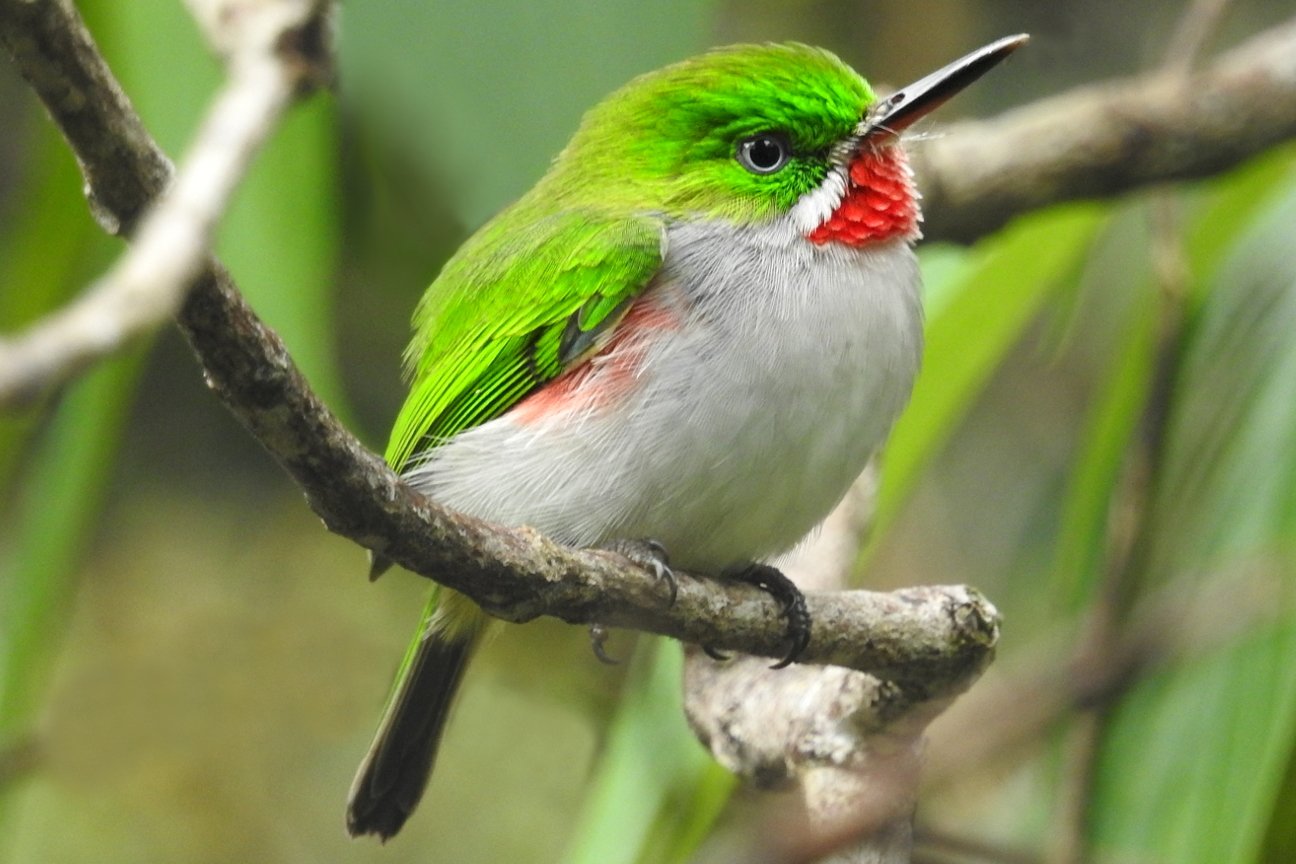
The Narrow-billed Tody is the montane tody of Hispaniola. It lives in moist and wet forest with dense undergrowth, mainly above 900 m, replacing the Broad-billed Tody of the drier lowlands. It forages lower in the vegetation than its relative and often stays in the shade of the understorey.
Voice
A buzzy two-note chik-zhwik, stressed and slightly upslurred on the second note, and a rapid buzzy chatter.
Recording: Ross Gallardy — CC BY-NC-SA 4.0 · converted to mono · xeno-canto
Identification
11 cm, compact, with a large head, short tail and a long, flat, rather narrow bill. The upper mandible is black, the lower mandible red with a dark tip. The upperparts are bright green, the throat carmine, set off from the face by a white malar stripe. The eye is pale. The sides of the neck and breast are grey, breast and belly white, and the flanks pinkish red. The underwing is sulphur yellow. The sexes are alike.
Confusion species
Broad-billed Tody Todus subulatus has a broader bill with an all-red lower mandible, a dark eye, greyer, yellow-washed underparts and pale pink flanks; it lives mainly lower down and in drier forest. Where both occur, the call separates them fastest. Hispaniolan Emerald Riccordia swainsonii has a thin bill and hovers at flowers.
Habitat
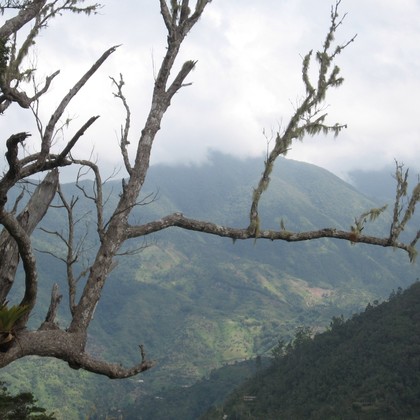
Moist and wet montane forest and cloud forest with dense undergrowth, also secondary forest and shade coffee, mostly between 900 and 2400 m; locally lower, where it overlaps with Broad-billed Tody. It hunts from a low perch for insects on leaves. Both adults dig a nest tunnel about 30 cm long in an earth bank; a single clutch of one to four white eggs is laid between April and July.
Where the bird is most at home, classified by the vegetation types of the Caribbean.



Range and movements
Endemic to Hispaniola, in the mountains of both the Dominican Republic and Haiti. The species does not occur outside Hispaniola.
- Resident
- dark = core range, pale = thinly spread
How and when to look
In montane and cloud forest in the Dominican Republic, where the buzzy two-note call is the first sign. The bird often sits low and still in the undergrowth along forest trails. At the transition to drier forest, both Hispaniolan todies can be compared.
Conservation status
Not threatened. The species depends on montane forest; in heavily deforested Haiti that habitat is limited.
Scientific name
Todus angustirostris | de Lafresnaye, 1851
De Lafresnaye described the species in 1851 and placed it straight away in the genus where it still stands. The genus Todus was introduced in 1760 by Brisson. Todus is a Latin word for a small bird, mentioned by the playwright Plautus and the grammarian Festus. angustirostris is Latin, from angustus 'narrow' and rostrum 'bill', after the bill, narrower than that of the Broad-billed Tody. The specimen the first description was based on came from Hispaniola.