All species › Kingfishers, bee-eaters and rollers › Todies › Broad-billed Tody
Broad-billed Tody | Todus subulatus
Diksnaveltodie | Barrancolí picogrueso
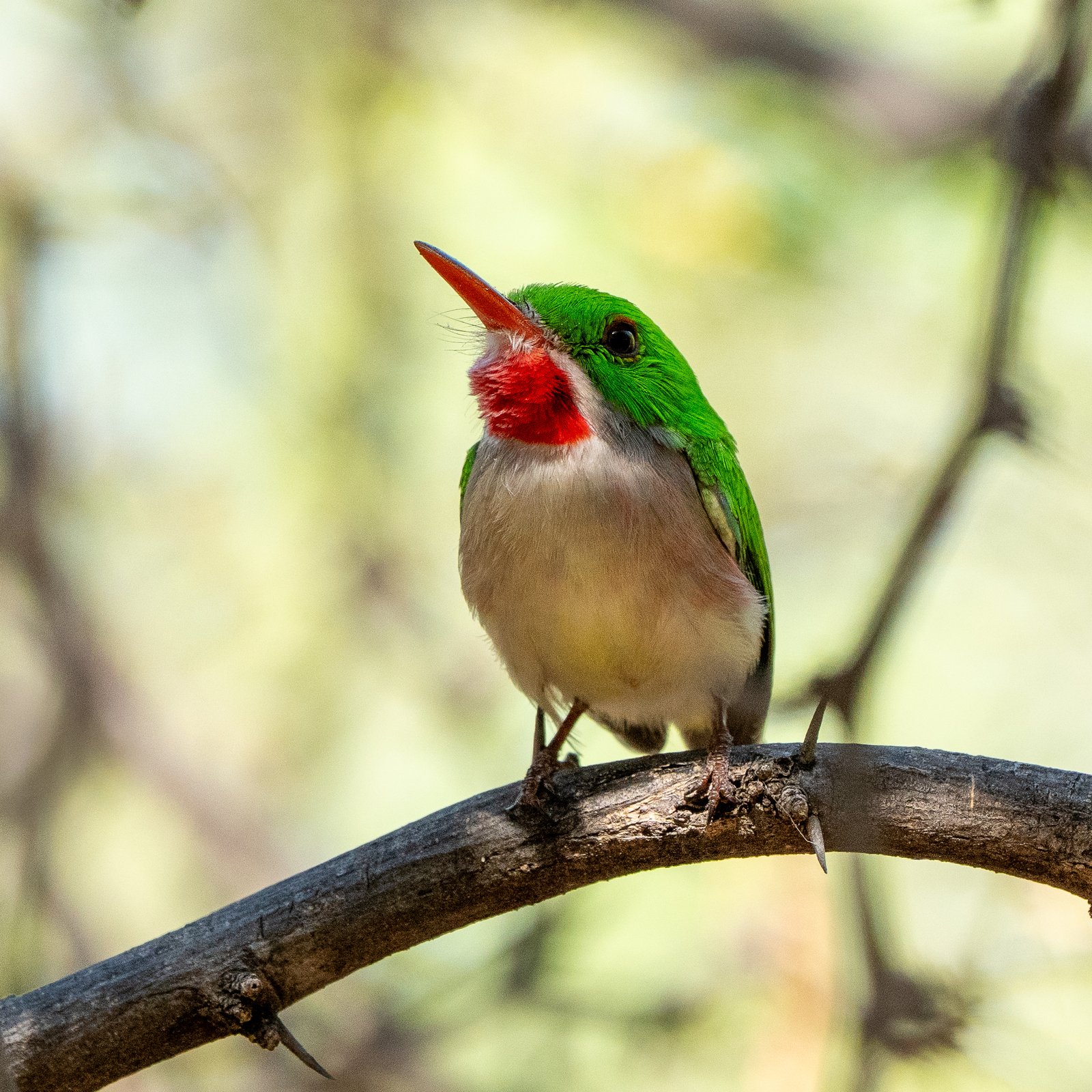
The Broad-billed Tody is the largest of the five todies and one of the two found on Hispaniola. It is the tody of the drier lowlands and lower mountain slopes, while the Narrow-billed Tody occupies the moist montane forest. Like all todies it sits still for long spells on a thin twig, then darts at an insect on the underside of a leaf.
Voice
A monotonous series of terp-terp-terp notes at a constant pace and pitch. When disturbed, a trilling chatter. It can also produce a rattling sound with the wings.
Recording: George Wagner — CC BY-NC-SA 4.0 · converted to mono · xeno-canto
Identification
11–12 cm, compact, with a large head, short tail and a broad flat bill. The upper mandible is black, the lower mandible entirely red. The upperparts are bright green, the throat red. The underparts are greyish white washed yellow, the flanks pale pink and the undertail coverts yellow. The eye is dark. The sexes are alike.
Confusion species
Narrow-billed Tody Todus angustirostris is very similar, but has a narrower bill with a dark tip to the lower mandible, a pale eye, whiter underparts and pinkish-red flanks; it lives mainly higher up in moist montane forest. Where both occur, the call is the most reliable feature. Hispaniolan Emerald Riccordia swainsonii is also green, but has a thin bill and hovers at flowers.
Habitat
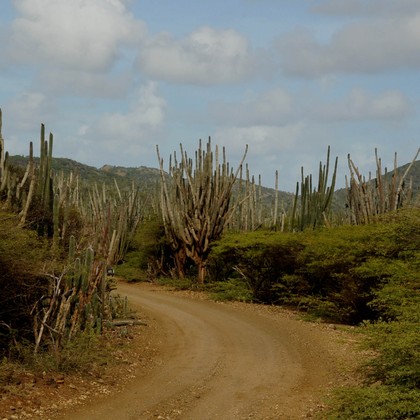
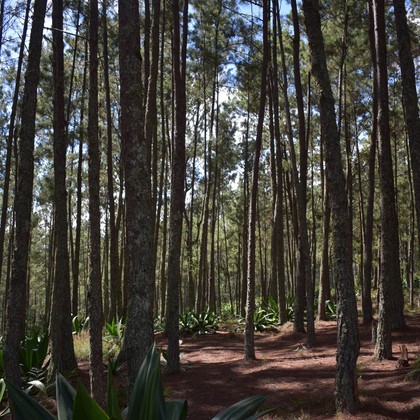
Dry deciduous forest, arid lowland scrub and semi-desert with cacti and agaves, but also secondary forest, shade coffee and pine forest, from sea level to about 1700 m. It hunts from a perch for insects and other small invertebrates on leaves and twigs. It breeds from April to July in a self-dug tunnel in an earth bank, up to about 60 cm deep; the clutch is one to four eggs.
Where the bird is most at home, classified by the vegetation types of the Caribbean.



Range and movements
Endemic to Hispaniola, in both the Dominican Republic and Haiti, and on Gonâve Island. More common in the Dominican Republic than in heavily deforested Haiti. The species does not occur outside Hispaniola.
- Resident
- dark = core range, pale = thinly spread
How and when to look
Best found in dry forest and scrub in the south-west of the Dominican Republic and on the lower mountain slopes. The monotonous call usually gives the bird away before its green plumage does. Where dry and moist forest meet, both Hispaniolan todies can be compared.
Conservation status
Not threatened. The species is widespread and also occurs in secondary forest, scrub and coffee plantations.
Scientific name
Todus subulatus | Gray, 1847
Gray described the species in 1847 and placed it straight away in the genus where it still stands. The genus Todus was introduced in 1760 by Brisson. Todus is a Latin word for a small bird, mentioned by the playwright Plautus and the grammarian Festus. subulatus is Latin for 'awl-shaped' (from subula 'awl'), after the bill. The specimen the first description was based on came from not stated.