All species › Passerines › New World blackbirds › Montserrat Oriole
Montserrat Oriole | Icterus oberi
Montserrattroepiaal | Turpial de Montserrat
The Montserrat Oriole is the national bird of Montserrat and occurs nowhere else. It is the only Lesser Antillean oriole with a clear difference between male and female. The eruptions of the Soufrière Hills volcano from 1995 onwards destroyed a large part of its habitat.
Voice
The song is a loud, slow series of clear whistles, with short sharp notes and a steeply falling tseew. The alarm call is a harsh, sharp chic or chuck, often repeated several times.
Recording: Barry Edmonston — CC BY-NC-SA 4.0 · converted to mono · xeno-canto
Identification
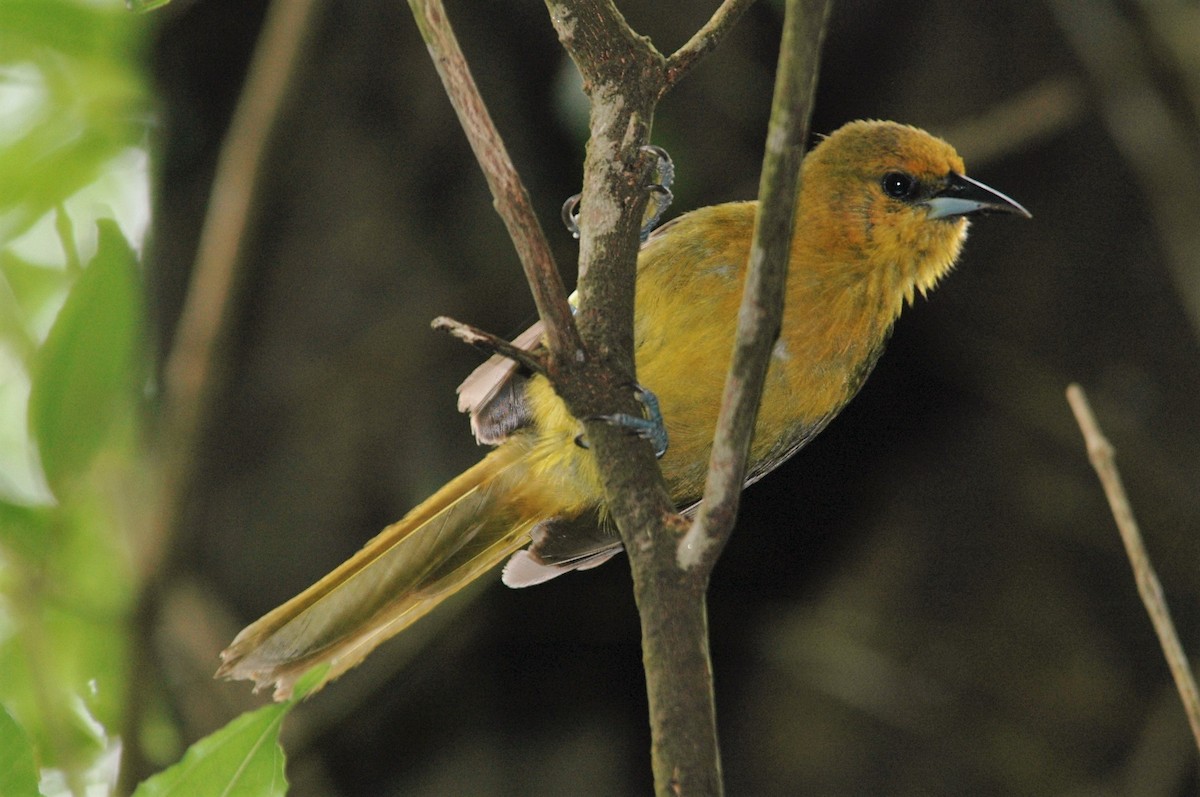
20–22 cm, slender, with a long tail and a pointed, slightly decurved bill. The male has a black head, throat, upper breast, back, wings and tail and a yellow-orange belly, flanks, rump and shoulder. The female is greenish yellow on the head and underparts and greenish olive above, with greenish-brown wings whose flight feathers are edged yellow. Immatures resemble the female but are duller.
Confusion species
On Montserrat the male cannot be confused: Carib Grackle Quiscalus lugubris and Shiny Cowbird Molothrus bonariensis are all black. The greenish-yellow female may suggest a warbler but is much larger, with a long tail and a long, pointed bill. Baltimore Oriole Icterus galbula is a vagrant in the Lesser Antilles and has white wing bars.
Habitat
Humid to wet evergreen montane forest, mainly between 250 and 900 m, occasionally down to about 100 m. It forages in the middle levels and canopy for insects, often in dense foliage. The nest is a basket of plant fibres woven by the female beneath a large leaf, 1.5 to 20 m above the ground; the clutch is usually two or three eggs.
Where the bird is most at home, classified by the vegetation types of the Caribbean.


Range and movements
Only on Montserrat, in two areas: the Centre Hills, which hold most of the population, and the South Soufrière Hills. The species does not occur outside Montserrat.
- Resident
- dark = core range, pale = thinly spread
How and when to look
The Centre Hills, with trails such as the Oriole Walkway Trail, are the place to look. The song and the harsh alarm call give the birds away; the female is less obvious than the male in the green canopy.
Conservation status
Vulnerable. The population is estimated at about 460 adults in an area of some 48 km². The Soufrière Hills eruptions destroyed half or more of the habitat, including forest beyond the lava flows that was damaged by ashfall. Numbers are now considered stable.
Scientific name
Icterus oberi | Lawrence, 1880
Lawrence described the species in 1880 and placed it straight away in the genus where it still stands. The genus Icterus was introduced in 1760 by Brisson. Icterus is from Ancient Greek ikteros, a yellow bird usually taken to be the golden oriole, the sight of which was thought to cure jaundice. oberi honours the American naturalist Frederick Albion Ober (1849–1913), who led the Lesser Antilles expedition on which the type was collected. The specimen the first description was based on came from Montserrat.