All species › Waterfowl › Ducks and geese › Masked Duck
Masked Duck | Nomonyx dominicus
Maskerstekelstaart | Pato enmascarado
The Masked Duck is a small, secretive stiff-tailed duck of densely vegetated freshwater marshes in tropical America. It lives hidden among floating and emergent plants and, when disturbed, dives or slips away into cover, so that it is often overlooked even where it occurs. In Cuba it is called pato agostero.
Voice
Mostly silent. In display the male gives a soft repeated oo-oo-oo and a rolling series of notes; a short clucking sound has also been described.
Recording: Fernando Igor de Godoy — CC BY-NC-SA 4.0 · converted to mono · xeno-canto
Identification
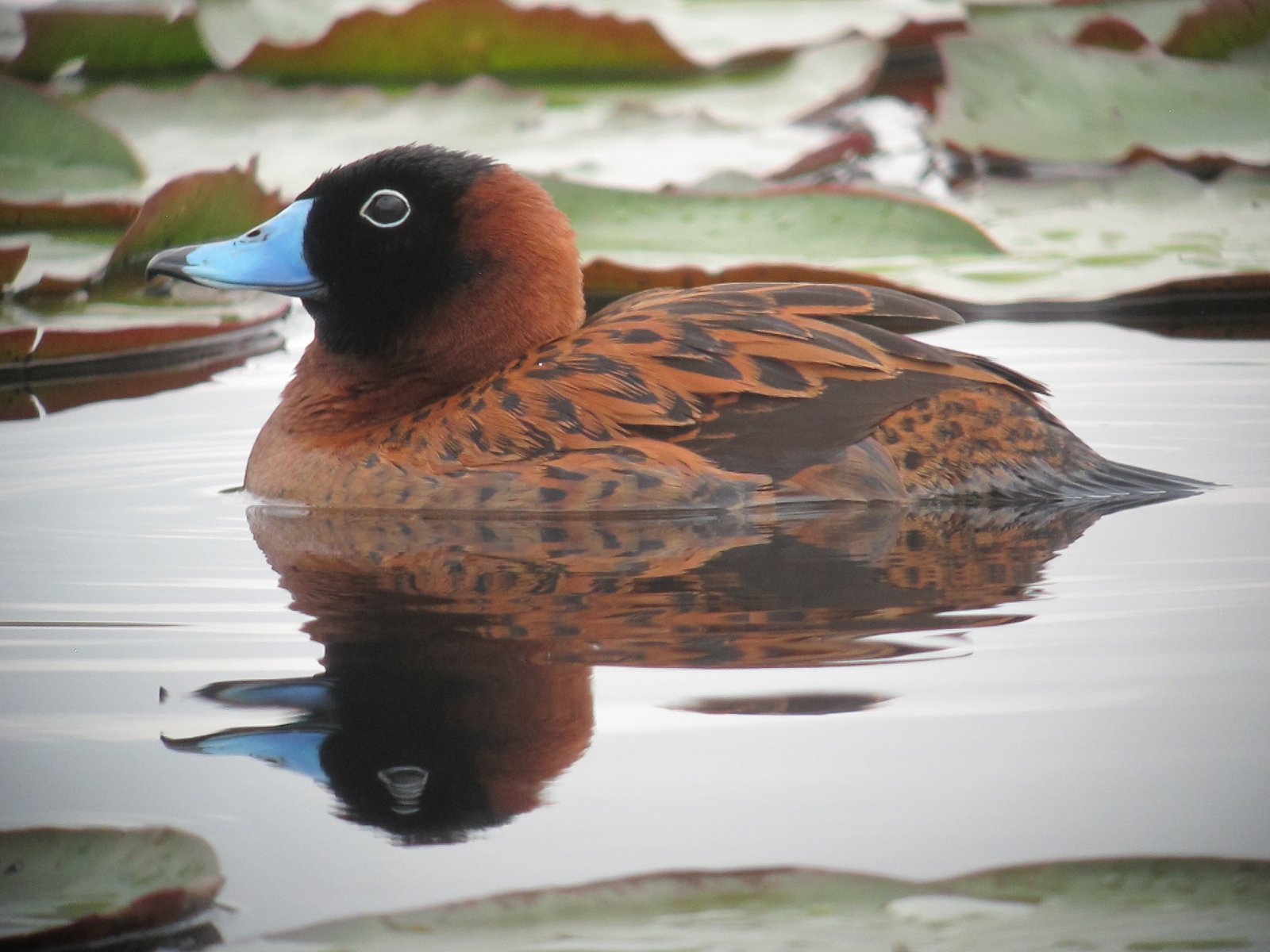
30–36 cm, compact, with a long, stiff tail often held cocked. The breeding male is rufous-chestnut with black spots on back and flanks and a black mask from the forehead to behind the eye; the bill is bright blue with a dark tip. Females, juveniles and non-breeding males are brown with pale scaling, and the pale face shows two dark horizontal stripes: one through the eye and one across the cheek. In flight the species shows a white patch in the wing in every plumage. It takes off directly from the water, without a run.
Confusion species
Ruddy Duck Oxyura jamaicensis is slightly larger. The male has a white cheek and black cap rather than a black mask; the female has one dark cheek stripe rather than two. Ruddy Duck has no white in the wing and needs a run across the water to take off. Least Grebe Tachybaptus dominicus also lives on vegetated ponds, but has a thin bill, a yellow eye and no stiff tail.
Habitat
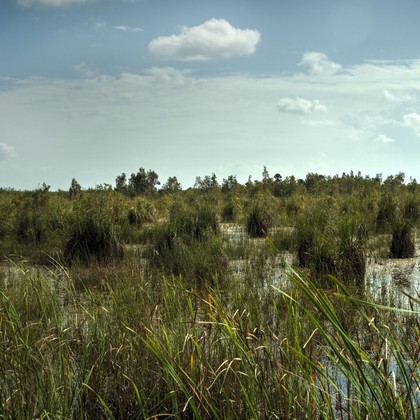
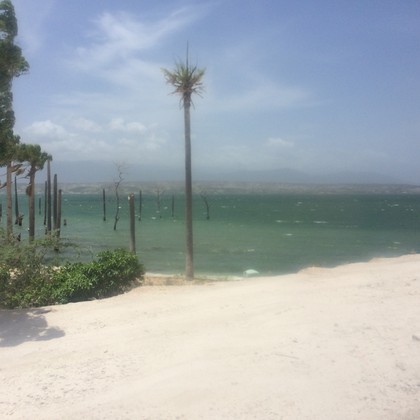
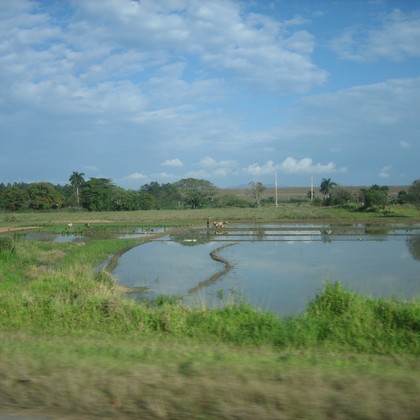
Freshwater marshes and ponds with plenty of floating and emergent vegetation, rice fields, flooded grassland and swamp forest; sometimes brackish ponds at the edge of mangroves. It dives for the seeds and roots of aquatic plants and for small aquatic animals. The nest is well hidden in dense marsh vegetation or in a rice field.
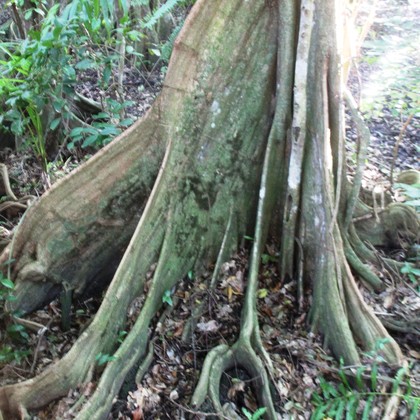
Where the bird is most at home, classified by the vegetation types of the Caribbean.
Range and movements
Scattered but irregular across the Greater Antilles: Cuba, Jamaica, Hispaniola (mainly the Dominican Republic) and Puerto Rico, which provides most records. In the Lesser Antilles on Guadeloupe, Barbados, Martinique, Saint Lucia and Antigua, among others, and also in the Virgin Islands, on Curaçao and on Trinidad. On many islands the species comes and goes as wetlands fill and dry out, and numbers are small. Outside the region from Mexico, with outliers into Texas, through Central America to northern Argentina.
- Resident
- Winter visitor (c. Apr–Sep)
- Passage (Mar–Apr, Oct–Nov)
- dark = core range, pale = thinly spread
How and when to look
Secretive; the best chances are at the edges of densely vegetated freshwater ponds and rice fields, preferably early in the morning or late in the afternoon, when birds sometimes come out onto open water. It often takes patience before a bird emerges from cover. After a spell of heavy rain, newly formed marshes can suddenly hold birds.
Conservation status
Not threatened globally. In the West Indies the species is scarce and local on most islands and, because of its hidden habits, poorly monitored. The loss and draining of freshwater marshes is the main threat; hunting and introduced predators are also mentioned.
Scientific name
Nomonyx dominicus | (Linnaeus, 1766)
Linnaeus described the species in 1766 as Anas dominica; because it was later moved to another genus, the author and year stand in brackets. The genus Nomonyx was introduced in 1880 by Ridgway. Nomonyx is Greek, from nomos 'customary' and onux 'nail', after the distinctive shape of the nail at the bill tip. dominicus means 'of Santo Domingo', the old name for Hispaniola. The specimen the first description was based on came from Hispaniola (Santo Domingo).