All species › Cranes, rails and allies › Rails and crakes › Mangrove Rail
Mangrove Rail | Rallus longirostris
Grijze ral | Rascón manglero
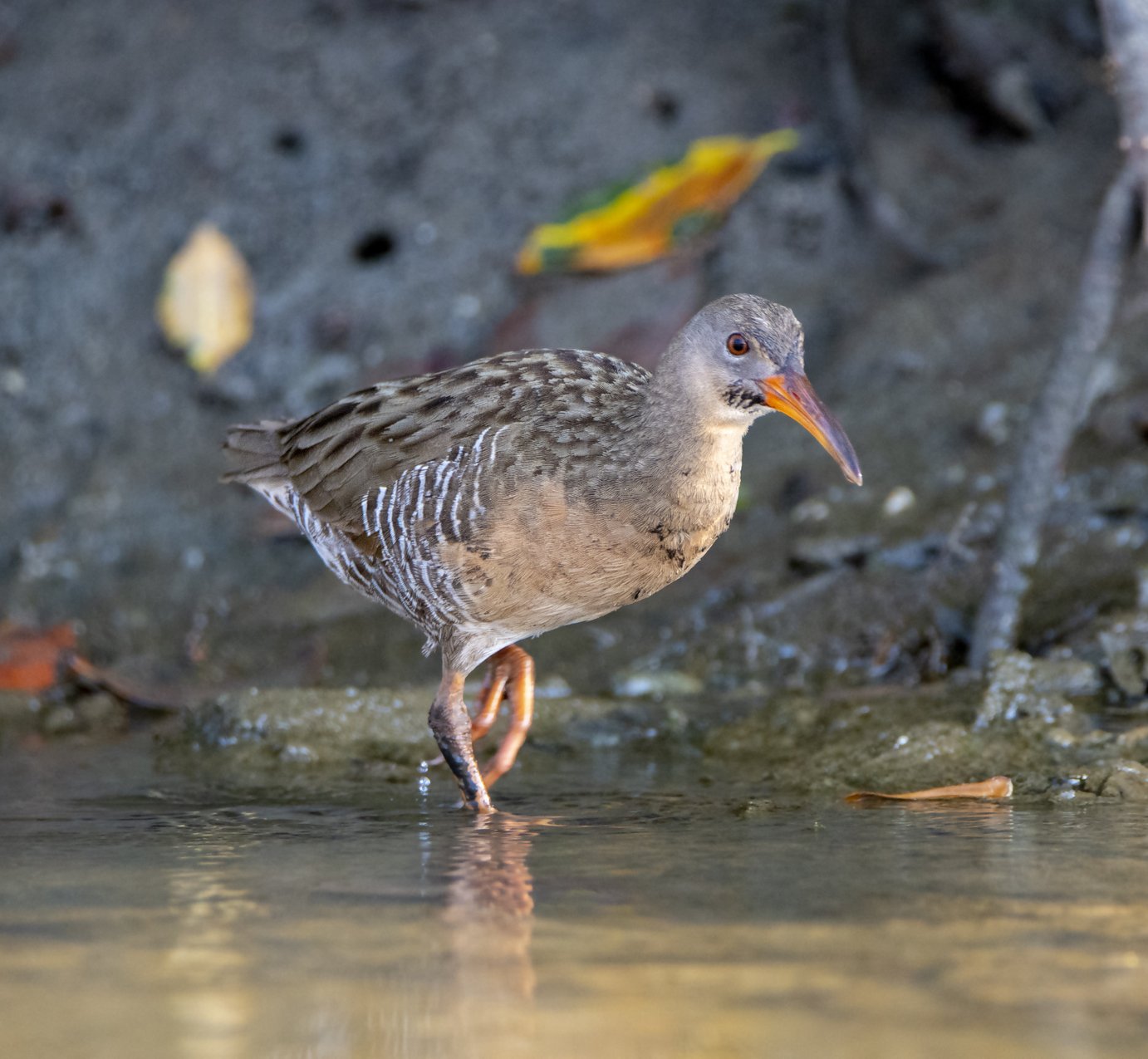
The Mangrove Rail is a large, drab rail of the mangroves, with a long, slightly curved bill and black-and-white barred flanks. It was long included in the Clapper Rail, but since a genetic study in 2013 has been treated as a separate species. In the Caribbean it occurs only in Trinidad, home to the subspecies Rallus longirostris pelodramus. On the other islands it is not this species but the Clapper Rail that lives.
Voice
A loud, dry, clattering series kek-kek-kek-kek, first accelerating and then slowing, often answered by other birds nearby; heard mainly at dusk and at the turn of the tide.
Recording: Carlos Henrique Luz Nunes de Almeida — CC BY-NC-SA 4.0 · converted to mono · xeno-canto
Identification
About 33 cm, with a long, slender, slightly decurved bill: the upper mandible brownish, the lower orange-yellow. The upperparts are dull grey-brown with dark feather centres; cheek and side of the neck are grey. Throat and a narrow supercilium are whitish. Breast and neck are drab grey-brown to pale cinnamon. Flanks and belly are blackish with narrow white bars; the undertail is white. The legs are pale orange-red. The sexes are alike. It walks with short tail flicks among the mangrove roots and seldom flies.
Confusion species
Grey-cowled Wood Rail Aramides cajaneus is larger, with a grey neck, a rufous breast, a black rear and red legs. Sora Porzana carolina, a winter visitor, is much smaller, with a short, thick yellow bill. Clapper Rail Rallus crepitans closely resembles the Mangrove Rail but does not occur in Trinidad; elsewhere in the region a rail of this type is almost always a Clapper Rail.
Habitat
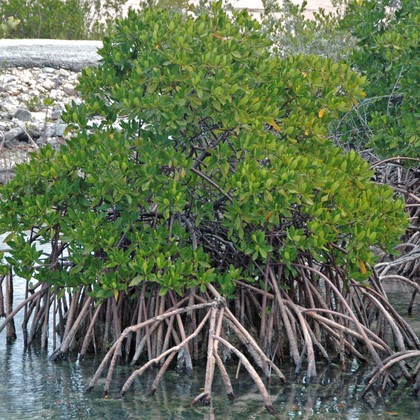
Mangroves and adjacent brackish and salt marshes, creeks and muddy banks. It feeds on mud and in shallow water beneath and between the mangrove roots, especially at low tide, on crabs, other crustaceans, molluscs and small fish. The nest is hidden in the mangroves or in dense marsh vegetation, just above the high-water line.
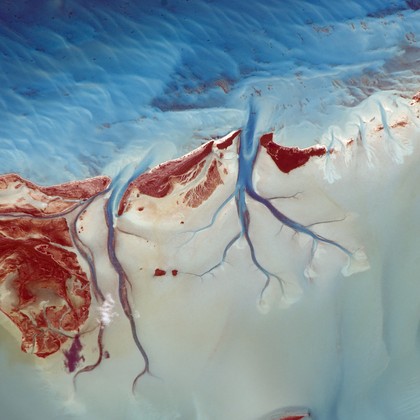
Where the bird is most at home, classified by the vegetation types of the Caribbean.
Range and movements
Within the region only in Trinidad, in the mangrove areas of the west, south and east coasts, including the Caroni Swamp. Records under this name from other islands belong to the Clapper Rail, which until 2013 fell under the same scientific name. Beyond the region along the coasts of South America, from Colombia and Venezuela through the Guianas to Brazil and on the Pacific coast from Colombia to Peru, and on the Pacific coast of Central America from El Salvador to Costa Rica.
- Resident
- Summer visitor (c. Oct–Mar)
- Winter visitor (c. Apr–Sep)
- Passage (Mar–Apr, Oct–Nov)
- dark = core range, pale = thinly spread
How and when to look
In the Caroni Swamp, preferably from a boat at low tide, when the muddy edges under the mangroves are exposed. The call is the best clue; a bird that answers sometimes shows itself briefly at the edge of the roots.
Conservation status
Not threatened. In Trinidad tied to mangroves, which are under pressure from cutting, building, pollution and the draining of coastal wetlands. Little is known about the size of the population in Trinidad.
Scientific name
Rallus longirostris | Boddaert, 1783
Boddaert described the species in 1783 and placed it straight away in the genus where it still stands. The genus Rallus was introduced in 1758 by Linnaeus. Rallus is the name English ornithologists such as Willughby and Albin already used for the water rail before Linnaeus; the precise origin of the word is uncertain. longirostris is Latin, from longus 'long' and rostrum 'bill', after the long bill. The specimen the first description was based on came from Cayenne, French Guiana.