All species › Hummingbirds and swifts › Hummingbirds › Little Hermit
Little Hermit | Phaethornis longuemareus
Kleine heremietkolibrie | Ermitaño chico
The Little Hermit is one of the smallest hummingbirds in the region, weighing about three grams. In its current, narrow sense the species lives only in Trinidad, north-eastern Venezuela and the Guianas; related forms in Central America and Amazonia, such as Phaethornis striigularis, have been split as separate species. Males sing at leks in the understorey, wagging their tails.
Voice
The song at the lek is a high, squeaky and complex phrase that is repeated endlessly and varies from place to place.
Recording: Brice de la Croix — CC BY-NC-SA 4.0 · converted to mono · xeno-canto
Identification
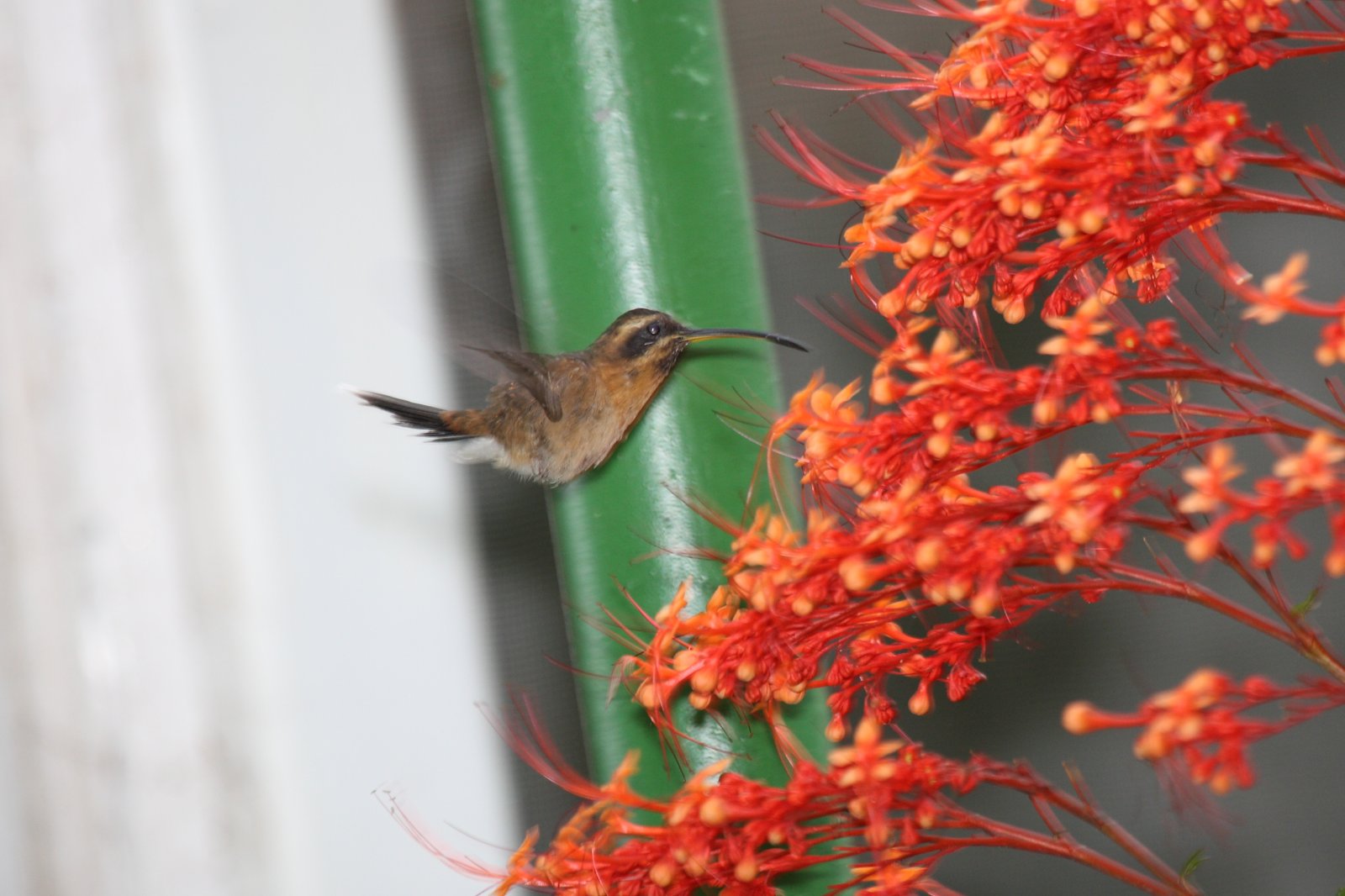
9–10 cm, including the elongated, white-tipped central tail feathers. The upperparts are olive-green, the uppertail coverts and underparts ochre to rufous-buff. A blackish mask runs through the eye, with a buff supercilium and a buff malar stripe. The bill is curved; the upper mandible is black, the lower yellow with a black tip. Males have a slightly darker throat than females.
Confusion species
Green Hermit Phaethornis guy is much larger and dark green or grey below. Rufous-breasted Hermit Glaucis hirsutus is larger, with a rufous breast and a rounded tail without elongated central feathers. Tufted Coquette Lophornis ornatus is equally small but has a short, straight bill and a pale band across the rump.
Habitat
The understorey of humid lowland and secondary forest, forest edges, shady cacao plantations and gardens at the forest edge; in Trinidad mainly the rainforest of the lower hills. It visits small flowers in the lowest layer of the forest.
Where the bird is most at home, classified by the vegetation types of the Caribbean.




Range and movements
Within the region only in Trinidad, where it is fairly common but inconspicuous. A few reports from Tobago are unconfirmed. Outside the region in north-eastern Venezuela and in Guyana, Suriname and French Guiana.
- Resident
- dark = core range, pale = thinly spread
How and when to look
Along the Discovery Trail at the Asa Wright Nature Centre, where the birds visit small yellow flowers in the understorey. A lek is first noticed by the persistent, high squeaking; the singing males perch low and can be seen at close range.
Conservation status
Not threatened. Because of the splits the range is much smaller than in older literature, but the species is common in suitable forest.
Scientific name
Phaethornis longuemareus | (Lesson, 1832)
Lesson described the species in 1832 as Trochilus Longuemareus; because it was later moved to another genus, the author and year stand in brackets. The genus Phaethornis was introduced in 1827 by Swainson. Phaethornis is Greek, from phaethōn 'sun, shining' and ornis 'bird': 'sun-bird'. longuemareus honours, according to Jobling, French naturalist Agathe-François Gouÿe de Longuemare (1792–1866); others name the collector Alphonse le Touze de Longuemare. The specimen the first description was based on came from Cayenne, French Guiana.