All species › Hummingbirds and swifts › Hummingbirds › Green Hermit
Green Hermit | Phaethornis guy
Groene heremietkolibrie | Ermitaño verde
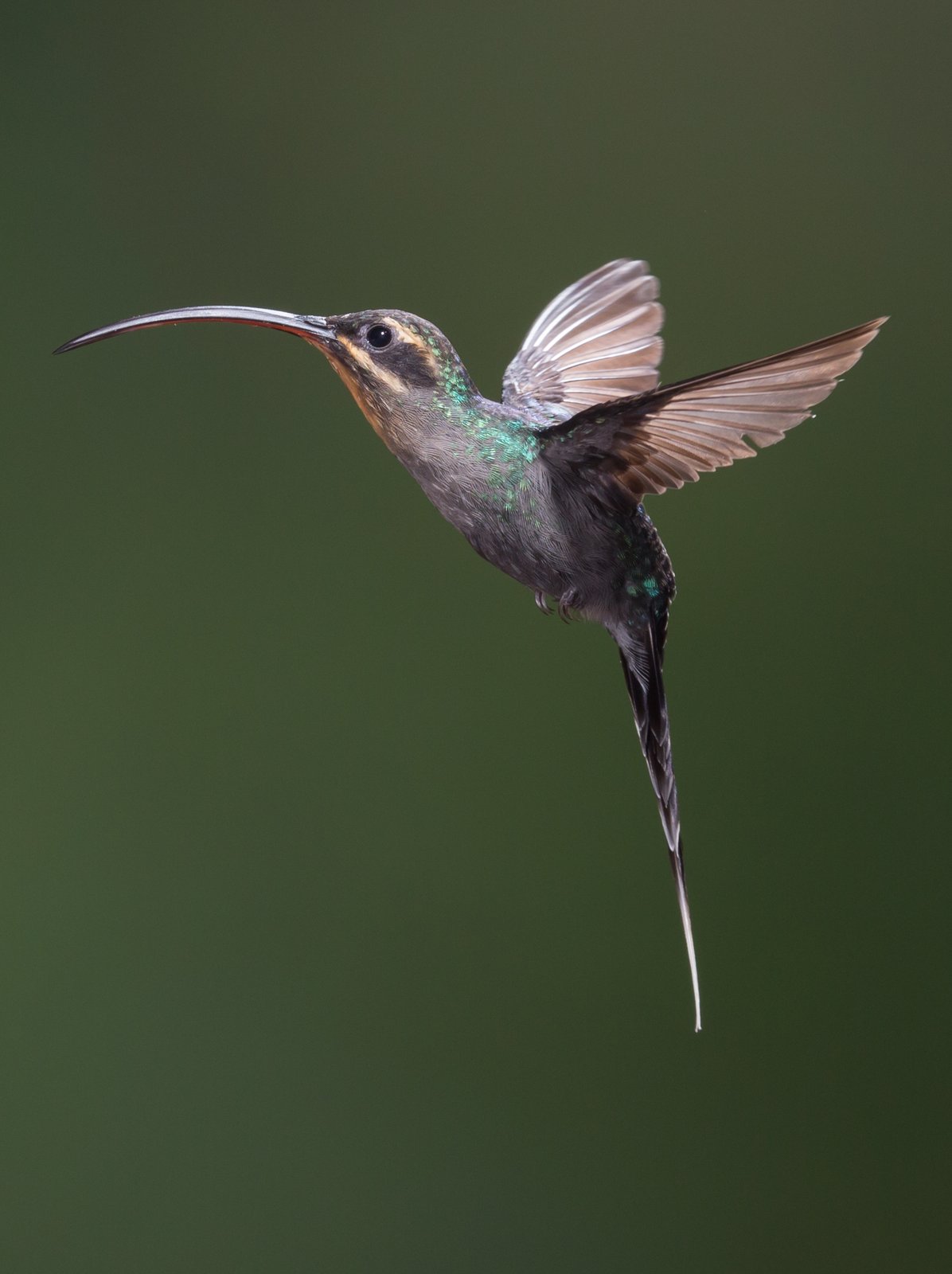
The Green Hermit is the largest hermit in Trinidad, a dark hummingbird with a long, curved bill and elongated central tail feathers that lives in the understorey of hill forest. Males sing in groups at fixed sites in the forest, known as leks, wagging their tails to attract females. Trinidad birds belong to the nominate form, which also occurs in north-eastern Venezuela.
Voice
The call is a loud zurk, often in flight. At the lek each male repeats a simple, grating swaark for long periods.
Recording: Juan Freile — CC BY-NC-SA 4.0 · shortened to the first 60 s, mono · xeno-canto
Identification
13–15 cm, including the elongated, white-tipped central tail feathers. The bill is long and curved, with a black upper and red lower mandible. The male is dark green with a blue-green rump; a black mask runs through the eye, bordered by a buff supercilium and a buff malar stripe, and a pale stripe runs down the centre of the throat. The female is grey rather than green below and has a longer bill and longer central tail feathers.
Confusion species
Little Hermit Phaethornis longuemareus is much smaller, with olive-green upperparts and ochre underparts. Rufous-breasted Hermit Glaucis hirsutus has rufous underparts and a rounded tail without elongated central feathers. Other large hummingbirds in Trinidad, such as White-necked Jacobin Florisuga mellivora and Brown Violetear Colibri delphinae, have short, nearly straight bills.
Habitat
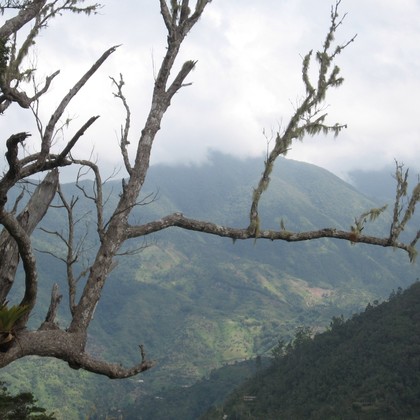
The understorey of humid hill forest and rainforest in rugged terrain, often along streams and in ravines, up to the cloud forest on the highest peaks of the Northern Range; also shady cacao and coffee plantations within forest. It feeds along a regular route at heliconias and other long-tubed flowers.
Where the bird is most at home, classified by the vegetation types of the Caribbean.




Range and movements
Within the region only in Trinidad, where it is common in the Northern Range and also occurs in the other forested hills. A single report from Tobago is unconfirmed. Outside the region in Costa Rica and Panama, northern Colombia and Venezuela, and along the eastern Andes to Peru.
- Resident
- dark = core range, pale = thinly spread
How and when to look
Along the forest trails of the Asa Wright Nature Centre and elsewhere in the Northern Range forest. The bird often appears suddenly at a heliconia and dashes off again, but returns on its route; a lek can be found by tracking the persistent calling of the males.
Conservation status
Not threatened. Common in suitable forest, but dependent on forest with a well-developed understorey.
Scientific name
Phaethornis guy | (Lesson, 1833)
Lesson described the species in 1833 as Trochilus Guy; because it was later moved to another genus, the author and year stand in brackets. The genus Phaethornis was introduced in 1827 by Swainson. Phaethornis is Greek, from phaethōn 'sun, shining' and ornis 'bird': 'sun-bird'. guy honours J. Guy (fl. 1833), a French amateur collector; possibly the same as the French preparator Claude-Joseph Guy. The specimen the first description was based on came from Venezuela (originally given in error as 'Brazil').