All species › Hummingbirds and swifts › Swifts › Lesser Antillean Swift
Lesser Antillean Swift | Chaetura martinica
Martiniquegierzwaluw | Vencejo de Martinica
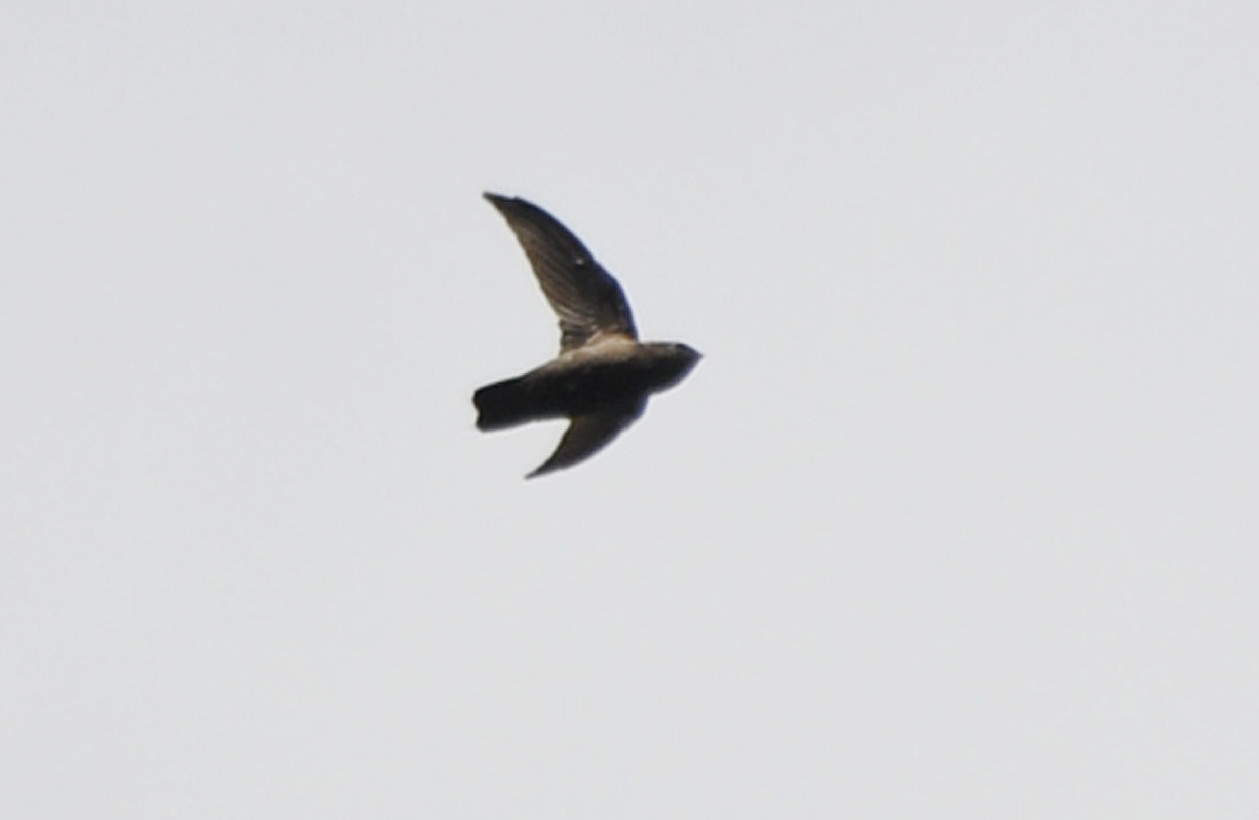
The Lesser Antillean Swift is the only swift endemic to the Lesser Antilles. It lives on the mountainous, forested volcanic islands from Guadeloupe to St Vincent and is the commonest small swift there. Groups feed low over forest and along ridges, especially in cloudy and rainy weather.
Voice
A high, twittering trill, prrrrrrr or prrrrrr-titi, repeated at intervals.
Recording: Étienne Leroy — CC BY-NC-SA 4.0 · converted to mono · xeno-canto
Identification
10–11 cm, small and dark, with a protruding head, a short, square, spiny tail and wings that bulge in the middle and hook slightly at the tip. Upperparts blackish brown, with a narrow grey band across the rump. Underparts brown, the throat slightly paler. The sexes are alike; juveniles have white tips to some wing feathers.
Confusion species
American Black Swift Cypseloides niger is much larger, all black and longer-tailed. On St Vincent Short-tailed Swift Chaetura brachyura also occurs; it is slightly larger, with a very short tail and a pale grey-brown rump and undertail that contrast more clearly. Chimney Swift Chaetura pelagica, a rare passage migrant, is larger, with a less contrasting rump and a paler throat. Swallows have broader wings and a forked tail.
Habitat
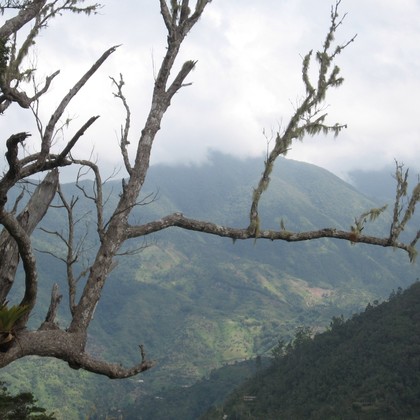
Mainly over rainforest and montane forest, but also over secondary forest, plantations, open country and drier coastal areas, from the coast to the highest peaks. It hunts small flying insects, often low over the canopy and along forested slopes. The nest is a half-cup attached to a vertical surface, probably in hollow trees or rock crevices; breeding takes place in late spring and early summer.
Where the bird is most at home, classified by the vegetation types of the Caribbean.




Range and movements
Endemic to the Lesser Antilles: Guadeloupe, Dominica, Martinique, St Lucia and St Vincent. Rather scarce on Guadeloupe, fairly common on the other islands. An undocumented report from Nevis is uncertain.
- Resident
- dark = core range, pale = thinly spread
How and when to look
On Dominica over the rainforest at the Syndicate nature trail and along roads through the Morne Trois Pitons area, on St Lucia in the interior at Des Cartiers, on Martinique on the slopes of Mont Pelée. The grey rump band shows when birds feed low along a slope or forest road.
Conservation status
Not threatened. The population appears stable, though its size is unknown. Hurricanes and volcanic eruptions, such as that of La Soufrière on St Vincent in 2021, can damage habitat locally and temporarily.
Scientific name
Chaetura martinica | (Hermann, 1783)
Hermann described the species in 1783 as Hirundo martinica; because it was later moved to another genus, the author and year stand in brackets. The genus Chaetura was introduced in 1826 by Stephens. Chaetura is Greek, from khaitē 'hair, bristle' and oura 'tail', after the spiny projecting shafts of the tail feathers. martinica refers to Martinique in the Lesser Antilles, where the species was described. The specimen the first description was based on came from Martinique.