All species › Waders, gulls and terns › Gulls and terns › Kelp Gull
Kelp Gull | Larus dominicanus
Kelpmeeuw | Gaviota dominicana
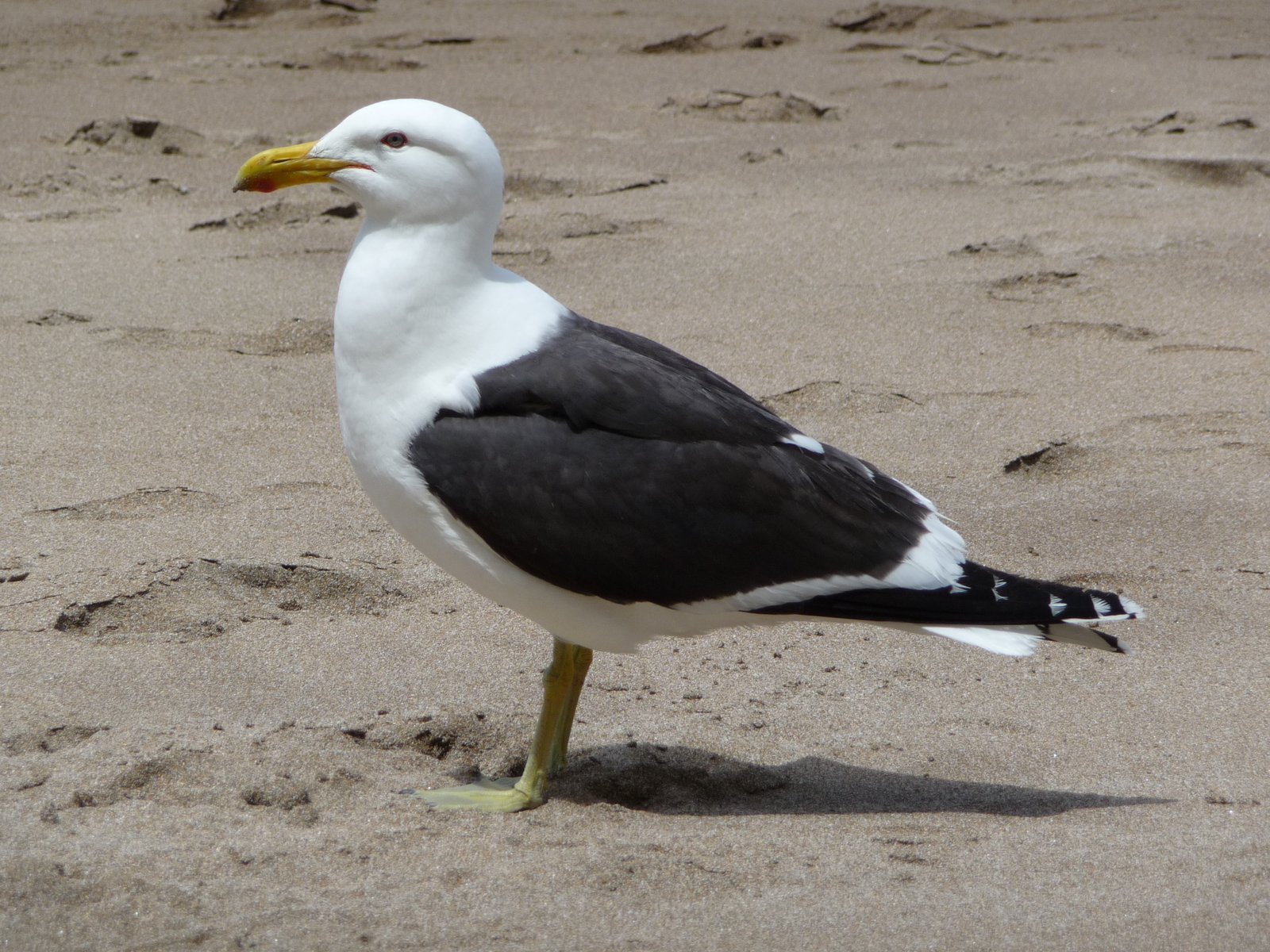
The Kelp Gull is the black-backed large gull of the southern hemisphere, from South America and southern Africa to Australia, New Zealand and the Antarctic Peninsula. North of the equator it is a rare vagrant. Only a few records are known from the Caribbean, almost all from the southern end of the island chain.
Voice
Mostly silent away from the colony. The usual call is a strident, laughing kee-ochh, lower and rougher than that of American Herring Gull; when alarmed a short, deep ga-ga-ga.
Recording: African Bioacoustics Community — CC BY-NC-SA 4.0 · converted to mono · xeno-canto
Identification
54–65 cm, large and heavy, between Lesser and Great Black-backed Gull in size, with a strong bill with a distinct gonys angle. Adults have a black mantle and wings with a broad white trailing edge, a white head that remains almost unstreaked in winter, a yellow bill with a red spot, usually a pale eye and greenish-yellow legs. The black wingtip shows only one small white mirror and narrow white tips. Adult plumage is reached in the fourth year. Juveniles are dark grey-brown and heavily scaled, with a dark head, black bill, rather dark tail and dull grey-brown legs; in flight there is no pale window in the primaries. Older immatures first acquire a blackish mantle and a pale bill base.
Confusion species
Great Black-backed Gull Larus marinus is larger, with pink legs, a larger white wingtip and a streaked head in winter; young Great Black-backs are much paler and more chequered, with a white rump. Lesser Black-backed Gull Larus fuscus is slimmer and longer-winged, with a slate-grey rather than black mantle, yellow legs and a heavily streaked head in winter. Young American Herring Gulls Larus smithsonianus have pink legs and a pale window in the inner primaries; adults have a pale grey mantle. Any suspected Kelp Gull calls for photographs of legs, wingtip and mantle.
Habitat
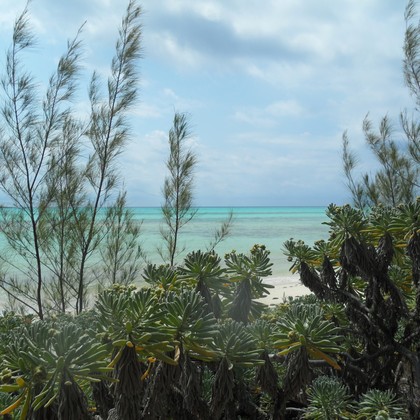
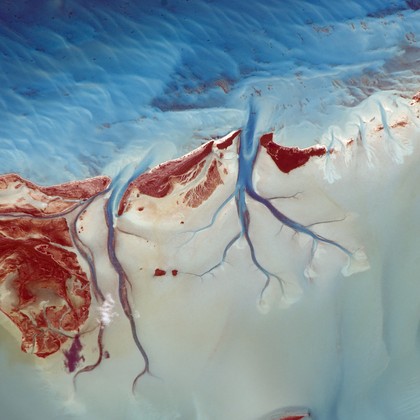
Beaches, harbours, tidal flats, lagoons and fish landing sites; in the breeding range also rocky shores, islets and rubbish dumps. It eats fish, shellfish, crabs, carrion and refuse, and drops shells onto hard surfaces to break them. In the Caribbean the birds roost among other gulls on sandbars and jetties.
Where the bird is most at home, classified by the vegetation types of the Caribbean.

Range and movements
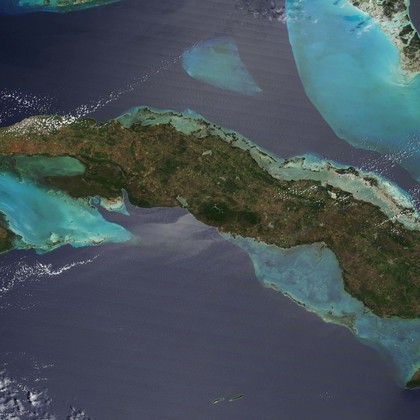
Vagrant. Several records have come from Trinidad since 2001, on the west coast near San Fernando and Siparia and along the shore between Couva and Waterloo, where other large gulls also gather; some birds stayed for several months. One record from Barbados in 2000 (Saint Lucy). There are no confirmed records from the Greater Antilles, the Bahamas or the ABC Islands. Beyond the region it breeds along the coasts of South America, on the Atlantic side north into Brazil, and in southern Africa, Madagascar, Australia, New Zealand, on subantarctic islands and on the Antarctic Peninsula. It has also reached the United States as a vagrant, first in 1989 on the Chandeleur Islands, Louisiana.
How and when to look
The best chance is among the gulls on Trinidad's west coast, at fish landing sites and on mudflats. An adult large gull with a black mantle and yellow or greenish-yellow legs deserves a closer look; the almost unstreaked head, the small white wingtip and the leg colour separate it from Lesser and Great Black-backed Gulls.
Conservation status
Not threatened. The world population is large and has increased in parts of the range thanks to fishery discards and rubbish dumps. In the Caribbean a very rare visitor with no regular presence.
Scientific name
Larus dominicanus | Lichtenstein, 1823
Lichtenstein described the species in 1823 and placed it straight away in the genus where it still stands. The genus Larus was introduced in 1758 by Linnaeus. Larus is Latin, from Ancient Greek laros, and appears to have referred to a gull or another large seabird. dominicanus refers to the Dominican friars, whose black-and-white habit recalls this gull's black back and white head and underparts. The specimen the first description was based on came from coast of Brazil.