All species › Passerines › New World blackbirds › Jamaican Blackbird
Jamaican Blackbird | Nesopsar nigerrimus
Jamaicaanse troepiaal | Zanate jamaicano
The Jamaican Blackbird is the only member of the genus Nesopsar and is found only in the wet montane forests of Jamaica. It feeds on insects and other small animals taken from bromeliads, moss and loose bark, filling the niche that elsewhere belongs to woodpeckers and other trunk-climbers. In Jamaica it is called wild-pine sergeant, after the bromeliads (wild pines) in which it forages.
Voice
Both sexes sing a loud, wheezy and buzzy song, often delivered in a short flight. The usual call is a sharp chek.
Recording: George Wagner — CC BY-NC-SA 4.0 · converted to mono · xeno-canto
Identification
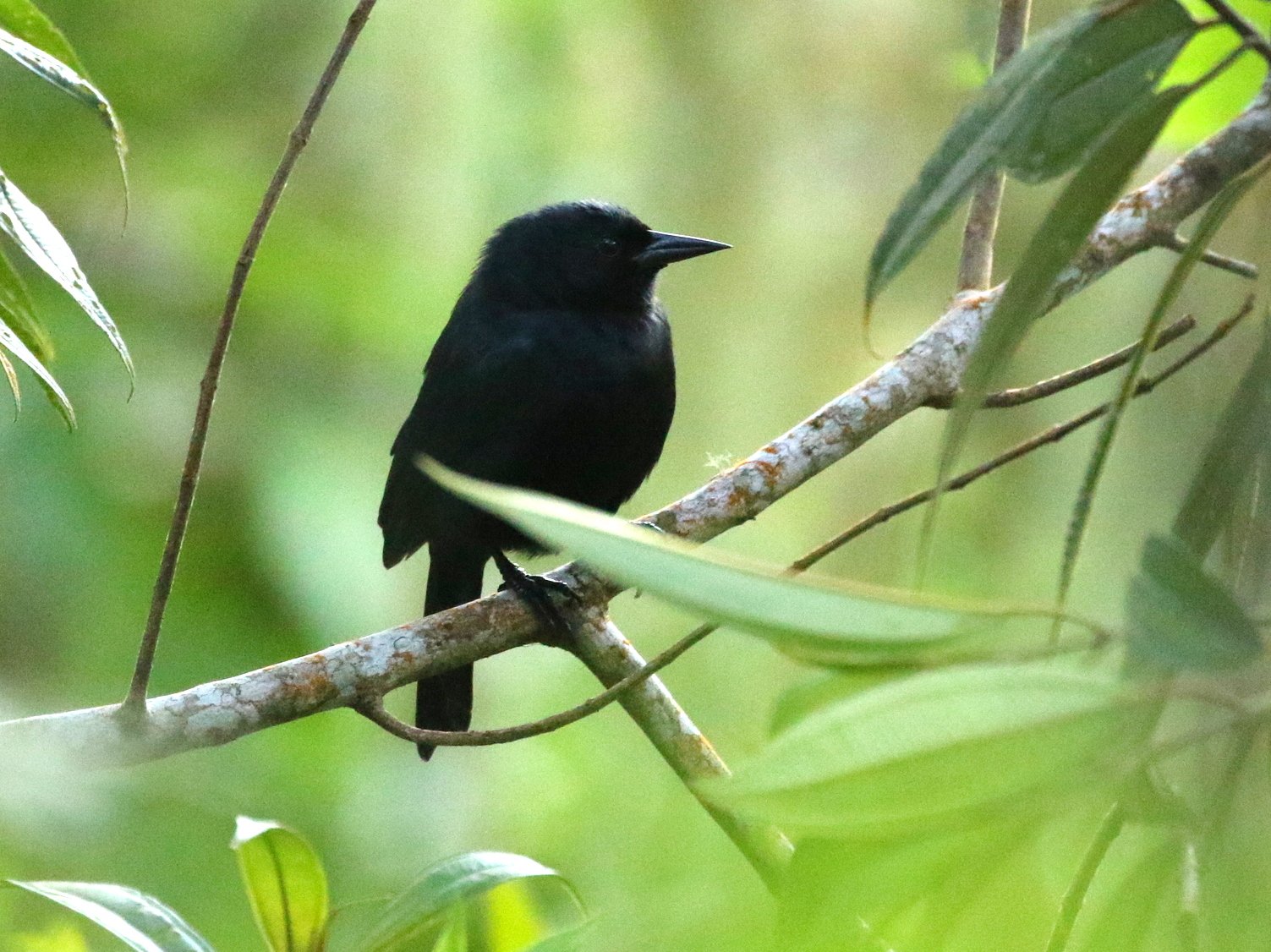
18 cm, a small, all-black blackbird with a faint blue gloss, a short, often frayed tail and a pointed, straight black bill. The eyes are dark brown and the legs black, with long claws. The sexes are alike. Juveniles are duller, browner black.
Confusion species
Greater Antillean Grackle Quiscalus niger is larger, has a yellow eye and a long, keel-shaped tail and lives in open country, villages and pastures, not in closed montane forest. The male Shiny Cowbird Molothrus bonariensis, rare in Jamaica, has a shorter, conical bill and a purple gloss and feeds on the ground in open country. Behaviour, climbing along trunks and probing into bromeliads, is diagnostic of the Jamaican Blackbird.
Habitat
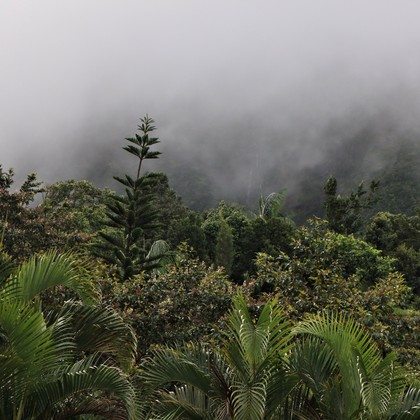
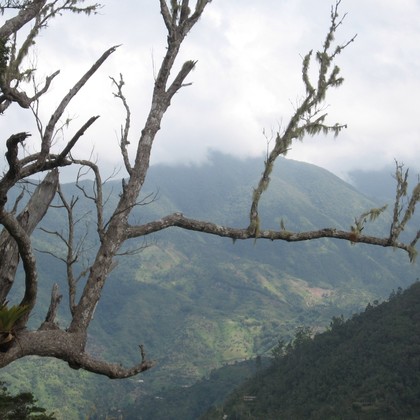
Wet montane forest, cloud forest and elfin woodland with abundant epiphytes, moss and bromeliads on the trees, and the wet limestone forest of Cockpit Country. It lives mainly above about 500 m and only rarely lower. It forages by climbing trunks and thick branches, using its tail as a prop, and searches bromeliads, moss and bark for insects, spiders and small vertebrates. The cup nest of moss and epiphytes is placed 6–11 m up.
Where the bird is most at home, classified by the vegetation types of the Caribbean.


Range and movements
Only on Jamaica, in three separate areas: the Blue and John Crow Mountains in the east, Cockpit Country in the west, and the hills of central Jamaica. It does not occur outside Jamaica.
- Resident
- Winter visitor (c. Apr–Sep)
- Passage (Mar–Apr, Oct–Nov)
- dark = core range, pale = thinly spread
How and when to look
Well-known sites are the area around Hardwar Gap and Holywell in the Blue Mountains and the forest tracks of Cockpit Country. Listening for the song and for rustling in bromeliads is the best approach; the bird rarely sits still in the open. Pairs hold permanent territories, so a bird once found can often be relocated at the same spot.
Conservation status
Endangered. The population is estimated at 1,500–7,000 birds and is declining. The species depends on undisturbed montane forest with large, epiphyte-rich trees. Threats are forest clearance for bauxite mining, charcoal production, coffee growing, conifer forestry and development.
Scientific name
Nesopsar nigerrimus | (Osburn, 1859)
Osburn described the species in 1859 as [Icterus] nigerrimus; because it was later moved to another genus, the author and year stand in brackets. The genus Nesopsar was introduced in 1859 by Sclater. Nesopsar is Greek, from nēsos 'island' (Jamaica) and psar 'starling': 'island starling'. nigerrimus is Latin for 'very black', superlative of niger, after the all-black plumage. The specimen the first description was based on came from lower mountains of Jamaica.