All species › Waders, gulls and terns › Sandpipers and snipes › Hudsonian Whimbrel
Hudsonian Whimbrel | Numenius hudsonicus
Amerikaanse regenwulp | Zarapito trinador americano
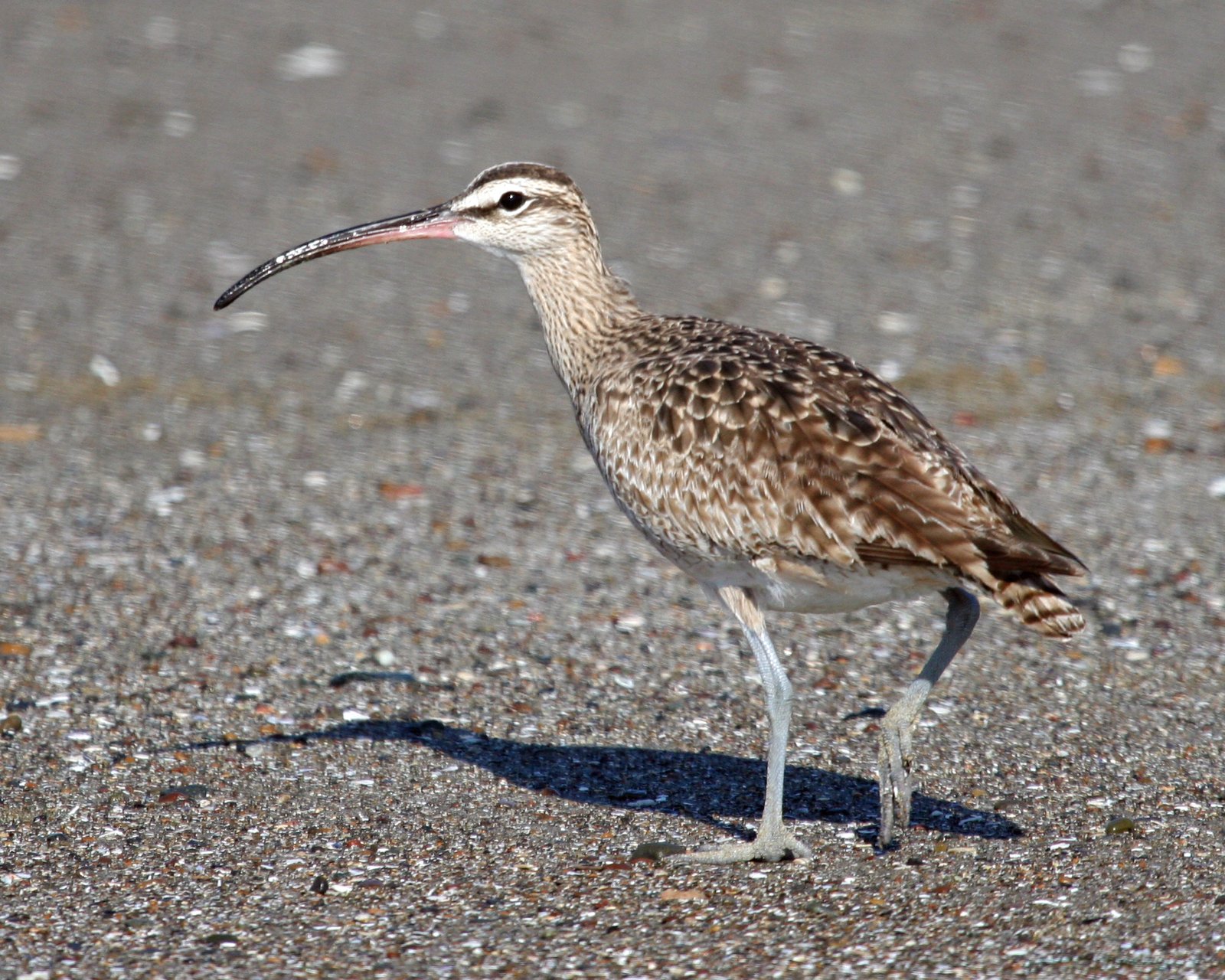
The Hudsonian Whimbrel is the curlew of the Caribbean: a large brown shorebird with a long, decurved bill that feeds along rocky shores, mudflats and mangroves. It was long treated as a subspecies of the Eurasian Whimbrel and is now considered a separate species by most lists. Satellite tracking has shown that birds of this species fly non-stop from Canada over the Atlantic to South America, passing the Lesser Antilles on the way.
Voice
A rapid, even series of clear whistles, pi-pi-pi-pi-pi-pi-pi, often on take-off and in flight. Also a short, soft kur-li.
Recording: JAYRSON ARAUJO DE OLIVEIRA — CC BY-NC-SA 4.0 · converted to mono · xeno-canto
Identification
37–47 cm. Grey-brown, with a long bill that curves down strongly in its outer part. The head shows two dark crown stripes with a pale central stripe, a pale supercilium and a dark eye-stripe. Neck and breast are finely streaked, the belly paler. The upperparts are brown with pale spotting. In flight the whole upper side, including rump and lower back, is uniformly brown, and the underwing and axillaries are barred cinnamon-brown. The sexes are alike; females average longer-billed.
Confusion species
Eurasian Whimbrel Numenius phaeopus, a very rare vagrant, has a white lower back and rump that show as a wedge in flight, and a paler underwing. Marbled Godwit Limosa fedoa is warmer cinnamon and has a straight or slightly upturned, two-toned bill and no crown stripes. Willet Tringa semipalmata has a straight bill and a black-and-white wing pattern in flight.
Habitat
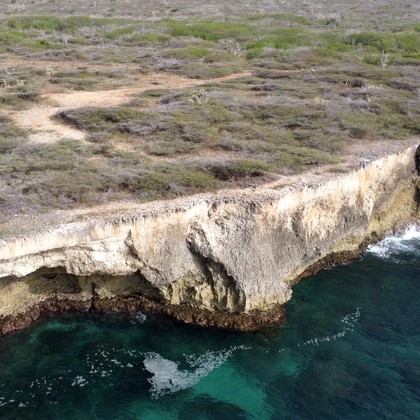
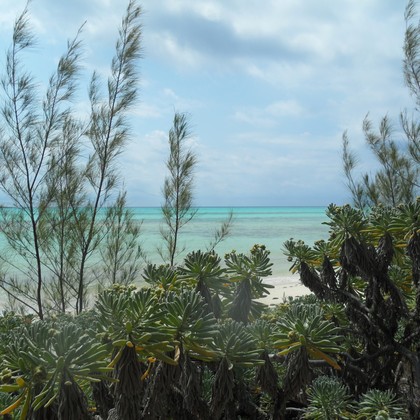
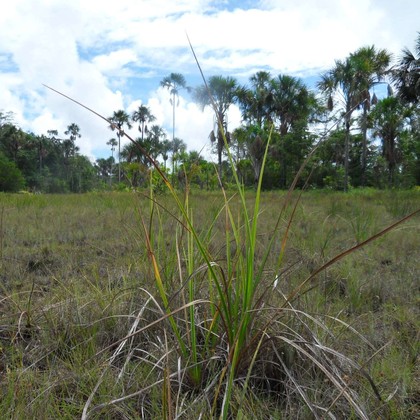
Rocky shores and limestone platforms by the sea, mudflats, salt ponds, mangrove edges and sandy beaches; sometimes short grass near the coast. It mainly eats crabs, which it pulls from burrows and crevices with its curved bill, and also other crustaceans, worms and molluscs. It roosts in small groups on rocks, in mangroves or on sandbars.
Where the bird is most at home, classified by the vegetation types of the Caribbean.



Range and movements
Winter visitor and passage migrant throughout the region. Fairly common on the ABC Islands, in Trinidad and Tobago, Puerto Rico, the Virgin Islands and the Lesser Antilles; less numerous, mainly as a migrant, on Cuba, Hispaniola, Jamaica, the Cayman Islands, the Bahamas and the Turks and Caicos Islands. Also known from San Andrés. Outside the region it breeds in Alaska, north-western Canada and around Hudson Bay, and winters along the coasts of the southern United States, Central America and South America to Chile and Brazil.
- Winter visitor (c. Apr–Sep)
- Passage (Mar–Apr, Oct–Nov)
- dark = core range, pale = thinly spread
How and when to look
Rocky shores and limestone platforms along the surf are good places, as are salt ponds on the ABC Islands and the Virgin Islands. The birds are wary and fly off calling; the brown rump in flight is the key difference from Eurasian Whimbrel.
Conservation status
Not threatened globally according to the assessment of Whimbrel in the broad sense; as a separate species it has not yet been assessed. Counts in North America point to a decline. On Guadeloupe two satellite-tagged birds were shot in 2011, drawing attention to shorebird hunting in the Lesser Antilles; on Barbados whimbrels are still shot in small numbers.
Scientific name
Numenius hudsonicus | Latham, 1790
Latham described the species in 1790 and placed it straight away in the genus where it still stands. The genus Numenius was introduced in 1760 by Brisson. Numenius is Greek, from neos 'new' and mēnē 'moon', after the bill that recalls a crescent moon; noumēnios is the name of a bird in Hesychius. hudsonicus means 'of Hudson Bay' in Canada, the type locality. The specimen the first description was based on came from Hudson Bay, Canada.