All species › Passerines › Finches › House Finch
House Finch | Haemorhous mexicanus
Mexicaanse roodmus | Pinzón mexicano
The House Finch is one of the commonest finches of North America, originally from the western United States and Mexico and since the 1940s also in the east, where released cage birds founded a new population. In the Caribbean it is a very rare vagrant: the only documented record is a male in Havana, published in Cuba as camachuelo mexicano.
Voice
The song is a long run of warbling and whistled notes, often ending in a harsh wheer. The call is a soft, chirping cheep, also in flight.
Recording: Andrew McCafferty — CC BY-NC-SA 4.0 · converted to mono · xeno-canto
Identification
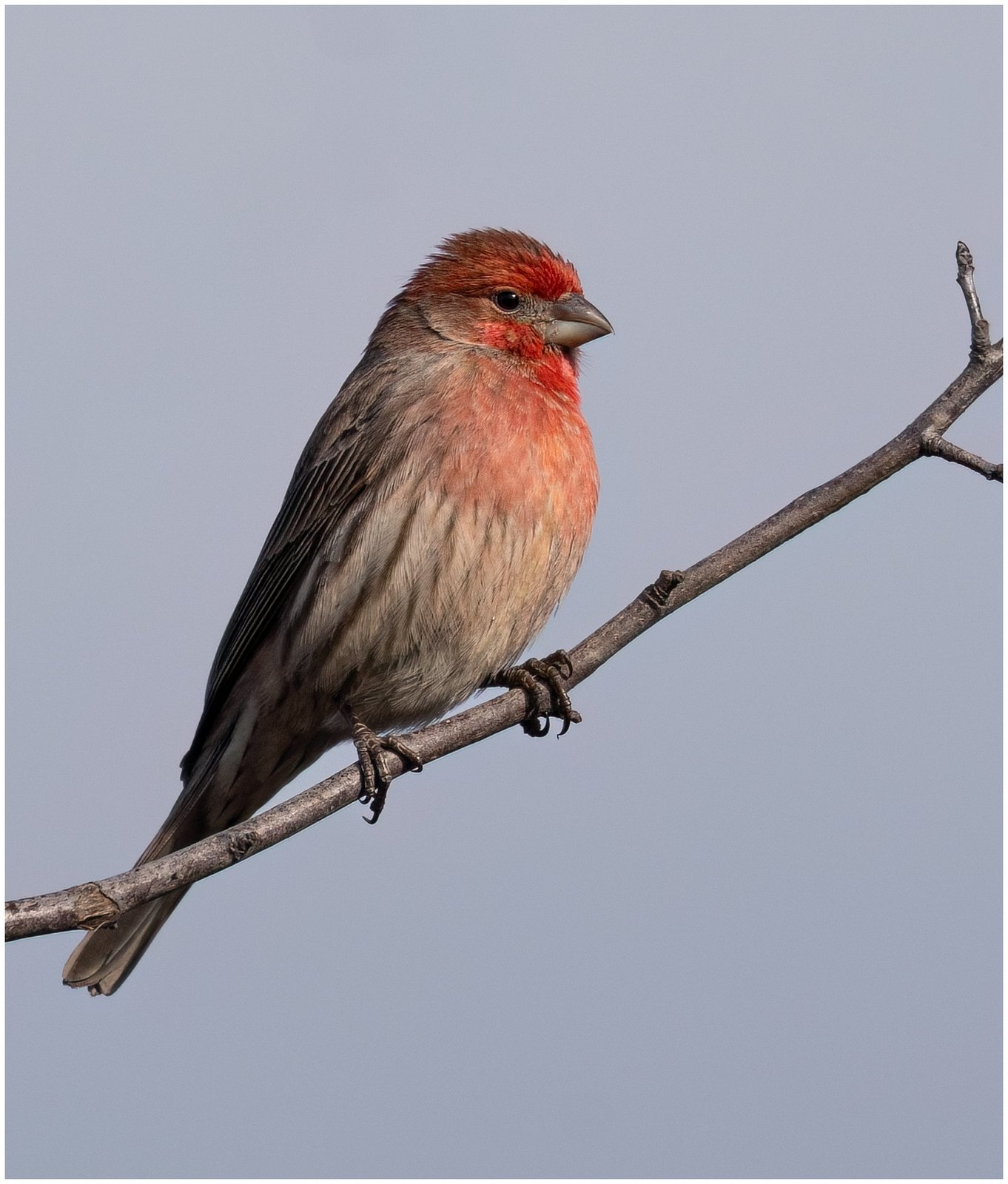
12.5–15 cm, a slim finch with a fairly long, square-ended tail and a short, curved conical bill. The male has red on the forehead, eyebrow, throat, breast and rump; the shade varies with diet from orange to yellow. Back and wings are streaked grey-brown, the flanks and belly streaked brown on off-white. The female is grey-brown, without red and without a clear head pattern, with blurry brown streaks on the underparts.
Confusion species
On the islands no other finch combines red with brown-streaked flanks. The female resembles a sparrow; Savannah Sparrow Passerculus sandwichensis has a clear crown stripe, often a yellow eyebrow, a finer bill and a shorter, notched tail. With any red finch an escaped cage bird of another species should also be considered.
Habitat
In its native range open country, dry scrub, farmyards, towns, parks and gardens. The Cuban bird stayed in a city park with gardens. It eats seeds, buds and fruit, on the ground and in trees, and readily visits feeders.
Where the bird is most at home, classified by the vegetation types of the Caribbean.


Range and movements
The only certain Caribbean record is an adult male that stayed at the Quinta de los Molinos in Havana, Cuba, from 28 December 2018 until mid-March 2019. Its origin is unknown. Old museum skins labelled only 'Antilles' do not count as Caribbean records. Breeds from southern Canada through the United States to southern Mexico; introduced to Hawaii.
How and when to look
No site to target. A red finch in a town or garden on the northern islands deserves a photograph and a report, with attention to the possibility of an escaped cage bird.
Conservation status
Not threatened. In eastern North America numbers fell sharply in the 1990s through an eye disease caused by the bacterium Mycoplasma gallisepticum. In the Caribbean a very rare vagrant.
Scientific name
Haemorhous mexicanus | (Müller, 1776)
Müller described the species in 1776 as Fringilla mexicana; because it was later moved to another genus, the author and year stand in brackets. The genus Haemorhous was introduced in 1837 by Swainson. Haemorhous comes from the Greek haimorrhoos 'bleeding', from haima 'blood' and rhoos 'stream', after the red plumage of the males. mexicanus is Latin for 'of Mexico', the country where the species was first collected. The specimen the first description was based on came from Valley of Mexico, Mexico.