All species › Passerines › New World warblers › Hooded Warbler
Hooded Warbler | Setophaga citrina
Monnikszanger | Chipe encapuchado
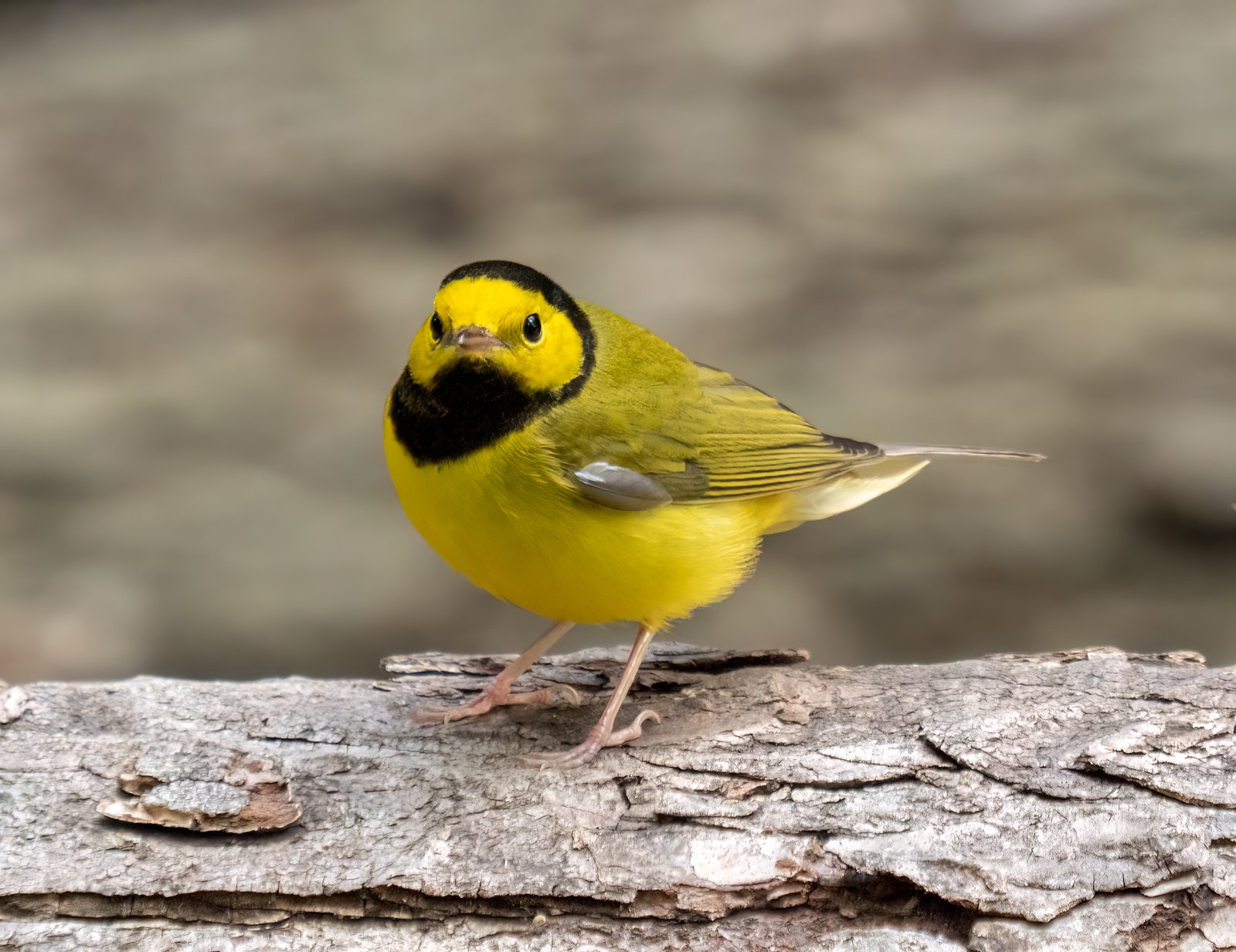
The Hooded Warbler is a yellow warbler whose male has a black hood framing a yellow face. It lives in the understorey of moist forest and repeatedly flicks its tail open, showing large white spots. Its main wintering grounds are in Mexico and Central America; in the Caribbean it is a scarce visitor, mainly to the western Greater Antilles and the Bahamas.
Voice
The call is a loud, metallic chink, often the first sign of the bird in dense cover. The song, rarely heard on the islands, is a clear, whistled series ending in an emphatic phrase: ta-wee ta-wee ta-wee tee-yo.
Recording: Jim Berry — CC BY-NC-SA 4.0 · shortened to the first 60 s, mono · xeno-canto
Identification
13–14 cm, fairly stocky for a warbler. Olive-green above and bright yellow below, with dark eyes in a yellow face. The male has a black hood and throat that frame the yellow forehead and cheeks like a mask. In females the hood ranges from absent, with just an olive crown around the yellow face, to a partial black hood in older females. Both sexes have extensive white on the inner webs of the outer tail feathers, visible when the tail is spread. No wing bars.
Confusion species
Wilson's Warbler Cardellina pusilla is smaller and has no white in the tail, and the male has only a black cap. Kentucky Warbler Geothlypis formosa has yellow spectacles and black sideburns below the eye. Female Common Yellowthroats Geothlypis trichas are browner, with a whitish belly and no tail spots. The round yellow face and the white tail spots are the best features of Hooded Warbler.
Habitat
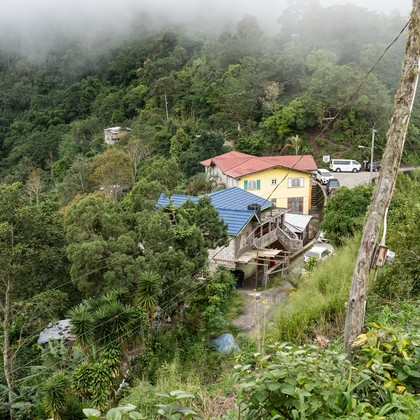
Understorey and shrub layer of moist and semi-deciduous forest, coastal woodland and shade-coffee plantations, also dense forest edges; on the islands mainly in the lowlands. On the wintering grounds males more often hold territories in tall, closed forest and females in scrub and young forest. It takes insects close to the ground in short sallies.
Where the bird is most at home, classified by the vegetation types of the Caribbean.



Range and movements
A scarce winter visitor and passage migrant in the Bahamas, Cuba, the Cayman Islands and Jamaica. Rare on Hispaniola (Haiti and the Dominican Republic), Puerto Rico and the Virgin Islands; a vagrant in the Lesser Antilles, on Trinidad and Tobago and the ABC Islands. Breeds in the eastern United States and extreme southern Canada and winters mainly from eastern Mexico to Panama.
- Summer visitor (c. Oct–Mar)
- Winter visitor (c. Apr–Sep)
- Passage (Mar–Apr, Oct–Nov)
- dark = core range, pale = thinly spread
How and when to look
The best chance is in autumn and spring in forest understorey on Cuba, the Bahamas and the Cayman Islands. The metallic chink usually gives the bird away before it is seen; after that, the repeated flicking of the white-spotted tail is a good clue.
Conservation status
Not threatened. The population has increased in recent decades and the breeding range has expanded northwards. Forest fragmentation on the breeding grounds and forest loss in Central America are the main threats.
Scientific name
Setophaga citrina | (Boddaert, 1783)
Boddaert described the species in 1783 as Muscicapa citrina; because it was later moved to another genus, the author and year stand in brackets. The genus Setophaga was introduced in 1827 by Swainson. Setophaga is Greek, from sēs, sētos 'moth' and -phagos '-eating': 'moth-eater'. citrina is Latin for 'lemon-yellow', after the yellow face and underparts. The specimen the first description was based on came from Louisiana, United States.