All species › Trogons › Trogons › Guianan Trogon
Guianan Trogon | Trogon violaceus
Guyanatrogon | Trogón violáceo
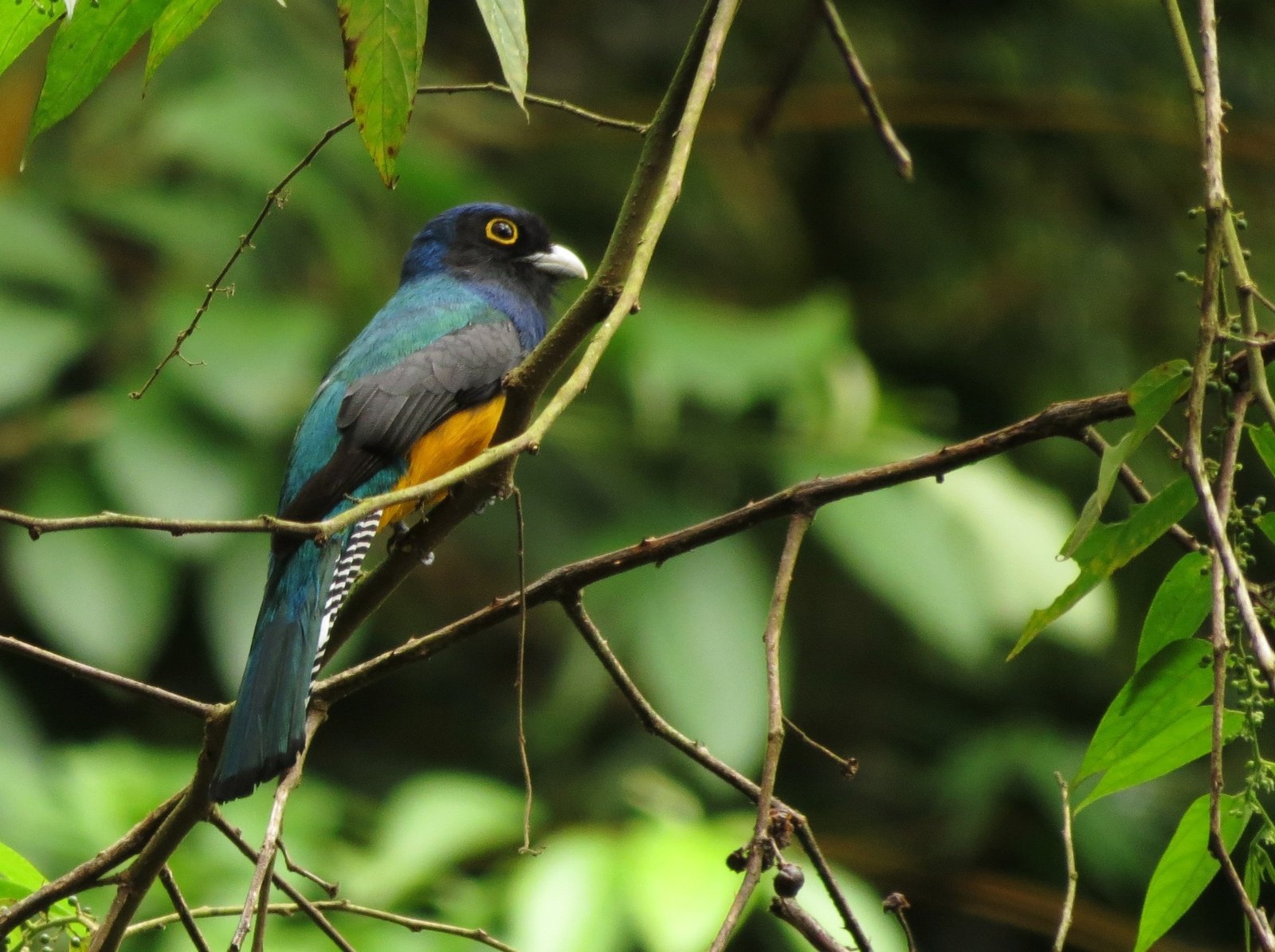
The Guianan Trogon is the smallest trogon in Trinidad and, like the Green-backed Trogon, a yellow-bellied trogon. In the Caribbean region it occurs only in Trinidad, where it is fairly common. It was formerly treated as a subspecies of the Violaceous Trogon, but most lists now recognise it as a separate species without subspecies. It joins mixed flocks more often than the Green-backed Trogon.
Voice
A long series of rapid, hollow, downslurred whistles, kyu-kyu-kyu-kyu-kyu, faster and more even than the accelerating series of Green-backed Trogon. Also rolling, chattering calls.
Recording: Ricardo Gagliardi — CC BY-NC-SA 4.0 · shortened to the first 60 s, mono · xeno-canto
Identification
23–25 cm. The male has a violet-blue head and breast with a black mask and throat, and bare pale yellow skin around the eye. A narrow white band separates the breast from the bright yellow belly. The upperparts are glossy metallic green; fine black-and-white markings make the wing look dark grey-brown. The undertail is finely barred black and white with broad white tips. The female is dark grey on head and upperparts, with white arcs above and below the eye, densely barred wings and a duller yellow belly with grey flanks.
Confusion species
Green-backed Trogon Trogon viridis is larger. The male has a pale blue eye-ring and a largely white undertail; the female has a pale blue rather than broken white eye-ring. Collared Trogon Trogon collaris has a red belly, a white breast band and, in the male, a green head.
Habitat
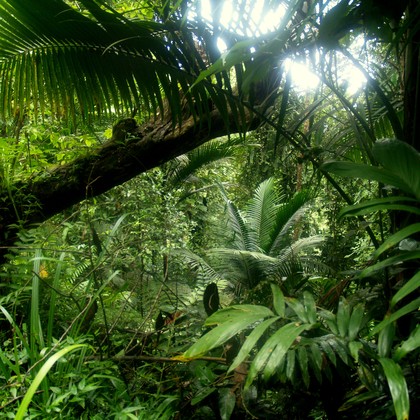
Semi-open country: edges and openings in primary forest, young secondary forest, cocoa and coffee plantations and humid lowland forest. It eats fruit and arthropods, taken in a hover after a short sally from a perch, and often joins mixed foraging flocks. It digs a nest cavity in a wasp, ant or termite nest, in rotten wood or in a mass of fern roots.
Where the bird is most at home, classified by the vegetation types of the Caribbean.


Range and movements
In the region only in Trinidad, where it is common in the Northern Range and in forest elsewhere. It does not occur on Tobago or the other islands; a single GBIF record from the Bahamas is almost certainly an error. Beyond the region it is resident in eastern Venezuela, the Guianas and adjacent northern Brazil.
- Resident
- dark = core range, pale = thinly spread
How and when to look
Around the Asa Wright Nature Centre in the Arima Valley it is often seen close to buildings and car parks. The rapid series of kyu notes points the way; on a yellow-bellied trogon the colour of the eye-ring (yellow or broken white versus pale blue) settles the matter quickest.
Conservation status
Not threatened. Common in Trinidad; elsewhere in its range locally common to scarce.
Scientific name
Trogon violaceus | Gmelin, 1788
Gmelin described the species in 1788 and placed it straight away in the genus where it still stands. The genus Trogon was introduced in 1760 by Brisson. Trogon is Greek, from trōgōn 'gnawing, fruit-eating'. violaceus is Latin for 'violet', after the violet-blue head and breast of the male. The specimen the first description was based on came from Suriname (designated later).