All species › Trogons › Trogons › Green-backed Trogon
Green-backed Trogon | Trogon viridis
Groenrugtrogon | Trogón dorsiverde
The Green-backed Trogon is the largest of Trinidad's three trogons and, like the Guianan Trogon, a yellow-bellied trogon. In the Caribbean region it occurs only in Trinidad. It used to be treated as one species with the White-tailed Trogon of Central America and western South America; the two have been separated since 2008. It sits motionless for long spells in the middle storey and is more of a fruit-eater than most other trogons.
Voice
A long series of about twenty hollow cow notes that starts slowly and speeds up towards the end. Also a dry chuck and a rattling churr when disturbed.
Recording: Juan Freile — CC BY-NC-SA 4.0 · converted to mono · xeno-canto
Identification
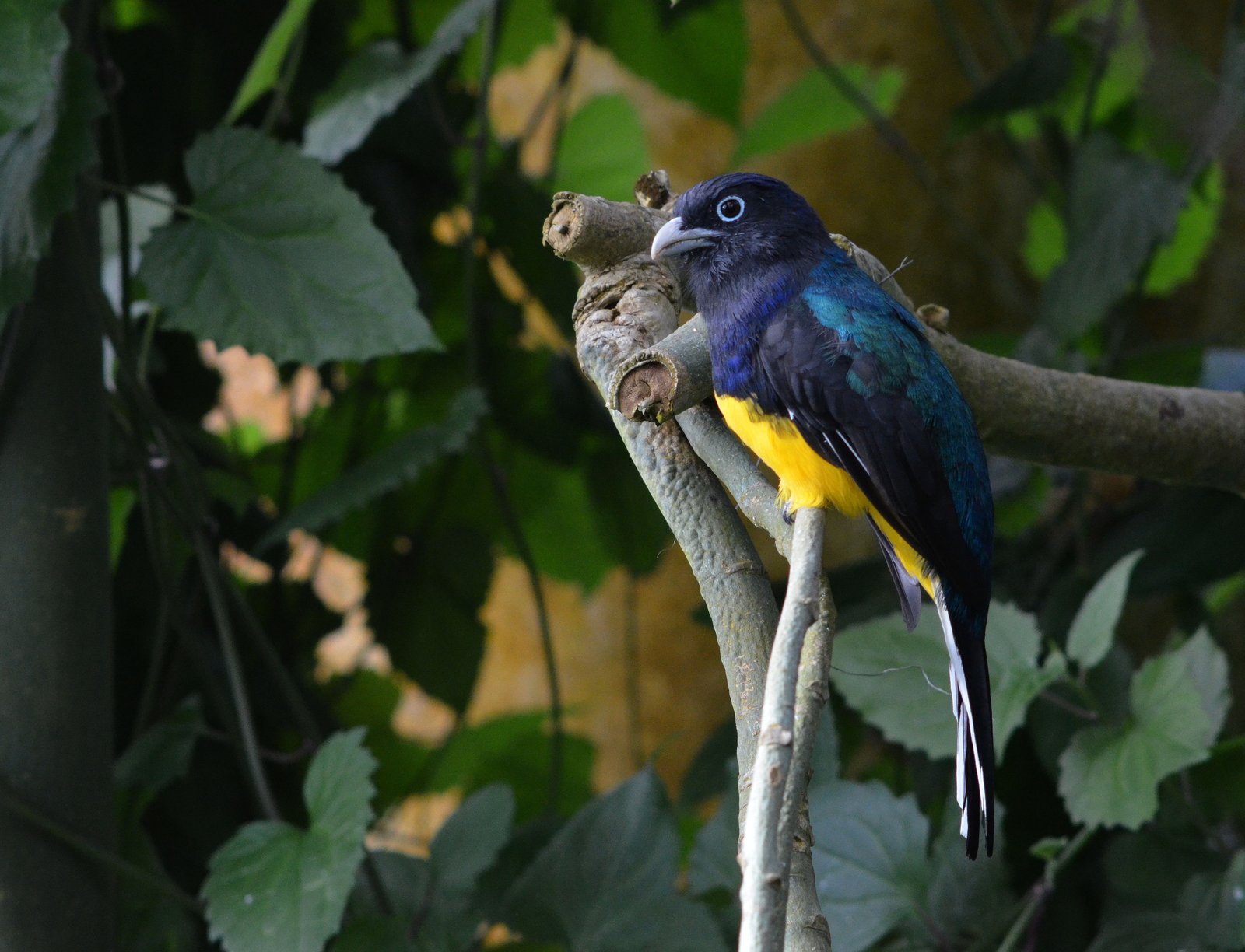
28–30 cm, the largest trogon in Trinidad. The male has a dark blue head and breast, looking blackish in poor light, and a green back. The lower underparts are orange-yellow. The wing is black with fine white markings. A complete pale blue eye-ring surrounds the eye. The undertail is mostly white: each feather has a broad black base and a broad white tip and outer edge. The female is grey on head, breast and back, with a yellow belly, a pale blue eye-ring and an undertail barred black and white, mainly on the outer webs.
Confusion species
Guianan Trogon Trogon violaceus is smaller. The male has a yellow eye-ring and a finely barred black-and-white undertail with white tips; the female has a broken white eye-ring instead of a pale blue one. Collared Trogon Trogon collaris has a red belly and a white breast band.
Habitat
Humid lowland forest and semi-evergreen forest, forest edges, mature secondary forest and shaded cocoa plantations, mainly in the middle storey and below the canopy. It eats mostly small fruit, supplemented by arthropods and lizards, and joins mixed foraging flocks less often than other trogons. The female digs a nest cavity in an arboreal termite nest or in rotten wood.
Where the bird is most at home, classified by the vegetation types of the Caribbean.



Range and movements
In the region only in Trinidad, mainly in the Northern Range and the forested parts of the interior. It does not occur on Tobago or the other islands. Beyond the region it is resident in the Amazon basin, the Guianas and the Atlantic Forest of eastern Brazil.
- Resident
- dark = core range, pale = thinly spread
How and when to look
In the Northern Range, for example around the Asa Wright Nature Centre in the Arima Valley and along the Blanchisseuse Road. The accelerating series of cow notes is the first lead; then search the middle storey for an upright bird. From below, the male's largely white tail is the best feature for separating it from Guianan Trogon.
Conservation status
Not threatened. A fairly common forest resident in Trinidad and widespread and common in much of South America.
Scientific name
Trogon viridis | Linnaeus, 1766
Linnaeus described the species in 1766 and placed it straight away in the genus where it still stands. The genus Trogon was introduced in 1760 by Brisson. Trogon is Greek, from trōgōn 'gnawing, fruit-eating'. viridis is Latin for 'green', after the glossy green back. The specimen the first description was based on came from Cayenne, French Guiana.