All species › Hummingbirds and swifts › Hummingbirds › Green-throated Mango
Green-throated Mango | Anthracothorax viridigula
Groenkeelmango | Mango gorjiverde
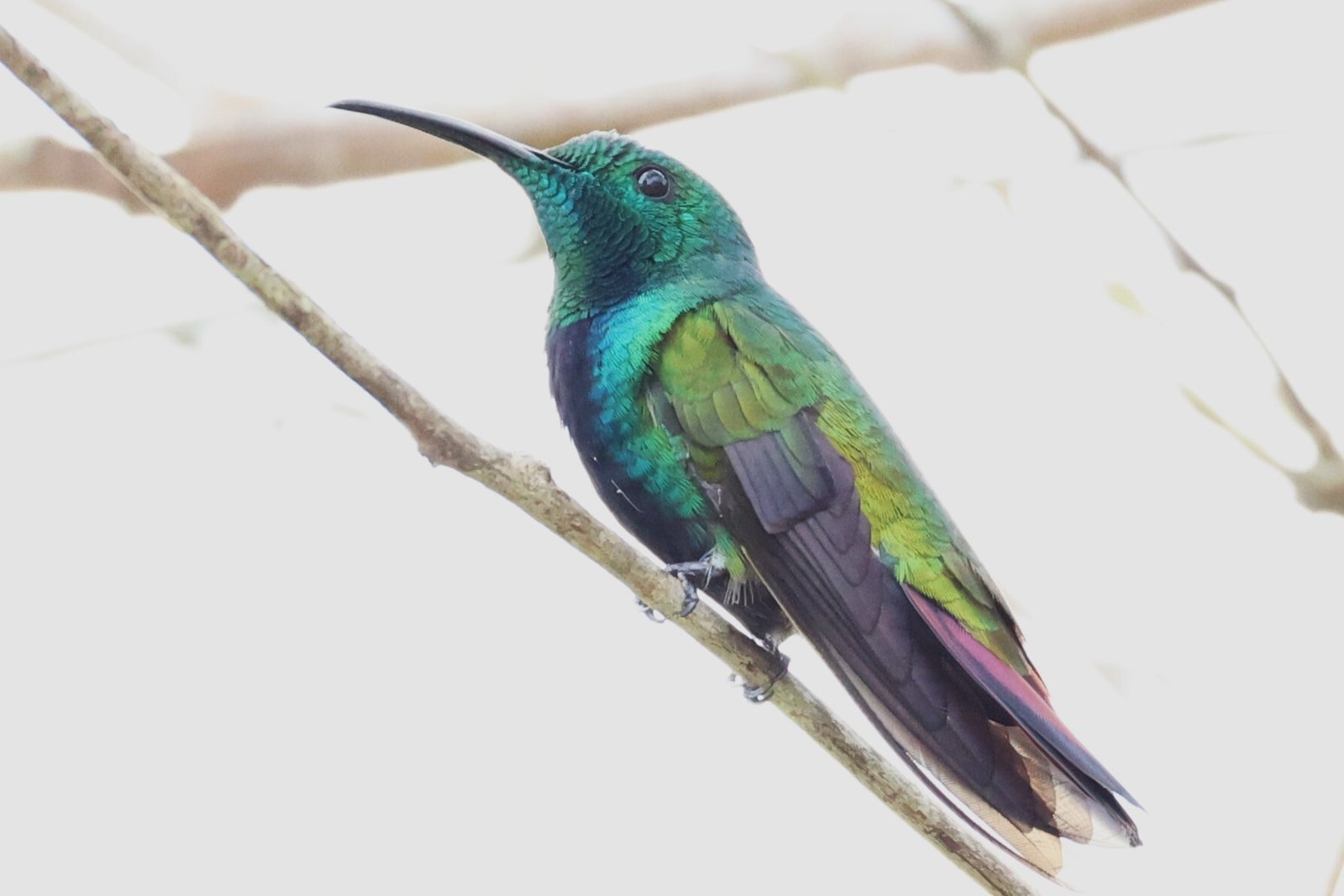
The Green-throated Mango is a hummingbird of the coastal swamps and mangroves of north-eastern South America, occurring in the region only in Trinidad. There it is much scarcer than Black-throated Mango and often overlooked, since females of the two species are very alike.
Voice
A short chep, often given in flight or while hovering. The song is a very high, slightly descending trill.
Recording: Dante Buzzetti — CC BY-NC-SA 4.0 · converted to mono · xeno-canto
Identification
11–12 cm, with a curved black bill. The male is glossy bronze-green above; throat and underparts are green, with a black central stripe that starts only on the breast and continues onto the belly. The central tail feathers are dark brown to green, the outer ones glossy purple with dark blue tips. The female is bronze-green above with a reddish tinge and white below with a black central stripe; the outer tail feathers have white tips.
Confusion species
Male Black-throated Mango Anthracothorax nigricollis has a black stripe beginning at the chin and running down the whole throat, and a purplish-red tail. Females of the two species often cannot be identified with certainty in the field; a female in mangrove or coastal swamp with scattered trees is more likely to be Green-throated, but Black-throated also occurs there. White-necked Jacobin Florisuga mellivora has a straight bill and a white tail.
Habitat
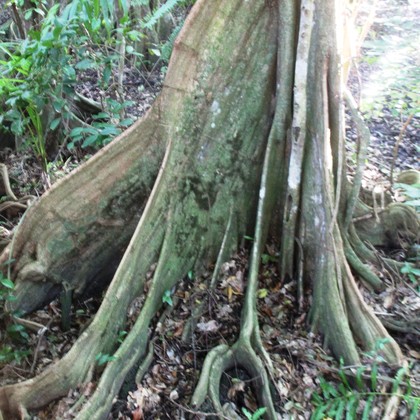
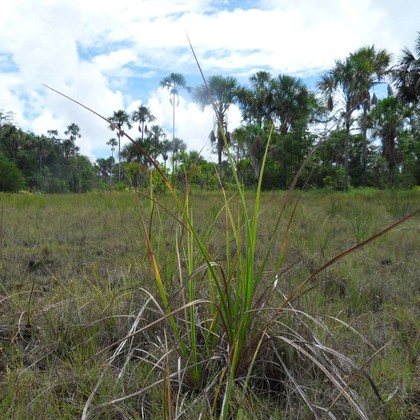
Mangroves, swamp forest and moist, partly flooded lowland savanna with scattered tall trees, from sea level to about 500 m. Visits flowering trees, often high in the crown.
Where the bird is most at home, classified by the vegetation types of the Caribbean.

Range and movements
In Trinidad a scarce and local resident, mainly in mangroves and swampy coastal areas; absent from Tobago. Outside the region along the coast from north-eastern Venezuela through the Guianas to north-eastern Brazil and inland along the Amazon.
- Resident
- dark = core range, pale = thinly spread
How and when to look
Best searched for in and along mangroves and coastal swamps in Trinidad, at flowering trees along the edge. Only males with the green throat clearly seen can be identified with certainty.
Conservation status
Not threatened. The species has a large range in South America. In Trinidad its restriction to coastal swamps and mangroves makes it vulnerable to the loss of those areas.
Scientific name
Anthracothorax viridigula | (Boddaert, 1783)
Boddaert described the species in 1783 as Trochilus viridigula; because it was later moved to another genus, the author and year stand in brackets. The genus Anthracothorax was introduced in 1831 by Boie. Anthracothorax is Greek, from anthrax 'coal' (i.e. 'black') and thōrax 'chest', after the black central stripe on breast and belly. viridigula is Latin, from viridis 'green' and gula 'throat', after the green throat. The specimen the first description was based on came from Cayenne, French Guiana.