All species › Passerines › Tyrant flycatchers › Great Crested Flycatcher
Great Crested Flycatcher | Myiarchus crinitus
Grote kuiftiran | Copetón viajero
The Great Crested Flycatcher breeds in eastern North America and winters in southern Mexico, Central America and northern South America. The Caribbean lies at the edge of its migration route: it is recorded on passage and in winter mainly in Cuba and the northern islands.
Voice
A loud, rising wheeep and a rolling prrrreet; in winter it is quieter than on the breeding grounds.
Recording: Bobby Wilcox — CC BY-NC-SA 4.0 · shortened to the first 60 s, mono · xeno-canto
Identification
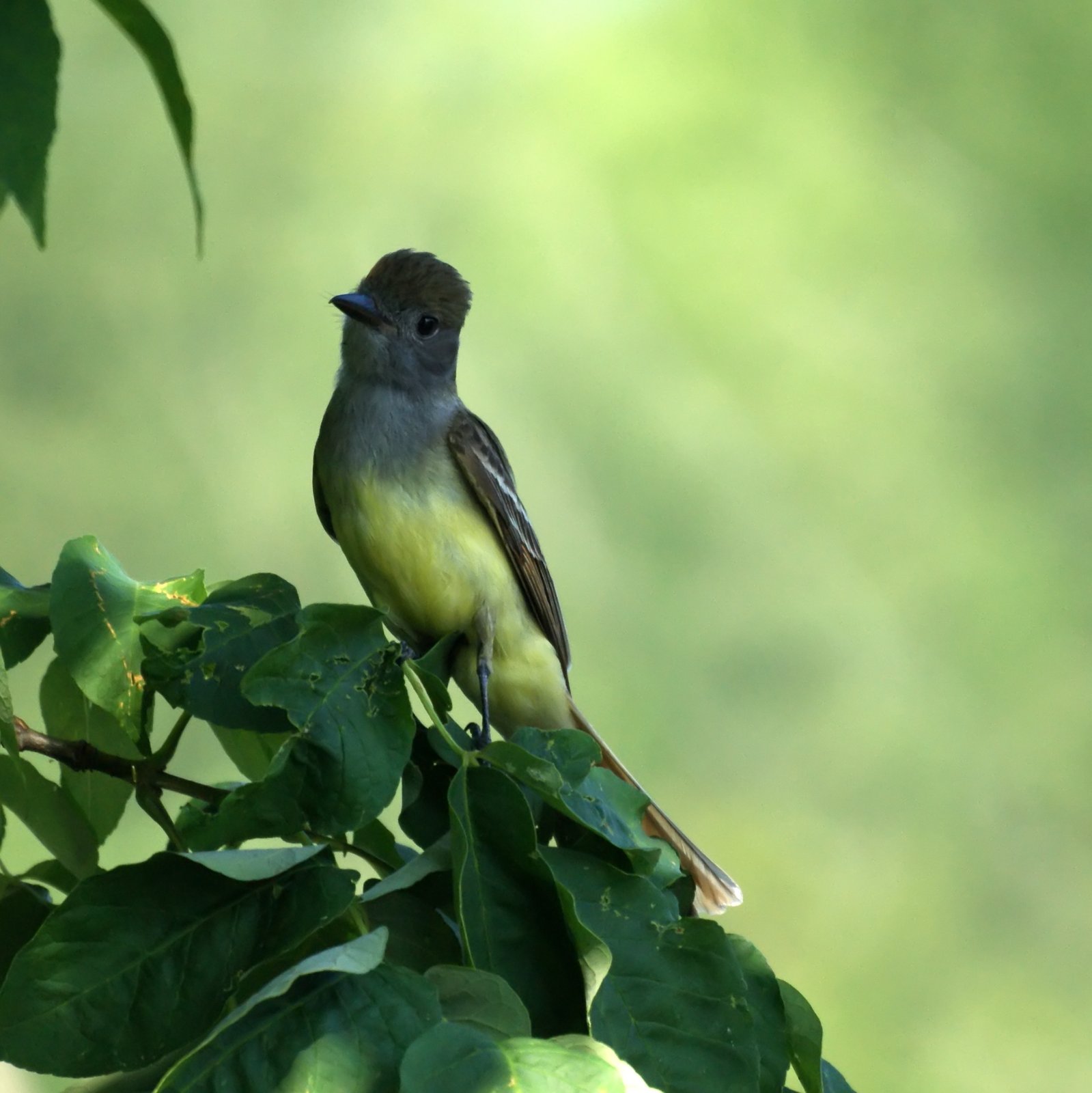
18–21 cm, with a full, bushy crest. The upperparts are olive-brown. Throat and breast are clear grey and meet the bright yellow belly in a sharp line. The primaries and the inner webs of the tail feathers are rufous, and the tertials have a white edge. The bill is black with a pale, brownish-pink base to the lower mandible. The sexes are alike.
Confusion species
La Sagra's Flycatcher Myiarchus sagrae of Cuba, the Bahamas and the Cayman Islands is smaller and slimmer, with greyish-white underparts lacking bright yellow. Rufous-tailed Flycatcher Myiarchus validus of Jamaica has rufous in the wings and tail but a less sharp contrast between grey breast and yellow belly. Brown-crested Flycatcher Myiarchus tyrannulus, found only in the south of the region, has a paler grey breast, a paler yellow belly and an all-black bill.
Habitat
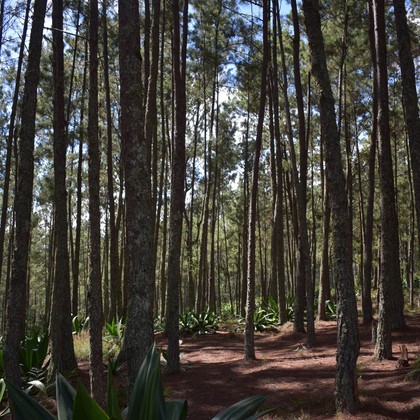
In the region forest and forest edges, both dry and moist broadleaf forest, coastal woodland and at times pine forest. It feeds in the upper levels of the forest, sallying from a perch after insects; in winter it also eats berries and small fruit. On the breeding grounds it nests in tree cavities and often works shed snakeskin into the nest.
Where the bird is most at home, classified by the vegetation types of the Caribbean.



Range and movements
In Cuba a scarce passage migrant and rare winter visitor, mainly in the west; rare in the Bahamas, the Cayman Islands and Jamaica; a vagrant further east. It breeds from southern Canada to the Gulf Coast and Florida and winters from southern Florida and southern Mexico through Central America to Colombia and Venezuela.
- Resident
- Summer visitor (c. Oct–Mar)
- Winter visitor (c. Apr–Sep)
- Passage (Mar–Apr, Oct–Nov)
- dark = core range, pale = thinly spread
How and when to look
The best chance is in western Cuba during spring and autumn migration. A Myiarchus with a bright yellow belly and much rufous in the tail in Cuba or the Bahamas is more likely to be this species than La Sagra's Flycatcher.
Conservation status
Not threatened. The species is common on its breeding grounds, where it benefits from nest boxes and old, hollow trees.
Scientific name
Myiarchus crinitus | (Linnaeus, 1758)
Linnaeus described the species in 1758 as [Turdus] crinitus; because it was later moved to another genus, the author and year stand in brackets. The genus Myiarchus was introduced in 1844 by Cabanis. Myiarchus is Greek, from muia 'fly' and arkhos 'ruler': 'fly-ruler'. crinitus is Latin for 'long-haired', after the bushy crest. The specimen the first description was based on came from South Carolina.