All species › Passerines › Tyrant flycatchers › Fork-tailed Flycatcher
Fork-tailed Flycatcher | Tyrannus savana
Vorkstaartkoningstiran | Tijereta sabanera
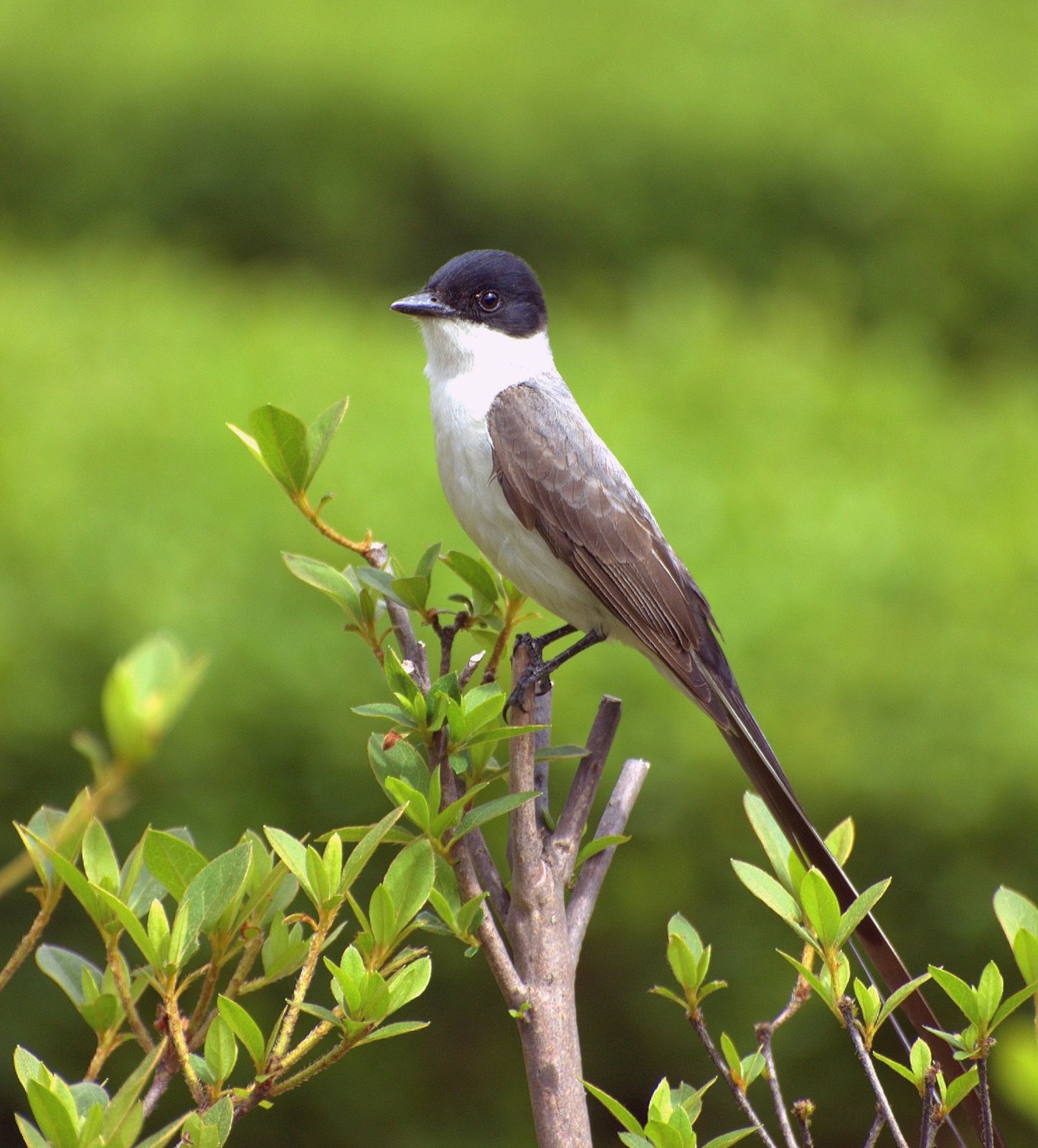
The Fork-tailed Flycatcher is a kingbird of open country with a long, deeply forked tail. The birds that reach the Caribbean come mainly from southern South America and spend the austral winter in the north of the continent. On Trinidad and Tobago they then appear in large numbers and roost communally in mangroves and trees.
Voice
A dry, buzzy call, a soft tik in flight and twittering series at the roost. The wings can produce a whirring or whistling sound in flight.
Recording: JAYRSON ARAUJO DE OLIVEIRA — CC BY-NC-SA 4.0 · shortened to the first 60 s, mono · xeno-canto
Identification
Adult males 37–41 cm, females 28–30 cm, much of it tail; body length is similar to that of other kingbirds. The head has a black cap with a concealed yellow crown patch. The back is pale grey, the wings darker grey-brown. The underparts are clean white. The tail is black and deeply forked, with outer feathers much longer in the male than in the female. Juveniles have a browner cap, browner upperparts and a much shorter tail. During moult the long tail may be missing.
Confusion species
Scissor-tailed Flycatcher Tyrannus forficatus, a vagrant from North America, has a pale grey head without a black cap, salmon-pink flanks and underwings, and black-and-white tail feathers. Grey Kingbird Tyrannus dominicensis lacks the black cap and has a short, notched tail. A Fork-tailed Flycatcher without its long tail is recognised by the black cap, grey back and white underparts.
Habitat
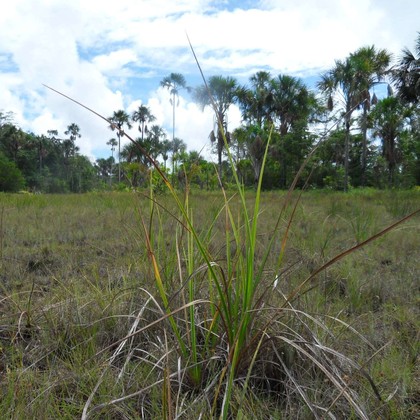
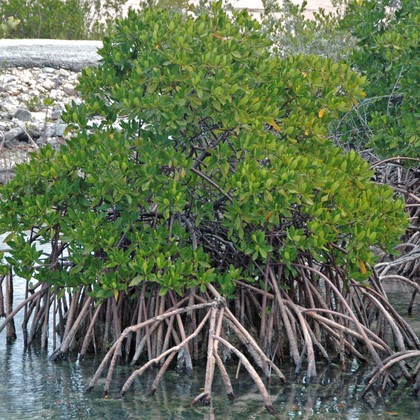
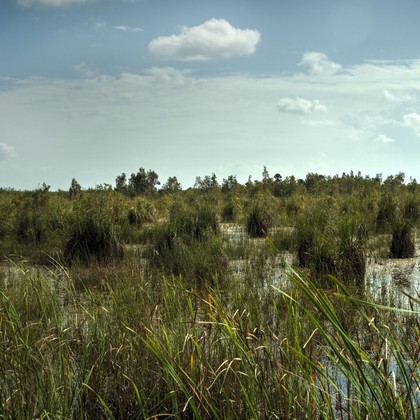
Savanna, flooded grassland, pasture, rice and sugar-cane fields, marsh edges and other open country with scattered perches. It sallies for flying insects from fences, wires and bushes, and outside the breeding season also eats much fruit. Communal roosts are often in mangroves or lines of trees.
Where the bird is most at home, classified by the vegetation types of the Caribbean.

Range and movements
On Trinidad and Tobago regular and often numerous from about May to October, as a non-breeding visitor. An irregular visitor to Aruba, Curaçao and Bonaire and to Grenada and Saint Vincent; a vagrant to Barbados, Guadeloupe, Puerto Rico, the Bahamas, the Cayman Islands, Cuba and other islands. Outside the region from southern Mexico to Argentina; southern populations move to northern South America in the austral winter.
- Resident
- Summer visitor (c. Oct–Mar)
- Winter visitor (c. Apr–Sep)
- Passage (Mar–Apr, Oct–Nov)
- dark = core range, pale = thinly spread
How and when to look
On Trinidad from May to October around open grassland and rice fields, for example around Caroni Swamp and Nariva, and at dusk at communal roosts. Outside Trinidad and Tobago every record is worth documenting.
Conservation status
Not threatened. The species has a very large range and locally benefits from the conversion of forest to pasture.
Scientific name
Tyrannus savana | Daudin, 1802
Daudin described the species in 1802 and placed it straight away in the genus where it still stands. The genus Tyrannus was introduced in 1799 by De Lacépède. Tyrannus is Latin (from Greek turannos) for 'tyrant, despot', after the aggressive way these birds drive off even raptors. savana goes back to Buffon's name 'le Savana', because the bird lives in (flooded) savannas. The specimen the first description was based on came from Río de la Plata and Montevideo, Uruguay.