All species › Passerines › Thrushes › Forest Thrush
Forest Thrush | Turdus lherminieri
Antillenlijster | Zorzal antillano
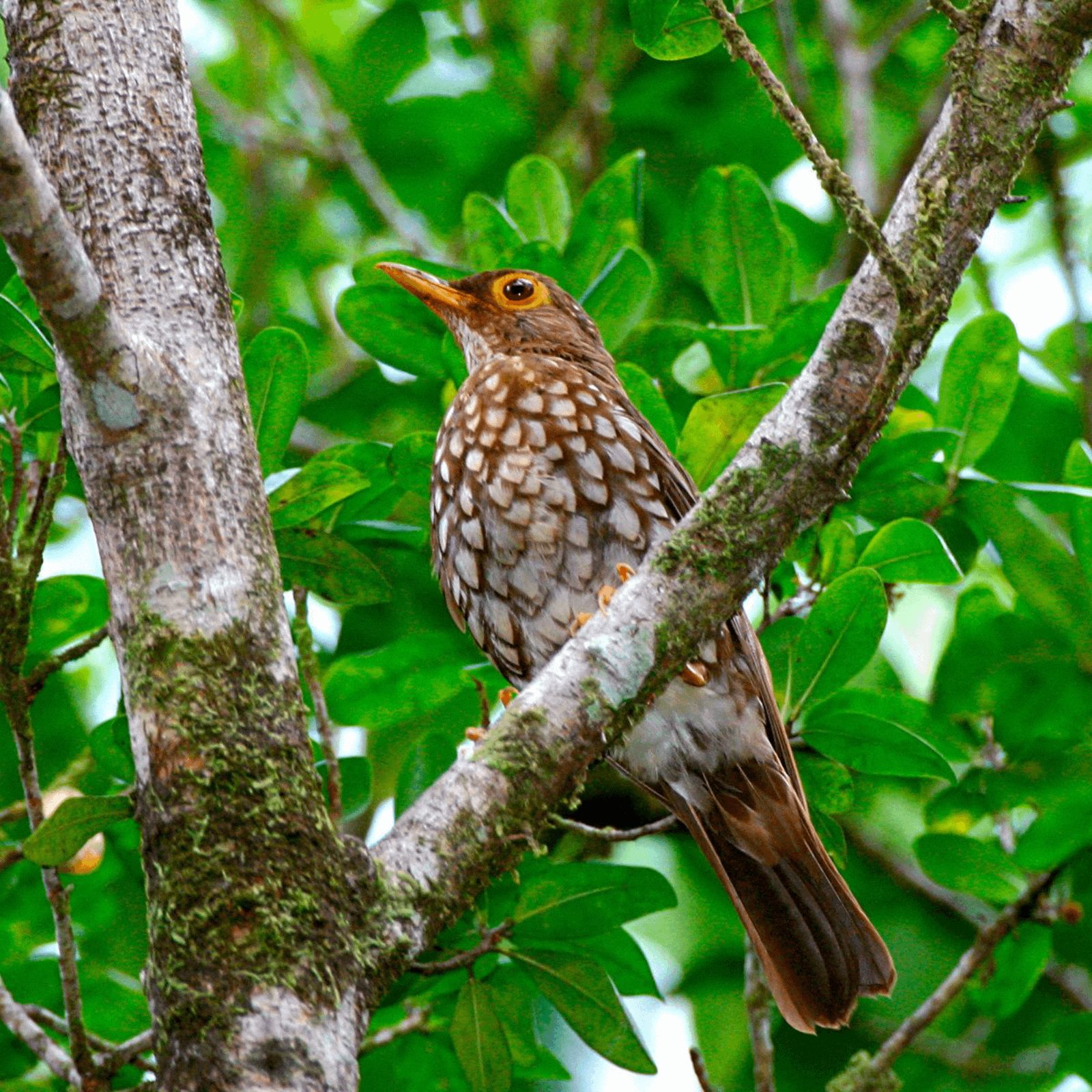
The Forest Thrush is a brown, heavily scaled thrush of the rainforests of four islands in the Lesser Antilles. It lives on or near the forest floor and is shy. Each island has its own subspecies. On Guadeloupe it is called grive à pieds jaunes and is a traditional game bird.
Voice
The song consists of soft, clear, musical notes. The call is a sharp chuk or chuk-chuk.
Recording: Valentin Monnoy — CC BY-NC-SA 4.0 · converted to mono · xeno-canto
Identification
25–27 cm, rather stocky, with a shorter tail than most Turdus. Head and upperparts are warm brown, with fine white streaks on the cheeks and ear-coverts. The underparts are whitish with large, buff-edged dark brown scallops on breast and flanks, giving a spotted to scaly look. Bill, broad eye-ring, iris and legs are yellow. The sexes are alike. Birds on Dominica and Saint Lucia are smaller; those on Dominica darker, those on Saint Lucia with larger, buffier scallops.
Confusion species
Pearly-eyed Thrasher Margarops fuscatus has a white iris, a heavy pale bill and dark legs, and more often sits high and in the open. Scaly-breasted Thrasher Allenia fusca is smaller, with a dark bill, a white wing bar and no yellow eye-ring. Spectacled Thrush Turdus nudigenis, on Saint Lucia and recently further north, has plain grey-brown underparts without scaling. On Dominica, Eastern Red-legged Thrush Turdus ardosiaceus is grey, with red legs and bill.
Habitat
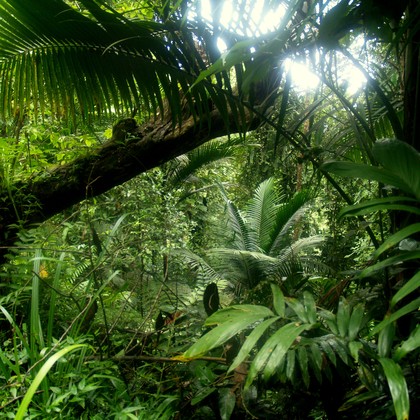
Primary and older secondary evergreen forest, from sea level to about 1000 m but mainly at middle and upper elevations; also wet ravines and forest edges with dense undergrowth. It forages in leaf litter for invertebrates and eats fruit, also in the canopy.
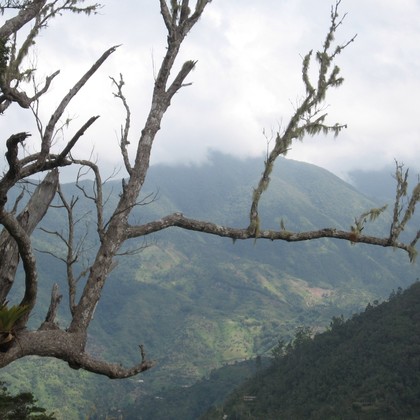
Where the bird is most at home, classified by the vegetation types of the Caribbean.


Range and movements
Lesser Antilles only: Montserrat (mainly the Centre Hills), Guadeloupe (mainly Basse-Terre), Dominica and Saint Lucia, each with its own subspecies. Rare on Saint Lucia. Not known from the other islands.
- Resident
- dark = core range, pale = thinly spread
How and when to look
Guadeloupe National Park on Basse-Terre and the forests around Morne Diablotin on Dominica offer the best chances, early in the morning along quiet forest trails or at fruiting trees. The call often gives the bird away before it is seen.
Conservation status
Near Threatened according to the IUCN; the population is declining. Threats are deforestation and logging, hunting on Guadeloupe, introduced predators, hurricanes and, on Montserrat, the volcanic eruptions since 1995, which destroyed much of the forest.
Scientific name
Turdus lherminieri | de Lafresnaye, 1844
De Lafresnaye described the species in 1844 and placed it straight away in the genus where it still stands. The genus Turdus was introduced in 1758 by Linnaeus. Turdus is the ordinary Latin word for 'thrush'. lherminieri honours the French pharmacist and naturalist Félix Louis L'Herminier (1779–1833), who studied the wildlife of Guadeloupe for many years. The specimen the first description was based on came from Guadeloupe.