All species › Passerines › Crows and jays › Fish Crow
Fish Crow | Corvus ossifragus
Viskraai | Cuervo pescador
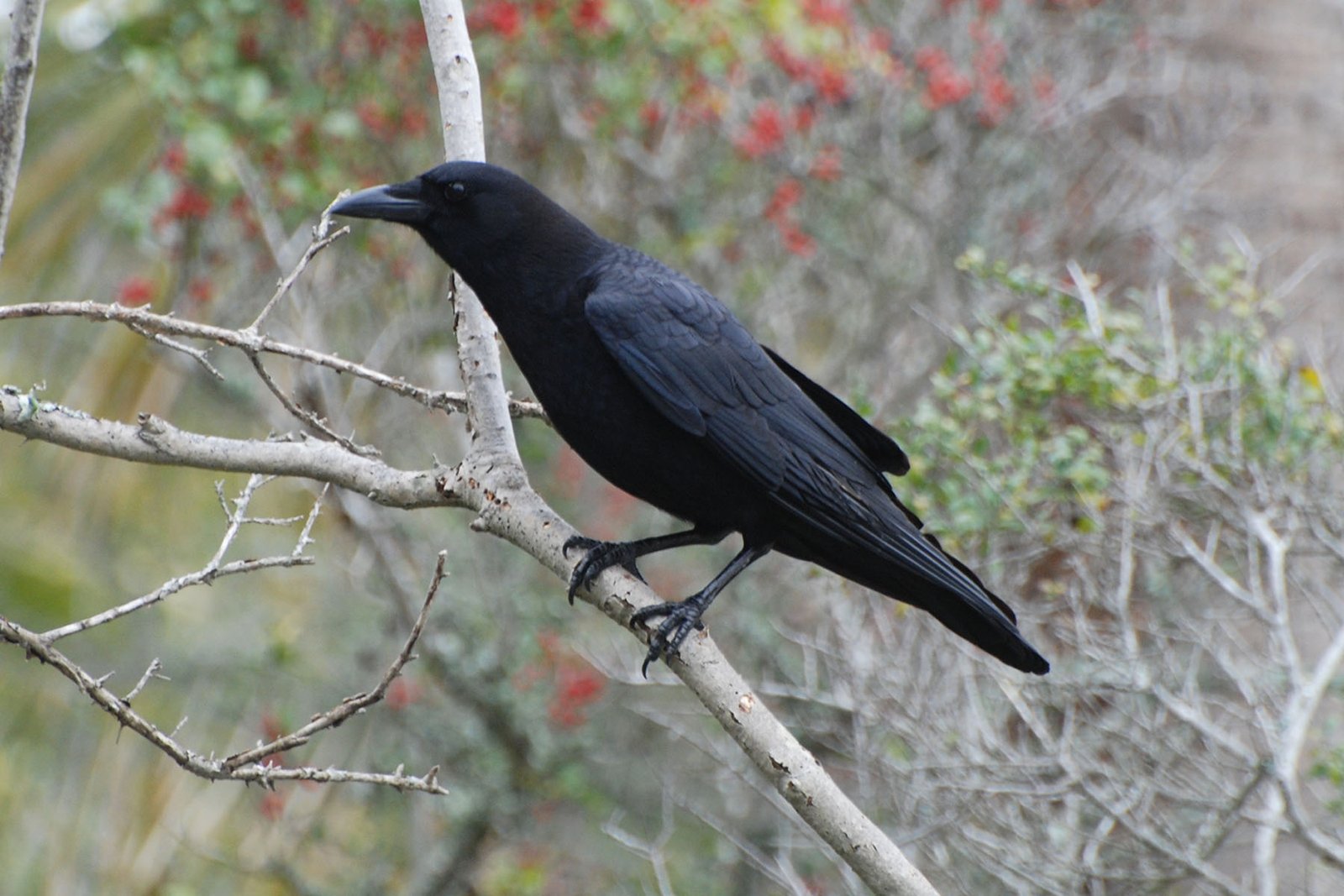
The Fish Crow is a small crow of the coasts and rivers of the eastern United States, south to Florida. Its range has been expanding in recent decades, both northwards and southwards. In the Caribbean it is known only from the northern Bahamas, mainly Grand Bahama, where small numbers have been seen regularly since the mid-2010s.
Voice
A nasal, short ah or ah-ah, often rendered nyuh-uh, higher and less clear than the call of American Crow. Young American Crows can give nasal begging calls, which may cause confusion.
Recording: Russ Wigh — CC BY-NC-SA 4.0 · converted to mono · xeno-canto
Identification
36–40 cm, a small, all-black crow with a relatively slender bill, fairly short legs and smooth, silky-looking plumage with a blue-purple gloss. Iris dark. The sexes are alike. In the field it is almost impossible to separate reliably from American Crow on appearance; the call is the best feature.
Confusion species
American Crow Corvus brachyrhynchos, the main confusion species in Florida, is larger, with a heavier bill, and gives a clear caw. Of the Caribbean crows, only Cuban Crow Corvus nasicus occurs nearby, in Cuba and the Caicos Islands; it is larger, with a long, deep bill and bubbling, parrot-like calls.
Habitat
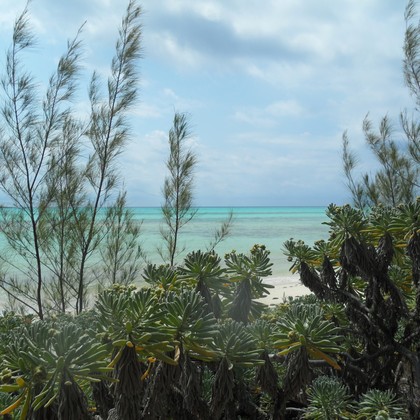
Coasts, beaches, harbours, mangrove and marsh edges, river banks and built-up areas. On Grand Bahama mainly at harbours, a landfill, golf courses and gardens. It eats almost anything: crabs, shellfish, fish, carrion, eggs, fruit and refuse.
Where the bird is most at home, classified by the vegetation types of the Caribbean.



Range and movements
In the region only in the northern Bahamas: most often on Grand Bahama (West End, Freeport and surroundings), with a few records from Abaco, Bimini and Andros. Breeding there has not been established. Elsewhere along the east coast of the United States from southern New England to Florida and along the Gulf coast, spreading inland along rivers and recently into southern Canada.
How and when to look
On Grand Bahama at West End and around Freeport, at the harbour and the landfill. A crow in the northern Bahamas is best identified by its nasal call; sound recordings help to document records.
Conservation status
Not globally threatened; the population is increasing and the range expanding. In the Caribbean a vagrant to rare visitor, with a small, possibly lasting presence on Grand Bahama.
Scientific name
Corvus ossifragus | Wilson, 1812
Wilson described the species in 1812 and placed it straight away in the genus where it still stands. The genus Corvus was introduced in 1758 by Linnaeus. Corvus is the Latin word for 'raven'. ossifragus is Latin for 'bone-breaker', from os 'bone' and frangere 'to break'; Wilson saw the bird as a coastal scavenger. The specimen the first description was based on came from Beesley's Point, New Jersey (USA).