All species › Passerines › New World blackbirds › Eastern Meadowlark
Eastern Meadowlark | Sturnella magna
Witkaakweidespreeuw | Sabanero
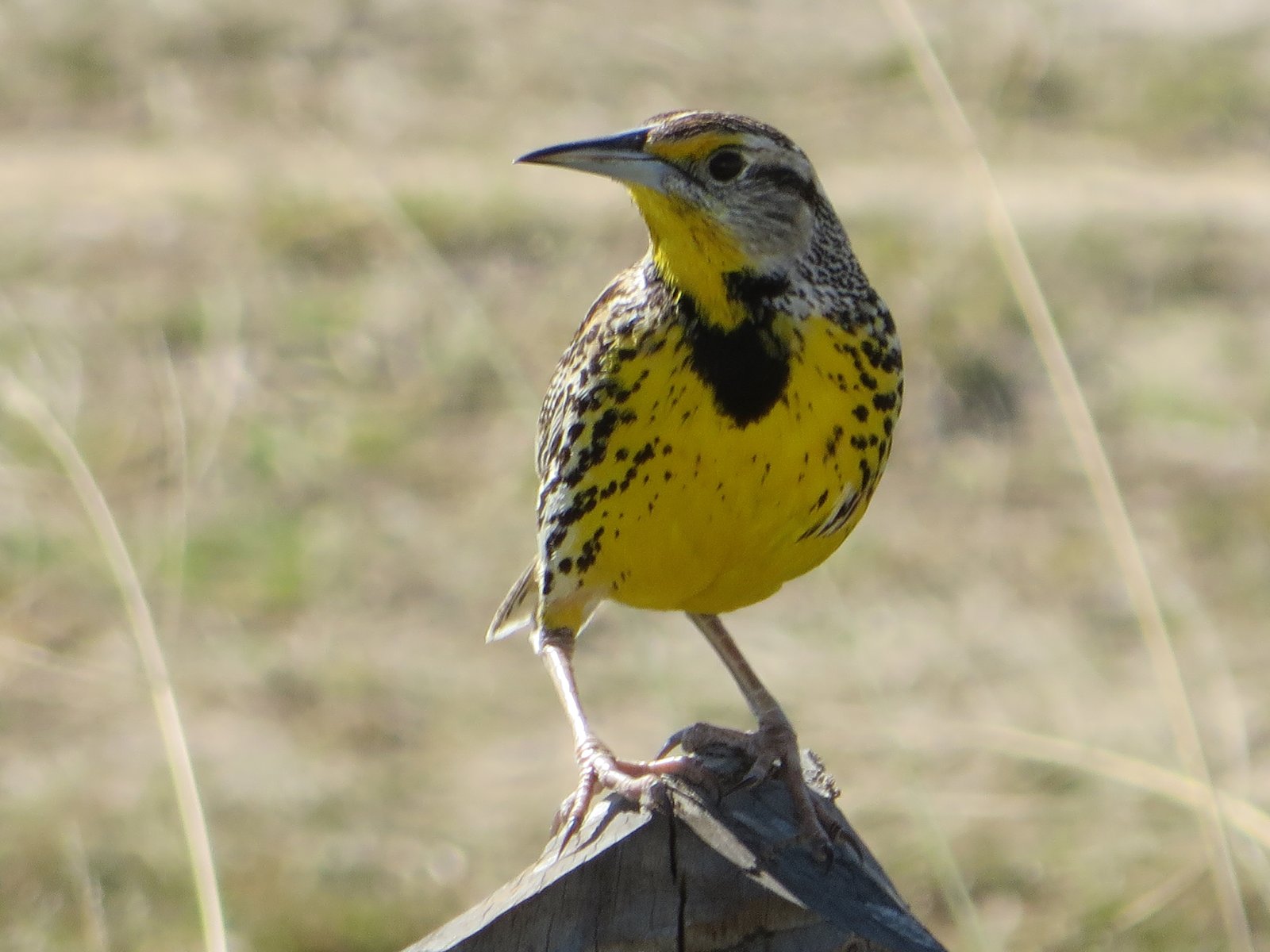
The Eastern Meadowlark is a stocky, short-tailed blackbird of open grassland that in the Caribbean occurs only in Cuba. The Cuban birds form their own subspecies, Sturnella magna hippocrepis, and are resident; in Cuba the species is called sabanero. Fossil remains from Sawmill Sink on Abaco show that it once lived in the Bahamas too.
Voice
The song is a series of clear, pure, rather plaintive whistles, often descending, given from a post, bush or wire. The call is a dry, buzzy dzert, with a chattering rattle when alarmed.
Recording: Manuel Grosselet — CC BY-NC-SA 4.0 · converted to mono · xeno-canto
Identification
19–26 cm, stocky, with a long pointed bill, a flat head, a short tail and strong legs. The upperparts are brown with black and buff streaks; the crown has dark lateral stripes and a pale central stripe. Throat, breast and belly are bright yellow, with a black V-shaped band across the breast. The supercilium is yellow in front of the eye and white behind it, and the cheeks are white. Flanks and undertail are white with black spots. The outer tail feathers are white and show when the bird takes off or spreads its tail. The sexes are alike; juveniles are paler, with a faint, streaked breast band.
Confusion species
No other meadowlark with a yellow breast occurs in the Caribbean; Red-breasted Meadowlark Leistes militaris lives only on Trinidad. In flight the bird may recall a quail with its short, rapid wingbeats alternating with glides, but the white outer tail feathers are distinctive. Bobolink Dolichonyx oryzivorus in non-breeding plumage is much smaller and lacks the black breast band.
Habitat
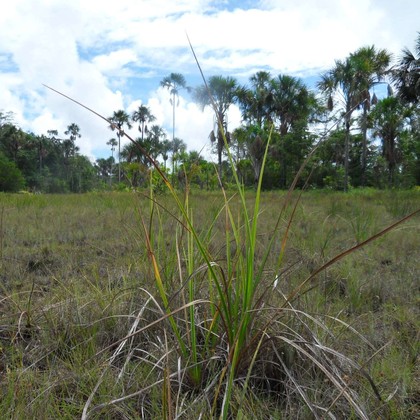
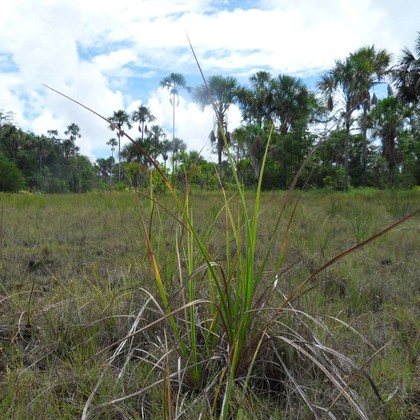
Savanna, pasture, open grassland with scattered palms, the edges of cane fields and other farmland with grassy patches, also moist, seasonally flooded grassland. It walks on the ground searching for insects, especially grasshoppers and beetles, and seeds. The nest is in a scrape on the ground, often roofed over with grass.
Where the bird is most at home, classified by the vegetation types of the Caribbean.


Range and movements
Resident in Cuba and on the Isla de la Juventud, throughout the island in open country and locally common. Gone from the Bahamas; the records from Abaco and New Providence in the map database are fossil bones. Outside the region in eastern North America, Mexico and Central America to northern South America.
- Resident
- Summer visitor (c. Oct–Mar)
- Winter visitor (c. Apr–Sep)
- Passage (Mar–Apr, Oct–Nov)
- dark = core range, pale = thinly spread
How and when to look
Early in the morning birds sing from posts and shrubs in pastures and savannas, for instance on the plains of western and central Cuba. A flushed bird shows the white tail sides and drops back into the grass after a short, low flight.
Conservation status
Near Threatened according to the IUCN, owing to a steep decline in North America caused by the loss and more intensive use of grassland. In Cuba still widespread in open country.
Scientific name
Sturnella magna | (Linnaeus, 1758)
Linnaeus described the species in 1758 as A[lauda] magna; because it was later moved to another genus, the author and year stand in brackets. The genus Sturnella was introduced in 1816 by Vieillot. Sturnella is a Latin diminutive of sturnus 'starling': 'little starling'. magna is Latin for 'great, large'; Linnaeus described the species as a large lark (Alauda magna). The specimen the first description was based on came from South Carolina.