All species › Hummingbirds and swifts › Hummingbirds › Blue-tailed Emerald
Blue-tailed Emerald | Chlorostilbon mellisugus
Blauwstaartsmaragdkolibrie | Esmeralda coliazul
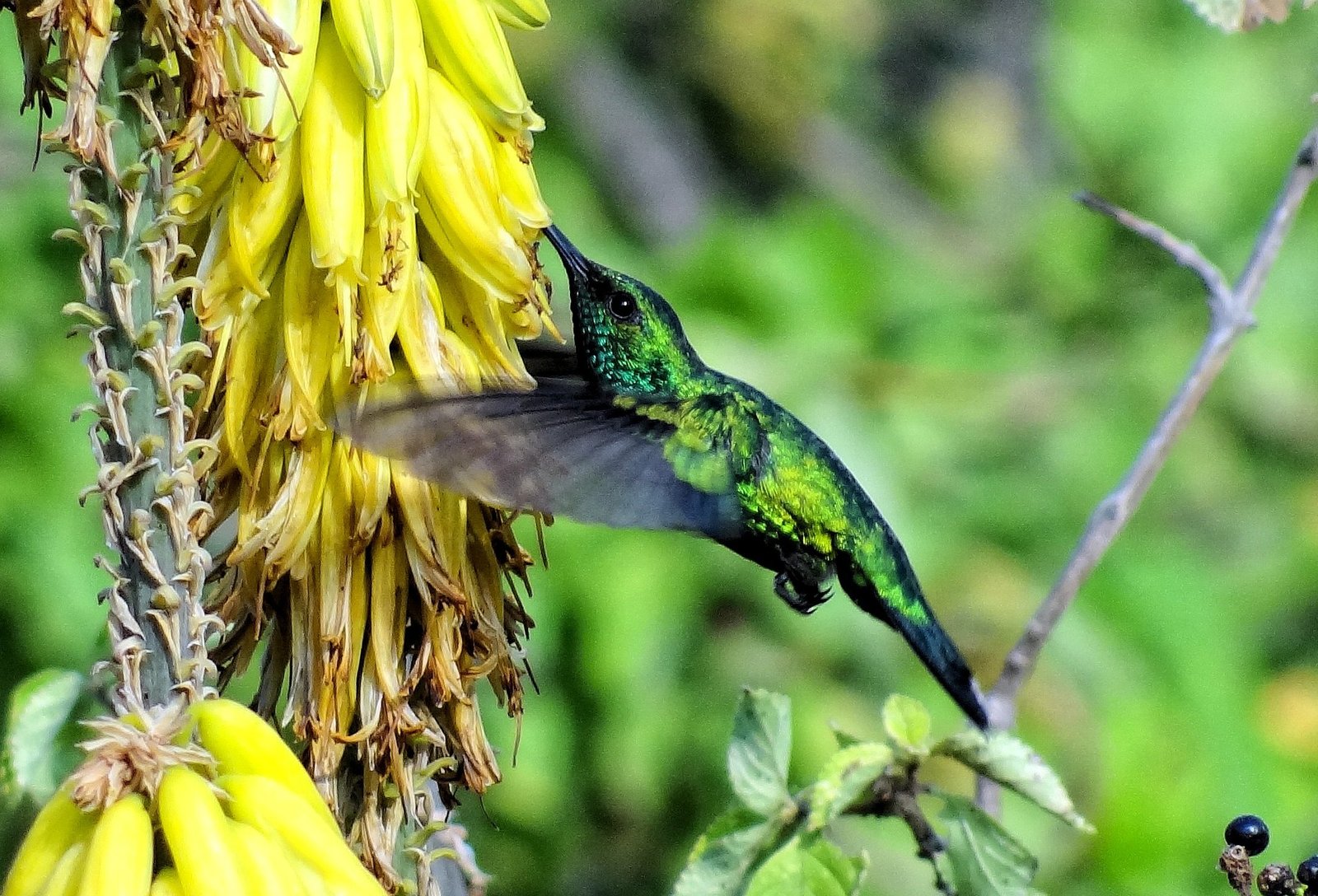
The Blue-tailed Emerald is a small hummingbird of northern South America. In the Caribbean it lives on Aruba, Curaçao, Bonaire and Trinidad, in open, often dry country. Birds of the ABC Islands, Trinidad and northern Venezuela belong to the subspecies caribaeus.
Voice
Repeated tsip or chwep notes, sometimes running into a roll or twitter; also a fairly loud, rasping chirrrt.
Recording: Wim Jacobs — CC BY-NC-SA 4.0 · shortened to the first 60 s, mono · xeno-canto
Identification
7–9 cm, the female smaller than the male, with a short, straight black bill. The male is entirely glittering green, bronzy green above and emerald below, with white thighs and a steel-blue, forked tail. The female is green above and pale grey below, with a blackish mask, a white stripe behind the eye and a blue-black tail with whitish tips.
Confusion species
Blue-chinned Sapphire Chlorestes notata in Trinidad is somewhat larger, with a red lower mandible, a blue chin and a rounded tail. Ruby-topaz Hummingbird Chrysolampis mosquitus is shorter-tailed, the male with a ruby crown and golden throat, the female with a rufous tail. White-chested Emerald Chrysuronia brevirostris is larger and white below.
Habitat
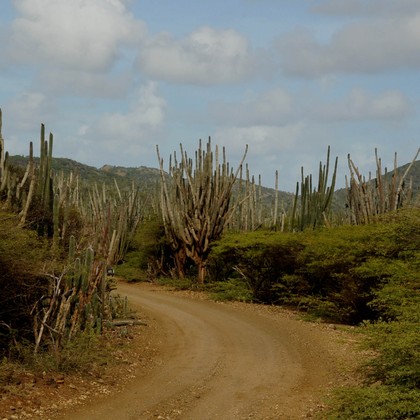
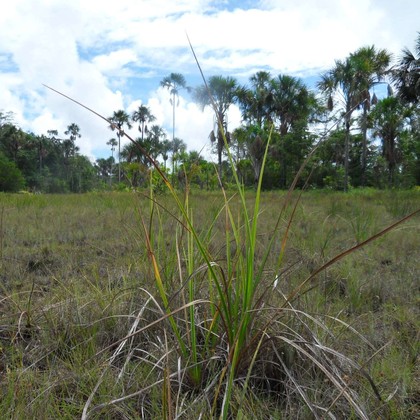
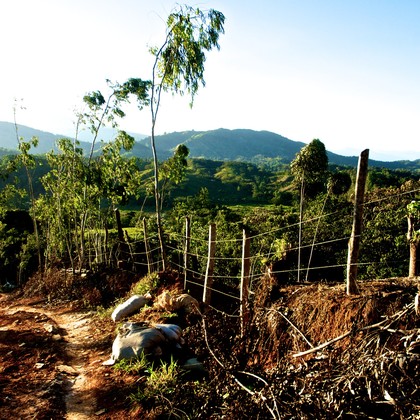
Open and semi-open country: thorn and cactus scrub, savanna, fields and small-scale farmland, gardens, forest edges and dry forest. In Trinidad mainly in moist grassland, savanna and cultivated land with scattered trees. Males defend a feeding territory with diving flights. In Trinidad it breeds from December to May.
Where the bird is most at home, classified by the vegetation types of the Caribbean.



Range and movements
Resident on Aruba, Curaçao and Bonaire, where it is the commonest hummingbird of the dry scrub, and in Trinidad, where it is local and less common; absent from Tobago. Outside the region from Colombia and Venezuela to the Guianas, Amazonia and Bolivia.
- Resident
- Summer visitor (c. Oct–Mar)
- Winter visitor (c. Apr–Sep)
- Passage (Mar–Apr, Oct–Nov)
- dark = core range, pale = thinly spread
How and when to look
On the ABC Islands found in Christoffel Park on Curaçao, Washington Slagbaai on Bonaire and Arikok on Aruba, and in gardens with flowering shrubs. In Trinidad in open country and farmland inland. In sunlight a male is recognisable by its uniformly glittering green and blue tail.
Conservation status
Not threatened. The species has a large range, a stable population and adapts well to man-modified landscapes.
Scientific name
Chlorostilbon mellisugus | (Linnaeus, 1758)
Linnaeus described the species in 1758 as Trochilus mellisugus; because it was later moved to another genus, the author and year stand in brackets. The genus Chlorostilbon was introduced in 1853 by Gould. Chlorostilbon is Greek, from khlōros 'green' and stilbōn 'shining', after the glittering green plumage. mellisugus is Latin, from mel 'honey' and sugere 'to suck': 'honey-sucker', after its nectar feeding. The specimen the first description was based on came from West Indies (unspecified).