All species › Waders, gulls and terns › Avocets and stilts › Black-necked Stilt
Black-necked Stilt | Himantopus mexicanus
Amerikaanse steltkluut | Candelero americano
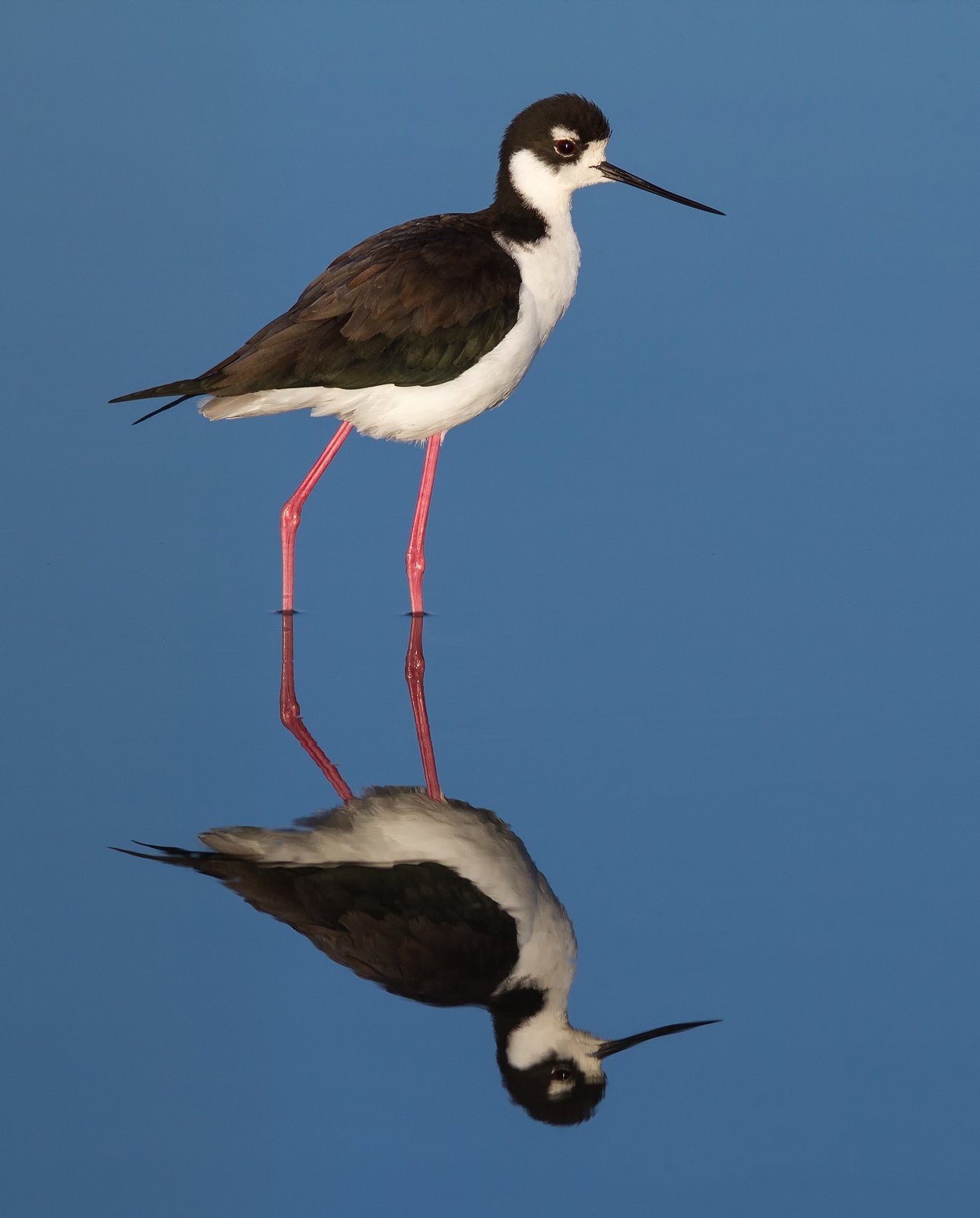
The Black-necked Stilt is a slender, black-and-white shorebird on very long pink legs, with a bill as thin and straight as a needle. In the Caribbean it is a characteristic bird of salt pans, lagoons and freshwater marshes and breeds on nearly all the larger islands. In Cuba it is called cachiporra, in Puerto Rico viuda.
Voice
Noisy. The call is a sharp, yapping kyep or kek, repeated in series, which becomes persistent and urgent when the birds are disturbed in the breeding season; the whole group then joins in. Also often calls in flight.
Recording: José María Loaiza B. — CC BY-NC-SA 4.0 · converted to mono · xeno-canto
Identification
35–39 cm, much of it leg. The upperparts, hindneck and head are glossy black, with a white spot above the eye; foreneck, breast and belly are white. The bill is black, long, thin and straight, the legs bright pink to red. The female has a browner back than the male. Juveniles are grey-brown above with pale feather fringes and have duller pink legs. In flight the wings are entirely black above and below and the legs project far beyond the tail.
Confusion species
Black-winged Stilt Himantopus himantopus, a very rare vagrant, has a white head and hindneck; in that species any black is limited to a patch on the crown and nape, and the white spot above the eye is lacking. American Avocet Recurvirostra americana has an upturned bill, blue-grey legs and white and black in the wing. Greater Yellowlegs Tringa melanoleuca is spotted grey, with yellow legs.
Habitat
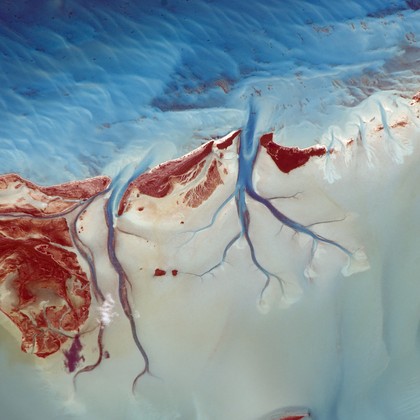
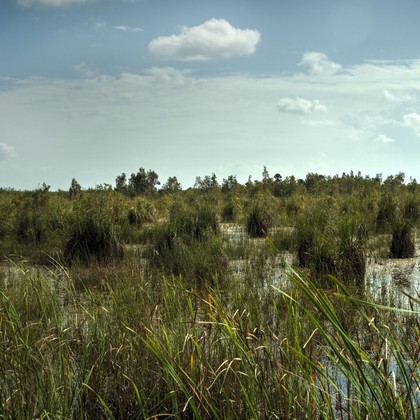
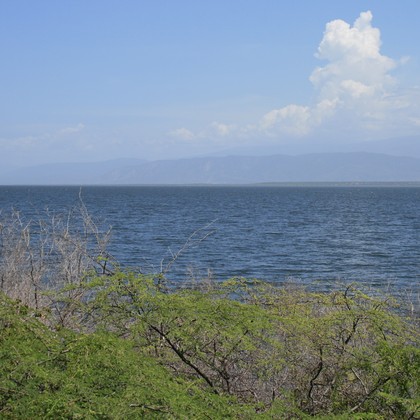
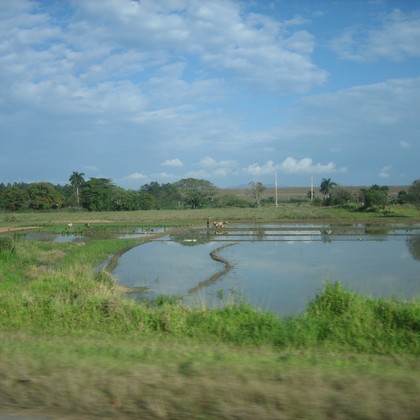
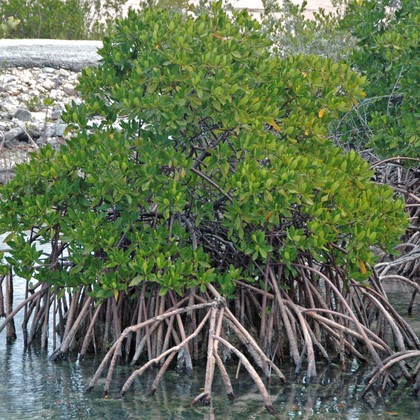
Shallow fresh, brackish and salt water: salt pans, coastal lagoons, mangrove edges, tidal flats, freshwater marshes, sewage ponds, fish ponds and flooded rice fields. It forages by wading in shallow water and picking small prey from the surface and the top layer of mud with its needle-like bill: aquatic insects and their larvae, small crustaceans and small fish. It breeds in loose groups on bare banks, dykes and islets; the nest is a scrape, sometimes on a small pile of plant material.
Where the bird is most at home, classified by the vegetation types of the Caribbean.

Range and movements
Common in Cuba, Hispaniola, Puerto Rico and Jamaica, and widespread in the Bahamas, the Turks and Caicos Islands, the Cayman Islands and the Virgin Islands. Also common on the ABC islands and in Trinidad. In the Lesser Antilles a local breeder, among others on Anguilla, Sint Maarten, Antigua and Guadeloupe; scarce on the more southerly islands and on Barbados, a vagrant on Tobago. On the northern islands part of the population leaves outside the breeding season, while migrants from North America arrive. Also on San Andrés. Beyond the region from the United States through Mexico and Central America to northern and western South America and the Galápagos; Hawaii has its own subspecies.
- Resident
- Summer visitor (c. Oct–Mar)
- Winter visitor (c. Apr–Sep)
- Passage (Mar–Apr, Oct–Nov)
- dark = core range, pale = thinly spread
How and when to look
Almost any salt pan or lagoon with shallow water is a good site, including close to buildings and along roads. In the breeding season the birds announce themselves with their yapping call and fly low around intruders; keeping away from the bare banks and dykes where they nest avoids disturbance.
Conservation status
Not threatened. Locally the species benefits from artificial waters such as salt works, fish ponds and wastewater basins. Filling of coastal lagoons, disturbance at breeding sites and predation of eggs and chicks by introduced mammals are local problems.
Scientific name
Himantopus mexicanus | (Müller, 1776)
Müller described the species in 1776 as Charadrius Mexicanus; because it was later moved to another genus, the author and year stand in brackets. The genus Himantopus was introduced in 1760 by Brisson. Himantopus is Greek, from himas 'strap, thong' and pous 'foot': 'strap-foot', after the long thin legs. mexicanus means 'of Mexico', the country of the type locality. The specimen the first description was based on came from Mexico.