All species › Passerines › New World warblers › Black-and-white Warbler
Black-and-white Warbler | Mniotilta varia
Bonte zanger | Chipe trepador
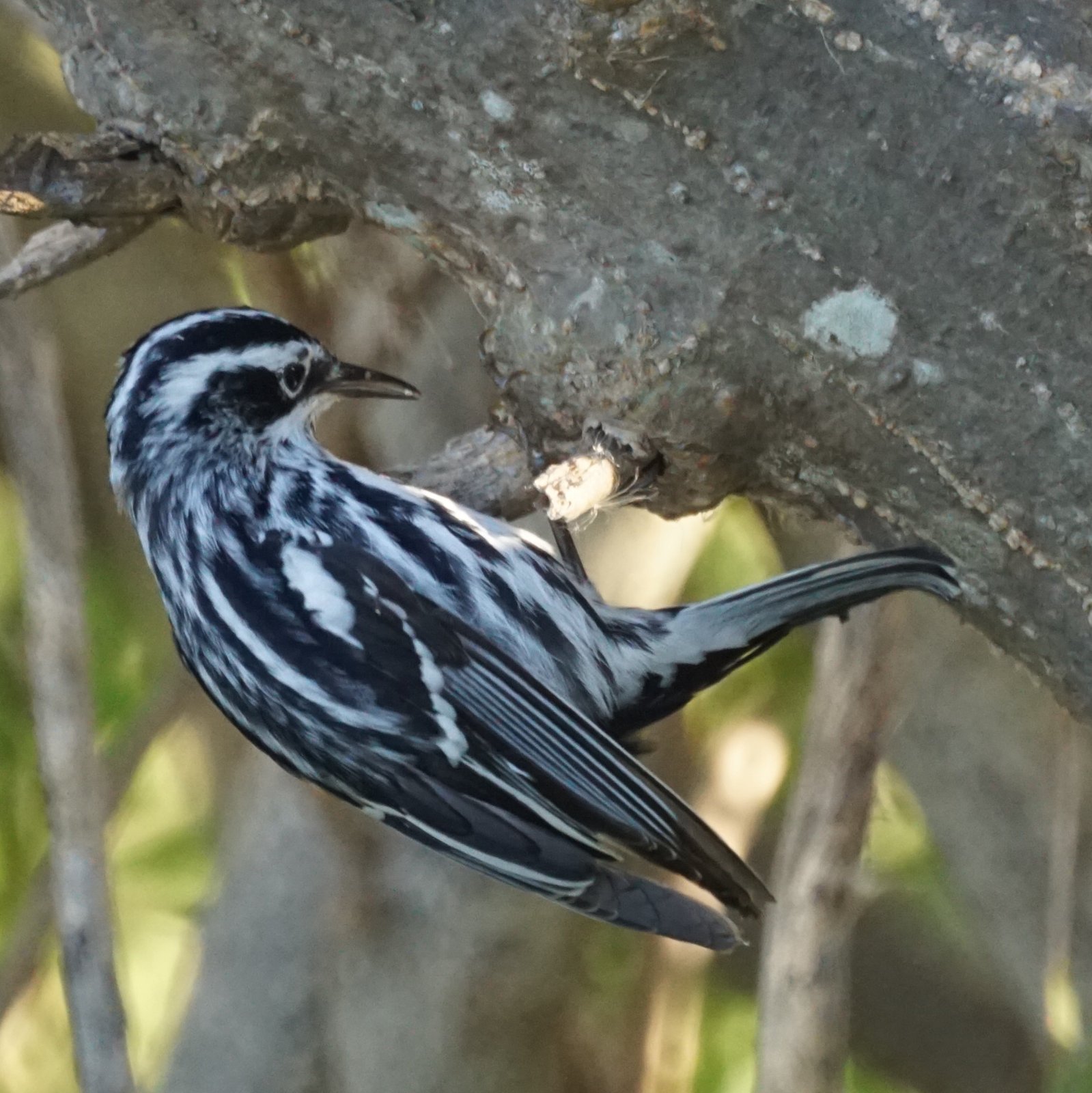
The Black-and-white Warbler is a black-and-white streaked wood-warbler that creeps over trunks and thick branches like a nuthatch, up, down and around. This gives it a niche of its own among warblers, which usually forage among the leaves. In winter it is one of the commonest and most widespread migrant warblers in the Caribbean.
Voice
The call is a sharp chik and a thin tsee. The song, sometimes heard in spring on the islands, is a high, squeaky repetition of two-syllable notes, like weesee weesee weesee weesee, recalling a squeaky wheel.
Recording: Bobby Wilcox — CC BY-NC-SA 4.0 · converted to mono · xeno-canto
Identification
11–13 cm, with a fairly long, slightly decurved bill. The entire plumage is streaked black and white, with a white central crown stripe between two black crown stripes, a white supercilium, two white wing bars and black-spotted undertail coverts. The male has black cheeks and, in breeding plumage, a black throat; in winter the throat is mostly white. The female has grey cheeks, a white throat and paler-streaked, often buff-tinged flanks.
Confusion species
Blackpoll Warbler Setophaga striata in breeding plumage has a solid black cap, white cheeks and a streaked olive-grey back, and forages among leaves rather than on bark. No other warbler in the region combines a striped head with creeping behaviour.
Habitat
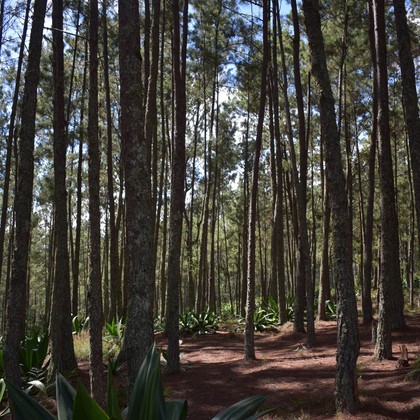
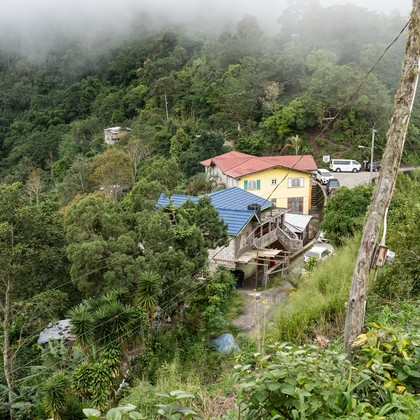
Almost any type of forest: moist, dry and montane forest, pine forest, mangroves and coastal woodland, also shade-coffee plantations, parks and gardens with large trees. It searches bark crevices and moss and epiphytes for insects and spiders, on trunks and branches at all heights. It often joins mixed flocks.
Where the bird is most at home, classified by the vegetation types of the Caribbean.





Range and movements
A common winter visitor in the Bahamas, the Turks and Caicos Islands, Cuba, the Cayman Islands, Jamaica, Hispaniola (Haiti and the Dominican Republic), Puerto Rico and the Virgin Islands. Less common in the Lesser Antilles, decreasing southwards; scarce on Trinidad and Tobago and the ABC Islands. Also on San Andrés. Breeds in Canada and the eastern United States and winters from the southern United States through Mexico, Central America and the Caribbean to north-western South America.
- Resident
- Summer visitor (c. Oct–Mar)
- Winter visitor (c. Apr–Sep)
- Passage (Mar–Apr, Oct–Nov)
- dark = core range, pale = thinly spread
How and when to look
Best found in mixed flocks in almost any forest in the Greater Antilles, also in hotel grounds and parks. A black-and-white streaked bird moving jerkily down a trunk is this species.
Conservation status
Not threatened. The population is large but, according to North American breeding bird surveys, slowly declining; forest loss on the breeding and wintering grounds plays a part.
Scientific name
Mniotilta varia | (Linnaeus, 1766)
Linnaeus described the species in 1766 as Motacilla varia; because it was later moved to another genus, the author and year stand in brackets. The genus Mniotilta was introduced in 1816 by Vieillot. Mniotilta is Greek, from mnion 'moss' and tillō 'to pluck': 'moss-plucker', after its foraging for insects on mossy trunks and branches. varia is Latin for 'variegated', after the black-and-white striped plumage. The specimen the first description was based on came from Hispaniola (Santo Domingo).