All species › Waders, gulls and terns › Plovers and lapwings › American Golden Plover
American Golden Plover | Pluvialis dominica
Amerikaanse goudplevier | Chorlito dorado americano
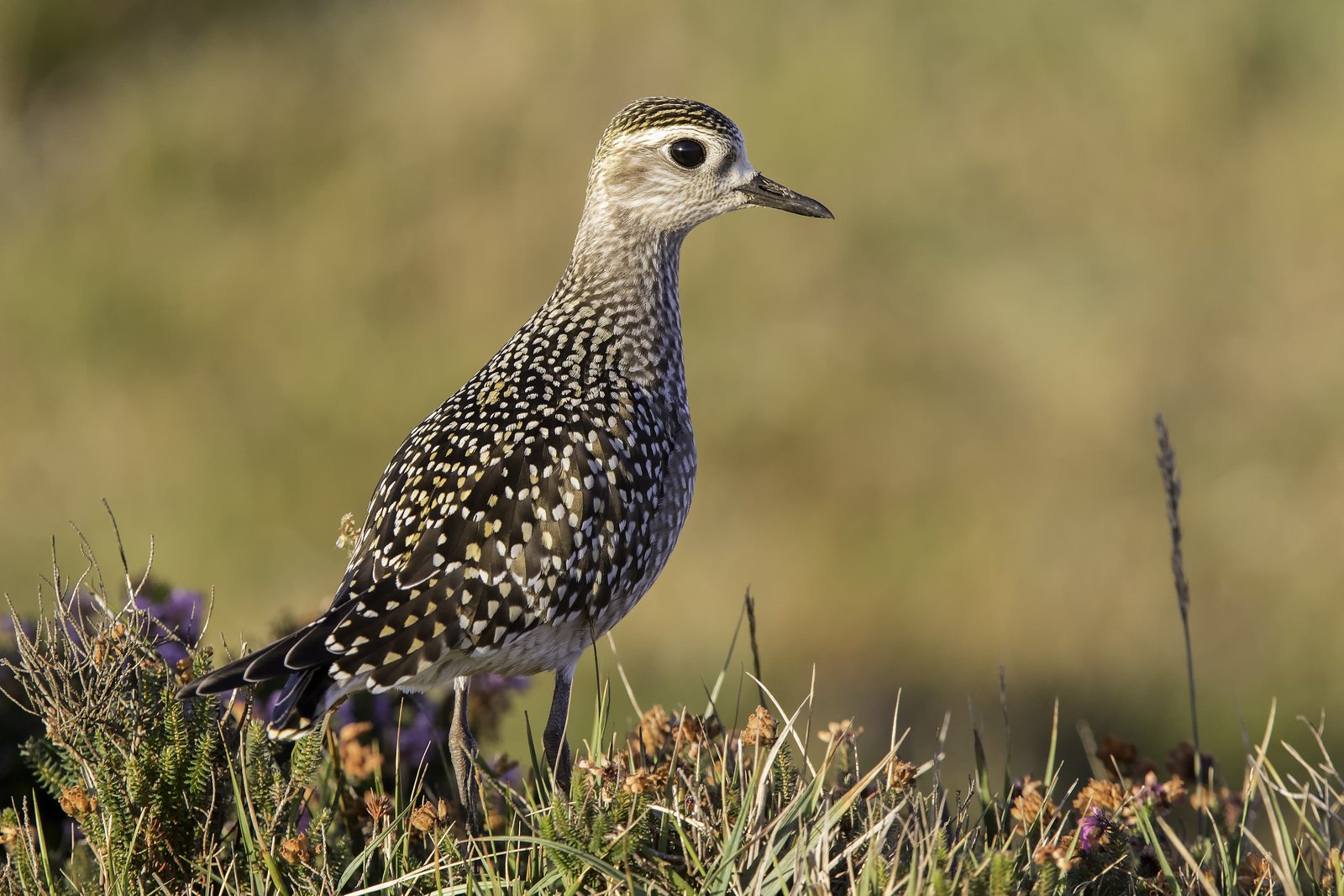
The American Golden Plover is a slim, long-winged plover of open grassland that makes one of the longest migrations of any bird. In autumn it flies non-stop from the Canadian tundra over the Atlantic to South America; in spring it returns through the interior of North America. In the Caribbean it is therefore mainly an autumn migrant, which drops onto the islands in flocks in bad weather.
Voice
A clear, disyllabic kwee-dl or klee-oo, stressed on the first syllable; also a short kweep. Flocks often call on take-off.
Recording: Doug Hynes — CC BY-SA 4.0 · converted to mono · xeno-canto
Identification
24–28 cm. Smaller and slimmer than Grey Plover, with a small round head, a short, thin bill and long wings that extend well beyond the tail at rest; the primary projection usually shows four or five tips. In autumn grey-brown with fine golden or pale spots on the upperparts, a pale supercilium, a dark crown and a greyish mottled breast. Adults may still show remnants of breeding plumage in August and September: black from face to undertail coverts, with a broad white band along the head and side of the neck. In flight a faint wing bar, a dark rump and a uniformly grey underwing.
Confusion species
Grey Plover Pluvialis squatarola is larger and bulkier, with a heavier bill, a white rump and black axillaries. Pacific Golden Plover Pluvialis fulva, a very rare vagrant, is slightly smaller, with longer legs, a shorter primary projection (usually two or three tips beyond the tertials) and often a warmer golden tone; in breeding plumage it shows white on the flanks and undertail. Single birds can only be identified with a good view of these features.
Habitat
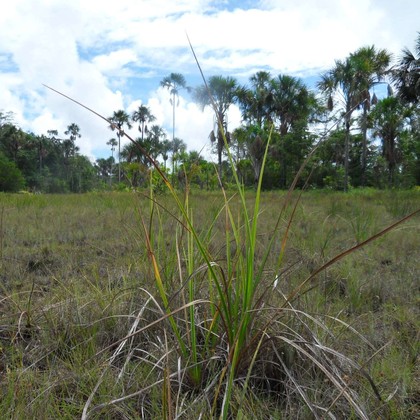
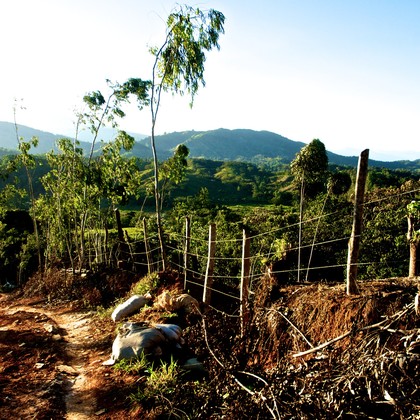
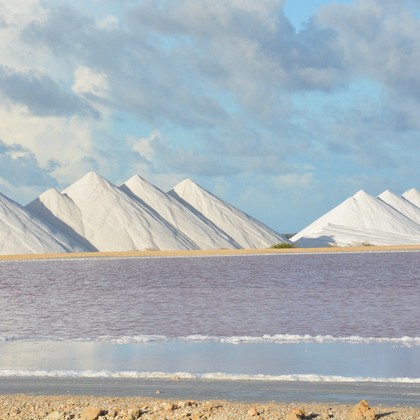
On migration mainly short grassland: pastures, playing fields, golf courses, airfields and drying salt pans, less often tidal flats. In the region also at marshy grasslands and drained ponds. It feeds scattered, in plover fashion, and in the heat often rests in groups on open, bare ground.
Where the bird is most at home, classified by the vegetation types of the Caribbean.
Range and movements
Passage migrant throughout the region, most numerous in the east: in the Lesser Antilles, with Barbados, Guadeloupe and Martinique as well-known sites, and in Trinidad and Tobago. Regular in the ABC Islands, Puerto Rico and the Virgin Islands, scarcer in the Greater Antilles, the Cayman Islands, the Bahamas and the Turks and Caicos Islands. Numbers vary strongly from year to year and are highest when storms or north-east winds push migrants onto the islands. Beyond the region it breeds in Alaska and Arctic Canada and winters on the pampas of Argentina, Uruguay and southern Brazil.
- Winter visitor (c. Apr–Sep)
- Passage (Mar–Apr, Oct–Nov)
- dark = core range, pale = thinly spread
How and when to look
After a passing weather system in September, short grasslands, airfields and golf courses in the Lesser Antilles are worth searching; on Barbados the flooded grasslands and shooting ponds are also much used by shorebirds. Flocks often sit hidden in the grass and only show themselves when they fly up.
Conservation status
Not globally threatened, but the population declined sharply in the twentieth century through mass shooting and later through loss of grassland along the flyway and on the wintering grounds. On Barbados and in the French Antilles golden plovers and other shorebirds were traditionally shot in large numbers; agreements and restrictions on hunting have since been introduced there.
Scientific name
Pluvialis dominica | (Müller, 1776)
Müller described the species in 1776 as Charadrius Dominicius; because it was later moved to another genus, the author and year stand in brackets. The genus Pluvialis was introduced in 1760 by Brisson. Pluvialis is Latin for 'relating to rain', from pluvia 'rain', from the old belief that these plovers flocked when rain was imminent. dominica refers to Santo Domingo, the island now called Hispaniola, in the West Indies. The specimen the first description was based on came from Hispaniola.