All species › Waterfowl › Ducks and geese › American Black Duck
American Black Duck | Anas rubripes
Amerikaanse zwarte eend | Pato negro americano
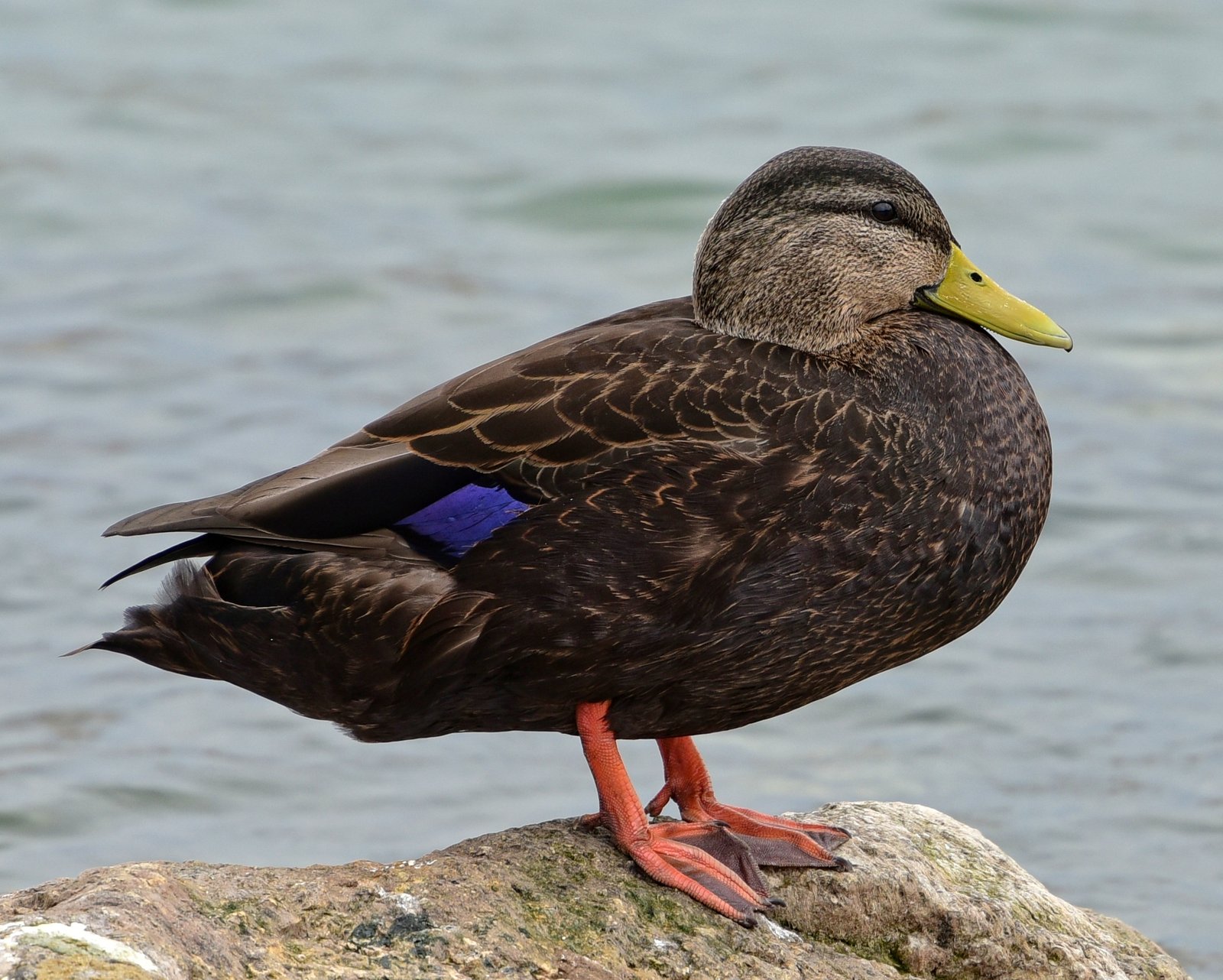
The American Black Duck is the dark relative of the Mallard from eastern North America, in which male and female are almost alike. It winters largely in the eastern United States and reaches the Caribbean only rarely.
Voice
Like that of the Mallard: the female quacks loudly in a descending quack-quack-quack, slightly rougher in tone; the male gives a hoarse raeb.
Recording: Stanislas Wroza — CC BY-NC-SA 4.0 · converted to mono · xeno-canto
Identification
54–59 cm, the size of a Mallard. Both sexes are dark chocolate-brown on the body, with a distinctly paler, finely streaked greyish-brown head and neck and a dark crown and eye-stripe. The male has a plain olive-yellow bill, the female a duller greenish-grey bill with dark spots. The legs are orange-red. In flight the dark body contrasts with the bright white underwings; the speculum is purplish-blue, with no or only a very narrow white trailing border.
Confusion species
Female Mallard Anas platyrhynchos is paler and more mottled brown, with an orange bill with a dark saddle and a speculum with a broad white border on both sides. Hybrids with Mallard are numerous in North America and show features of both; a dark duck in the region therefore deserves a careful look at the speculum, bill and head.
Habitat
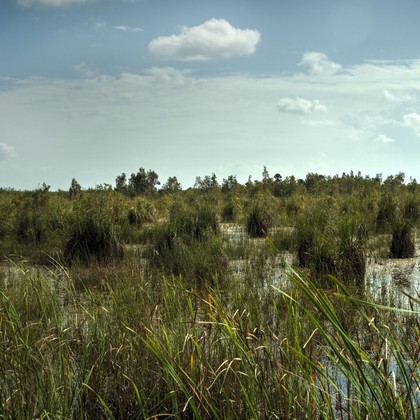
Fresh and brackish water: lakes, ponds, marshes and coastal lagoons. In North America in winter chiefly in tidal marshes and estuaries. In the region usually among other ducks.
Where the bird is most at home, classified by the vegetation types of the Caribbean.


Range and movements
A very rare visitor to the region: a casual winter visitor to Cuba, with scattered records from a few other islands in the north of the region; the number of occurrences is small. Breeds in north-eastern North America and winters chiefly in the eastern United States, in the largest numbers along the Atlantic coast.
- Resident
- dark = core range, pale = thinly spread
How and when to look
Any distinctly dark duck among migrant ducks in the north of the region is worth checking; white underwings in flight and a speculum without broad white borders are the key features.
Conservation status
Least Concern. The species declined steeply in the twentieth century through hunting, wetland loss and hybridisation with the Mallard, which spread into eastern North America; numbers have stabilised since the end of that century.
Scientific name
Anas rubripes | Brewster, 1902
Brewster described the species in 1902 and placed it straight away in the genus where it still stands. The genus Anas was introduced in 1758 by Linnaeus. Anas is the Latin word for 'duck'. rubripes is Latin, from ruber 'red' and pes 'foot', after the orange-red legs. The specimen the first description was based on came from Lake Umbagog, New Hampshire, United States.