All species › Passerines › Buntings › Yellowhammer
Yellowhammer | Emberiza citrinella
Geelgors | Escribano cerillo
The Yellowhammer is the bunting of small-scale farmland, with a sulphur-yellow head and a rusty rump that flares as it flies off. Its thin, repeated phrase is heard even on hot June afternoons over hedges and hedgebanks.

Click a thumbnail to switch the photo above.
Voice
The song is a thin, metallic series of identical notes running into a single drawn-out high or low final note, classically rendered tsi-tsi-tsi-tsi-tsi-tsi-tseeee; heard from March well into August, including through the heat of midday. Calls: a sharp short tsik and a ringing tsyu.
Recording: Benoît Van Hecke — CC BY-SA 4.0 · Wikimedia Commons
Identification
Slim and long-tailed, with white outer tail feathers and a warm chestnut rump shown by no other bunting. The summer male has an almost unmarked bright yellow head and yellow underparts, with chestnut streaking on breast and flanks. The female is duller, with more dark head streaking and a less saturated yellow ground colour. Juveniles are brown and finely streaked but already show the rusty rump.
Confusion species
Cirl Bunting is the critical species in southern Europe: it has an olive-grey rump instead of chestnut, and the male shows a black throat stripe, a black eyestripe and an olive breast band. For females and immatures the rump colour always settles it. Ortolan has a yellow eyering and yellow throat against a grey-green head.
Habitat
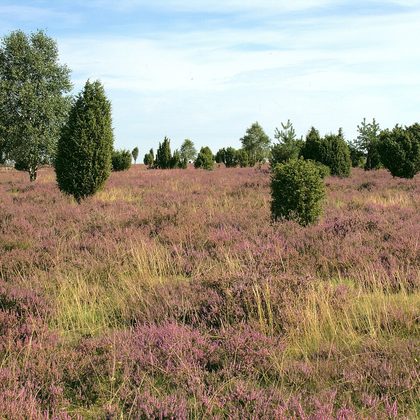
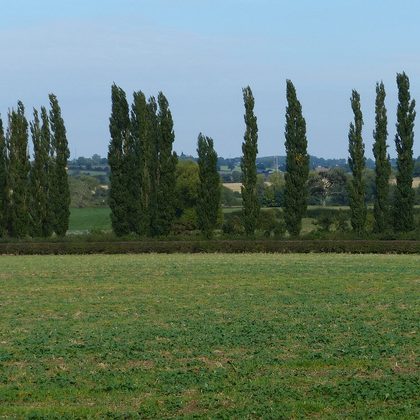
Small-scale farmland with hedges, hedgebanks, rough verges and unfarmed corners, plus heathland with scattered birches and pines, young plantations and clear-fells. It needs song posts at bush or wire height, cover close to the ground and seed-rich rough vegetation, in winter too.
Where the bird is most at home, classified with EUNIS — the European standard for habitats.


Range and movements
Breeds from Scandinavia and the British Isles to central Europe and the Balkans; northern birds move south and winter as far as the southern Balkans, Anatolia and the Levant. In the Low Countries mainly on the sandy soils of the east and south, scarce in the west. Around the Mediterranean it is confined to the northern half of Iberia — Pyrenees, Cordillera Cantábrica, Sistema Ibérico and the northern meseta — and absent from the south.
- Resident
- Breeding (summer)
- Winter
- Passage
- dark = core range, pale = thinly spread
How and when to look
Look in May and June during the hottest part of the afternoon, when other birds fall silent and the Yellowhammer sings on: walk or cycle a hedgebank and listen for that final drawn-out note. In winter search stubbles and freshly muck-spread fields, where small parties join finches and Tree Sparrows.
Conservation status
Not globally threatened (IUCN: Least Concern), but sharply reduced in western Europe through field enlargement, the loss of hedges and odd corners, and the disappearance of winter stubbles. In the Low Countries it holds on across the sandy soils while having vanished from many arable districts.
Scientific name
Emberiza citrinella | Linnaeus, 1758
Linnaeus described the species in 1758 and placed it straight away in the genus where it still stands. He introduced the genus Emberiza in that same work. Emberiza comes from Old German Embritz, a name for a bunting. citrinella is Italian for a small yellow bird. The specimen the first description was based on came from Sweden.