All species › Passerines › Bulbuls › White-Eared Bulbul
White-Eared Bulbul | Pycnonotus leucotis
Witoorbuulbuul | Bulbul orejiblanco
The White-Eared Bulbul is the garden bird of the Gulf: in Kuwait City, Basra and along the eastern Gulf coast it sits on every fence and in every date palm. It belongs in the south-eastern corner of the map area, and is the only bulbul that the Middle East contributes to this guide as a native breeder.
Voice
More chattering than singing: a short, slightly nasal and quickly repeated witchee-yoo or kwitcher-weet, in which the third or fourth note jumps conspicuously high. There is also a run of short, tinny contact notes between members of a party. The species mimics other birds. Heard most in the early morning and the last hour before dark, all year.
Recording: David Darrell-Lambert — CC BY-NC-SA 4.0 · Wikimedia Commons
Identification
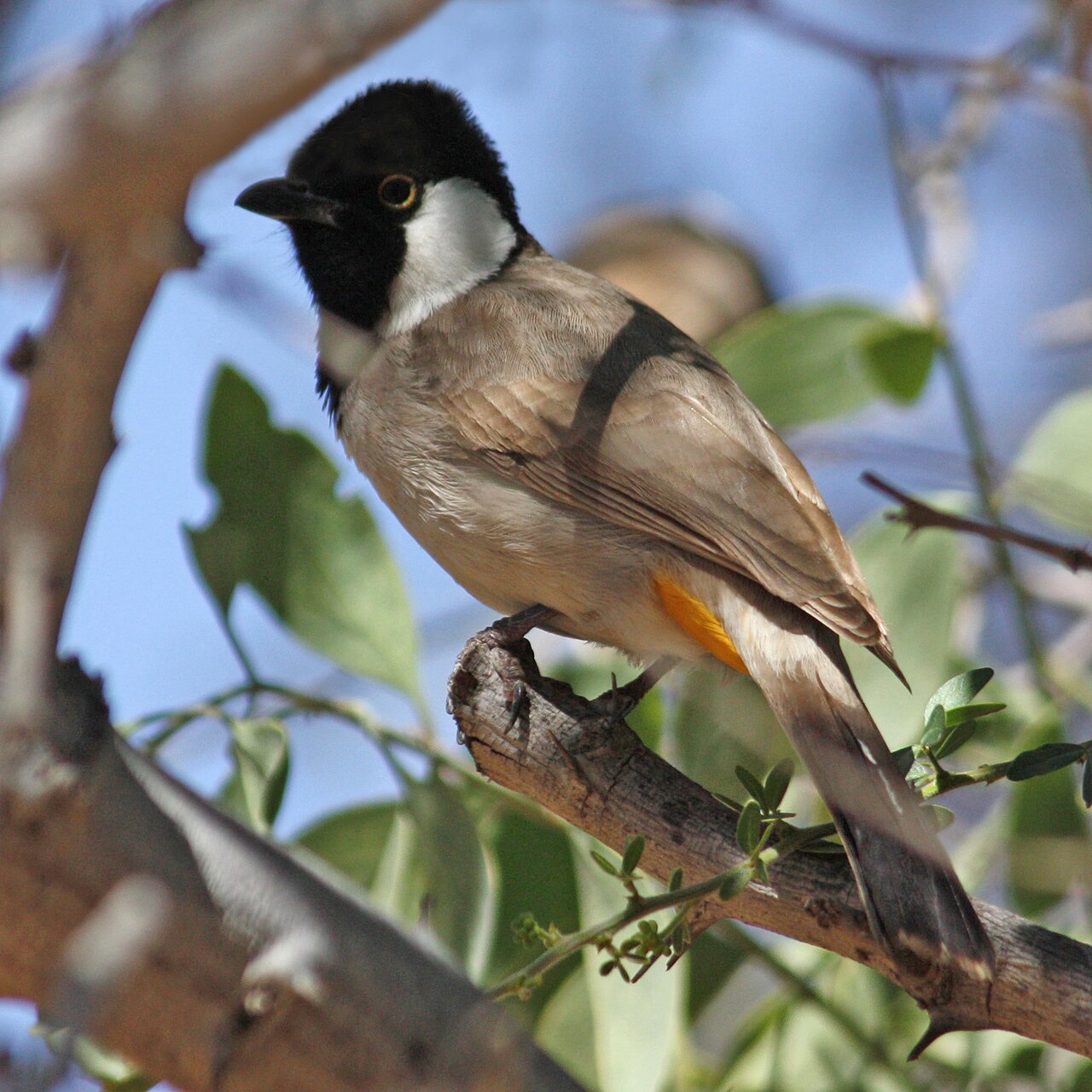
A small, compact bulbul with a short neck and a medium-length tail. The head is deep glossy black, from the base of the bill over crown, cheeks and throat to a sharp border on the upper breast. Set into it like a lamp is the large, oval, pure white ear patch — the mark everything rests on. Upperparts are plain grey-brown, underparts pale buff-grey, and under the tail a bright yellow patch flares as the bird flies off. The tail is dark brown to black with white tips to the outer feathers. The bill is short and black, the eye dark with a narrow bare grey ring. Sexes alike. Juveniles have a brown rather than black head, a duller ear patch and much paler yellow beneath the tail. There is no crest; at most the crown feathers are briefly raised.
Confusion species
In the overlap zone in southern Mesopotamia and the adjoining Zagros foothills, White-Spectacled Bulbul is the only real pitfall: it is larger and longer-tailed, has a dark brown rather than black head, lacks the white ear patch altogether and instead shows a thin white ring around the eye. Both species have yellow undertail coverts, so that mark decides nothing — look at the cheek. Further east, in the north of the Indian subcontinent, Himalayan Bulbul takes over, with a pointed brown crest and an off-white rather than snow-white cheek patch. Red-Whiskered Bulbul always shows a tall black crest, a red cheek spot and red undertail coverts.
Habitat
Shrubs, gardens and stands of trees in otherwise dry country: town gardens and parks, date palm groves, citrus and pomegranate plantations, tamarisk and oleander scrub along canals and rivers, field edges and the reed fringes of the Mesopotamian marshes. Also semi-desert where there is water and bush, and mangrove along the Gulf coast. Food is fruit, blossom, nectar and insects, taken from perches the birds like to keep high and open. The nest is a cup of twigs and plant fibre in a shrub or date palm one to three metres up, sometimes in a shed or under a canopy.
Where the bird is most at home, classified with EUNIS — the European standard for habitats.





Range and movements
The core is the Euphrates and Tigris basin — Mesopotamia and the head of the Gulf as far as Bahrain — plus the eastern Gulf coast and the Zagros foothills; from there the range runs on eastwards through the southern Iranian Plateau and the Indus plain to the north-west of the Indian subcontinent, so a good part of it lies outside the map area. Elsewhere on the Arabian Peninsula the populations go back to escaped birds; records in the Levant probably concern escaped cage birds as well.
- Resident
- Winter
- Passage
- dark = core range, pale = thinly spread
How and when to look
Any city park or hotel plot in Kuwait City, Basra or Bandar Abbas will produce the species within a quarter of an hour; watch for parties of five to thirty birds moving noisily from bush to bush. For a good photograph it pays to wait at a drip line or a garden fountain: bulbuls come there to drink and bathe in the midday heat, and then the white ear patch and the yellow vent appear in one frame.
Conservation status
Not globally threatened (IUCN: Least Concern) and clearly on the increase around the Gulf, helped by planting, irrigation and urban greenery. At the same time the species is trapped in numbers for the cage-bird trade in Mesopotamia and at the head of the Gulf, and that trapping, together with the loss of gardens and scrub, depresses local numbers. In the Mesopotamian marshes it depends, like everything there, on water levels and on the reed fringes that returned after re-flooding.
Scientific name
Pycnonotus leucotis | (Gould, 1836)
Gould described the species in 1836 as Ixos leucotis; because it was later moved to another genus, the author and year stand in brackets. The genus Pycnonotus was introduced in 1826 by Boie. Pycnonotus is Greek, from puknos 'thick, compact' and -nōtos '-backed', from nōton 'back', after the dense plumage of the back. leucotis is Greek for 'white-eared', from leukos 'white' and ous, ōtos 'ear', after the white cheek patch. The specimen the first description was based on came from Karachi, Pakistan.