All species › Passerines › Reed warblers › Upcher's Warbler
Upcher's Warbler | Hippolais languida
Grote vale spotvogel | Zarcero escita
The tree warbler of stony desert: a grey, long-tailed bird of arid slopes in south-east Anatolia, the Caucasus and the Levant, forever swinging its blackish tail sideways and pressing it down. That movement is distinctive and gives it away before any colour does. It sings in the open from the top of a bush, which makes it one of the easiest tree warblers to actually see.
Voice
The song is a run of short Acrocephalus-like phrases with clear, almost fluty notes among them, slower and purer than the faster song of Eastern Olivaceous. It often starts from a bush top and turns into a song flight — a slow flapping climb, then a diagonal glide down on spread wings. The call is a deep, soft tcheck or tak, often in short series. Song from late April into July, including the middle of the day.
Recording: Stanislas Wroza — CC BY-NC-SA 4.0 · Wikimedia Commons
Identification
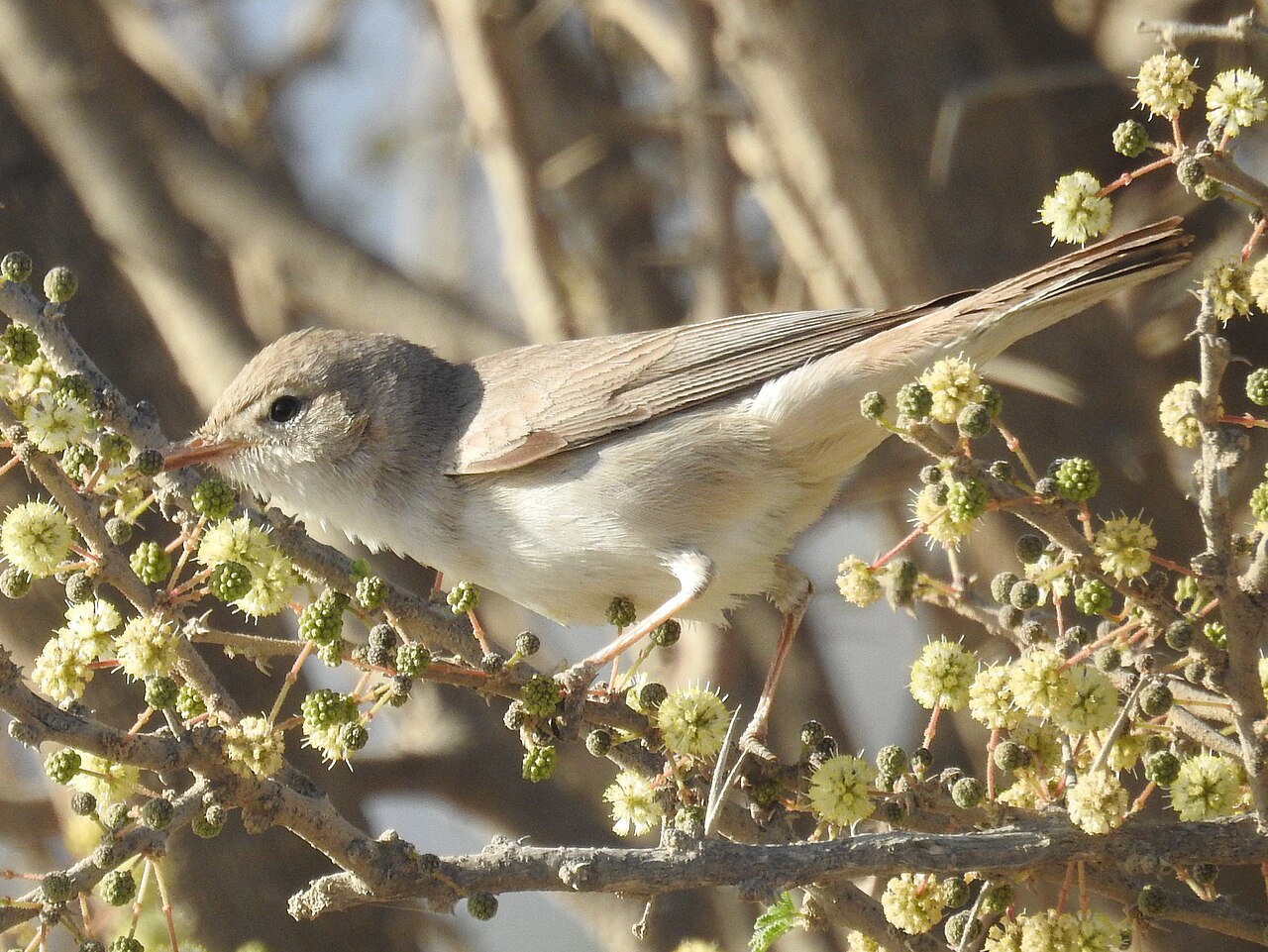
Larger and greyer than the olivaceous warblers, with a long heavy bill showing an orange lower mandible and a pale supercilium above a white eye-ring. Head and neck are distinctly grey and contrast with the browner mantle. Underparts white with a cream or grey-brown wash along the flanks. The tail decides it: long, broad and blackish-brown with white edges and tips to the outer feathers, so that it looks darker than the back — in the olivaceous warblers the tail is the same brown as the back. A pale panel shows on the secondaries; legs are stout and fleshy grey. Sexes alike.
Confusion species
Icterine and Melodious Warblers are settled at once: both are smaller, greener or yellower, and never show a blackish tail. The real problem is Eastern Olivaceous Warbler, which breeds alongside it in Anatolia and the Levant: that bird is smaller and more compact, warmer brown, lacks the grey head against a brown mantle, has a tail concolorous with the back, and dips its tail downwards only, never sideways. Olive-Tree Warbler is a size larger, heavier still in the bill, and has a pale grey rather than dark tail.
Habitat
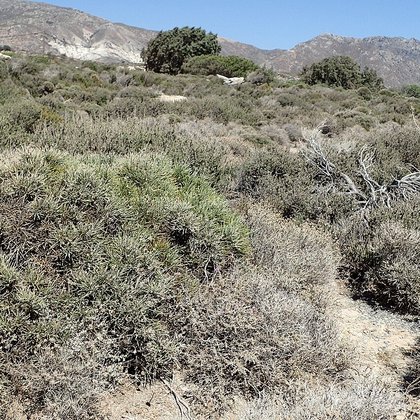
Dry and semi-desert slopes with scattered low bushes, stony hills, wadis with tamarisk and oleander, and field edges with vines and fruit trees. It always needs bushes to nest in and to sing above, but no woodland; in the mountains of Anatolia and the Iranian plateau it reaches well over two thousand metres.
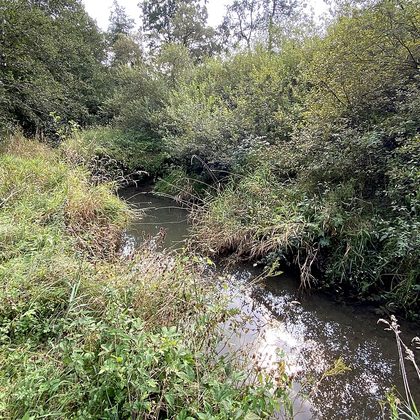
Where the bird is most at home, classified with EUNIS — the European standard for habitats.


Range and movements
Breeds in south-east Anatolia and the Levant, in the southern Caucasus, and eastwards across the Iranian plateau to Central Asia. Within the area of this guide it is therefore an ordinary breeding bird of the eastern margin, Anatolia and the Levant, and not a vagrant at all: it hardly ever strays into Europe. It winters in eastern Africa.
- Breeding (summer)
- Passage
- dark = core range, pale = thinly spread
How and when to look
May, mid-morning, on a stony slope with scattered bushes in the Golan, the Beqaa valley or south-east Anatolia. Scan the tallest bush on the slope: the singing bird is usually right on top of it, in full view. Keep watching until it moves the tail — the sideways swing, rather than a simple downward dip, is the mark that separates it from the olivaceous warblers.
Conservation status
Not threatened and still widespread across its range, with a stable population. Overgrazing of the shrub layer, the conversion of dry slopes to irrigated farmland and the flooding of valleys behind new dams eat into its habitat locally, but its taste for poor, half-abandoned ground leaves it less exposed than most birds of the same country.
Scientific name
Hippolais languida | (Hemprich & Ehrenberg, 1833)
Hemprich & Ehrenberg described the species in 1833 as Curruca languida; because it was later moved to another genus, the author and year stand in brackets. The genus Hippolais was introduced in 1827 by Conrad von Baldenstein. Hippolais goes back to Greek hupolais, a small bird mentioned by Aristotle, misspelt by Linnaeus; the word may be onomatopoeic or formed from hupo 'under' and laas 'stone'. languida is Latin for 'languid, listless'. The specimen the first description was based on came from Syria.