All species › Passerines › Reed warblers › Sedge Warbler
Sedge Warbler | Acrocephalus schoenobaenus
Rietzanger | Carricerín común
The most hurried singer in the marsh: a streaked Acrocephalus with a broad pale supercilium that delivers a hurried, scratchy phrase and halfway through launches into a short slanting song flight.

Voice
A hurried, continuously rattling phrase, much rougher than a Reed Warbler's: dry scratches and grating notes alternate abruptly with clear whistles and buzzing trills, without a settled rhythm and without the Reed Warbler's endless repetition — something like cherk-cherk-cherk-trrrrr-tsee-tsee-weedweedweed-krrrr, growing faster and louder until it stops dead. It sings in the open from a reed stem or bush top and regularly rises in a short slanting song flight, parachuting back with the tail spread while still singing. Heard from late April to early July, peaking in May, with much night song. Call: a hard tchek and, in alarm, a clattering rattled tcherrr.
Recording: Hannu Varkki — CC BY-SA 4.0 · Wikimedia Commons
Identification
Upperparts warm olive-brown with clear dark streaks on the mantle; the crown is dark and streaked, with no pale central stripe. The most striking feature is the broad, creamy to off-white supercilium, which runs well behind the eye and is bordered above by a dark line. The rump is unstreaked and warm rusty brown and lights up as the bird dives back into cover. Underparts off-white with buff flanks, unstreaked in adults; autumn juveniles are yellower and often show a fine gorget of streaks across the breast. Legs grey-brown, primary projection short, tail rounded.
Confusion species
Aquatic Warbler is the key one and the hard one: it has a broad pale crown stripe between two crisp black bands, a finely streaked rump and two pale braces down the back. Sedge Warbler has streaks only on the mantle, a uniformly dark crown and a plain rusty rump. Savi's Warbler resembles an unstreaked Sedge Warbler in shape, with a plain brown crown, a vague supercilium and a strongly graduated tail with long undertail coverts, and reels rather than scratches. Reed and Marsh Warblers are wholly unstreaked above and have a short, faint supercilium. A juvenile Sedge Warbler on a saltmarsh is occasionally called a Zitting Cisticola; the cisticola is far smaller with a short white-tipped tail.
Habitat
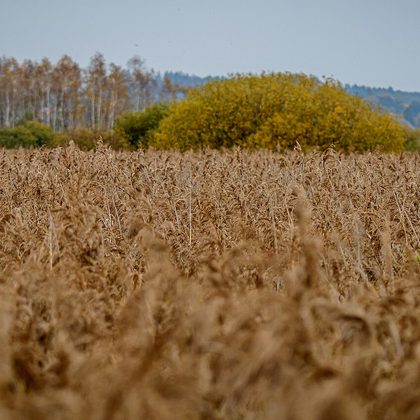
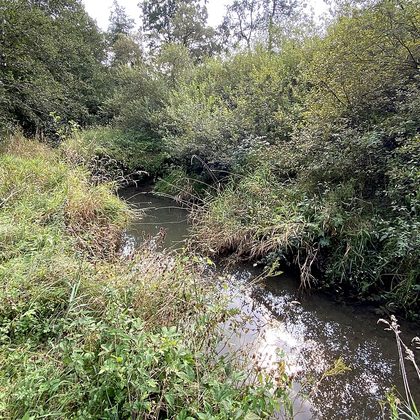
Low, varied, wet vegetation with some upright structure: reed fringes along ditches and canals, damp rank herbage with willow scrub, marshy shores, sedge beds, peat pools, polder reed and wet dune slacks. Unlike Reed Warbler it is not tied to reed standing in water, but it does need an untidy mixture of reed, herbage and low bushes with song posts sticking up above the rest.
Where the bird is most at home, classified with EUNIS — the European standard for habitats.

Range and movements
Breeds across almost all of Europe east into western Siberia. On the southern North Sea coast it is common in peat marsh, polder land, the Delta and the Wadden area, present from late April to September. Every bird crosses the Sahara to the West African Sahel, where survival depends directly on rainfall. In Iberia it breeds sparsely in the north and the interior, but in August and September the coastal marshes, rice fields and riverine reedbeds fill with migrants gorging on reed aphids to cross the desert in a single hop.
- Breeding (summer)
- Passage
- dark = core range, pale = thinly spread
How and when to look
Mid May, shortly after sunrise, along a reed-fringed ditch in peat marsh or polder: this is when it sings in the open and performs the song flight. Walk slowly and check every bird for the broad pale supercilium and for the warm, plain rump as it drops into cover. If you want Aquatic Warblers, work through every Sedge Warbler in August with the crown and the rump in mind; that discipline is exactly what turns up the rarity.
Conservation status
Not threatened (LC) and broadly stable in Europe, but numbers swing with Sahel rainfall: after dry years the population collapses, after wet ones it recovers within two or three seasons. On the breeding grounds, drying out, annual mowing of ditch banks and the loss of small reed fringes in farmland are the main pressures.
Scientific name
Acrocephalus schoenobaenus | (Linnaeus, 1758)
Linnaeus described the species in 1758 as Motacilla schoenobaenus; because it was later moved to another genus, the author and year stand in brackets. The genus Acrocephalus was introduced in 1811 by Naumann & Naumann. Acrocephalus is Greek, from akros 'topmost, pointed' and kephalē 'head'; the Naumanns, who introduced the genus, called these birds Spitzkopf 'pointed head', so they read akros as 'pointed'. schoenobaenus is Greek, from skhoinos, 'reed', and bainō, 'to tread'; it translates the old Swedish name Sävstigare. The specimen the first description was based on came from southern Sweden.