All species › Passerines › Reed warblers › Aquatic Warbler
Aquatic Warbler | Acrocephalus paludicola
Waterrietzanger | Carricerín cejudo
The only globally threatened songbird breeding on the European mainland, and one of the rarest birds on the North Sea coast. To see it there you must stand in the right reedbed in August: the entire western population then filters along a narrow corridor beside the North Sea on its way to West Africa.
Voice
Song: a simple two-part phrase, slower and less hurried than a Sedge Warbler's — first a series of dry rattling rerrr-rerrr-rerrr, then a short run of clear whistled dyu-dyu-dyu, then back to the start, with silences between and no song flight. It sings from a sedge tussock or grass stem on the breeding grounds in May and June, often at dusk and through the night, since males sing to attract females in a mating system without territories. On passage in Europe it is virtually silent; at most a short hard tchek or a rattling trrrt from the reed base.
Recording: Kevin Guille — CC0 · xeno-canto
Identification
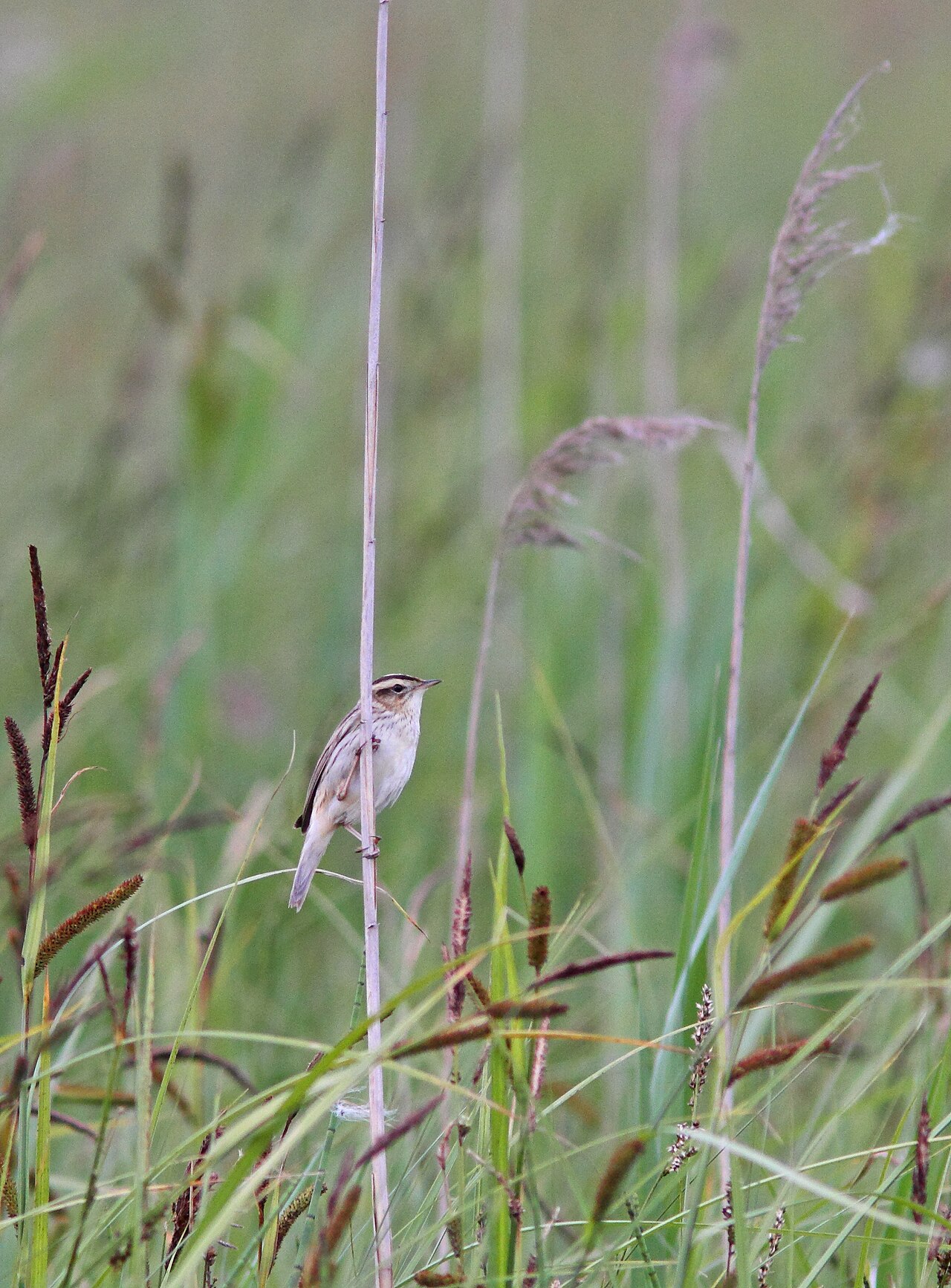
The size and shape of a Sedge Warbler, but more contrasting and much yellower throughout. The head settles it: a broad creamy-yellow crown stripe between two sharply defined black lateral crown bands, and below that an equally broad bright yellow supercilium, so that from above the head looks striped like a badger's. The mantle is warm ochre with black streaks and two pale lines down the back, the so-called braces. The rump is not plain but finely dark-streaked. Underparts pale buff-yellow, usually with fine streaks on the flanks and breast sides. The tail is pointed and graduated with sharp, worn feathers; legs pale flesh to light horn.
Confusion species
Sedge Warbler is the only real confusion species and the reason most claims fail. It lacks the pale crown stripe — its crown is uniformly dark and streaked, without the two crisp black bands — has a less sharply defined creamy supercilium, an unstreaked warm rusty rump and no pale braces. If you see a finely streaked rump and a clear crown stripe, it is an Aquatic Warbler; if either is missing, it is not. Juvenile Sedge Warblers in autumn are strikingly yellow and account for nearly every false alarm, so always check rump and crown together. Reed and Marsh Warblers are entirely unstreaked above and drop out at once.
Habitat
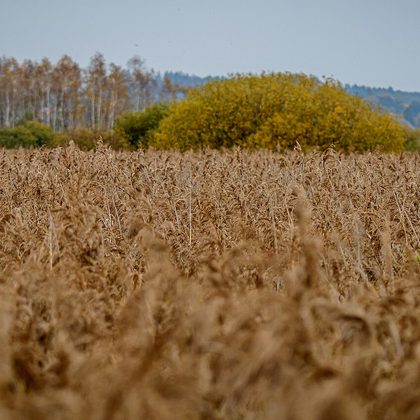
Breeds only in open, low, permanently wet sedge mire with ten to thirty centimetres of water, free of bushes and of tall reed — a habitat drained, fertilised or overgrown almost everywhere in Europe. On migration it is far less fussy: young, wet stands of reed and reedmace just behind the coast, and in Iberia salt marshes and rice fields, where it gorges on plant lice and puts on fat within days.
Where the bird is most at home, classified with EUNIS — the European standard for habitats.


Range and movements
The breeding range lies almost entirely within Europe: the Biebrza and Pomerania in central Europe, the Baltic region, the marshes of eastern Europe and the Pannonian plain, with a world population of the order of ten to fifteen thousand singing males and its core in the Polesie region. Virtually all birds move south-west via the southern North Sea coast, the Channel and the Bay of Biscay to the Senegal delta. The southern North Sea coast therefore sits squarely on the flyway. Iberia is an important stopover along the way: Santoña bay, Urdaibai, the Cantabrian marshes and the Ebro delta concentrate most of the Iberian records.
- Breeding (summer)
- Passage
- dark = core range, pale = thinly spread
How and when to look
The second half of August, early in the morning, in young wet reed just behind the coast: the Zwanenwater, the Kwade Hoek, Saeftinghe and the saltmarsh reedbeds of Groningen and Friesland. It feeds low in the reed base and surfaces only briefly, so be patient and photograph everything. Expect to miss more than you see.
Conservation status
Vulnerable (VU) on the global Red List and thus the only globally threatened songbird of mainland Europe. The decline is driven by drainage and peat reclamation of sedge mires, the end of extensive mowing and grazing, and the succession to scrub and tall reed that follows. International recovery projects across the breeding range, involving mowing regimes and even translocation of chicks, are slowing the loss, but the population remains small, fragmented and declining in most parts of the range.
Scientific name
Acrocephalus paludicola | (Vieillot, 1817)
Vieillot described the species in 1817 as Sylvia paludicola; because it was later moved to another genus, the author and year stand in brackets. The genus Acrocephalus was introduced in 1811 by Naumann & Naumann. Acrocephalus is Greek, from akros 'topmost, pointed' and kephalē 'head'; the Naumanns, who introduced the genus, called these birds Spitzkopf 'pointed head', so they read akros as 'pointed'. paludicola is Latin for 'marsh-dweller', from paludis, 'swamp', and colere, 'to inhabit'. The specimen the first description was based on came from Lorraine and Picardy.