All species › Waders, gulls and terns › Sandpipers and snipes › Ruddy Turnstone
Ruddy Turnstone | Arenaria interpres
Steenloper | Vuelvepiedras común | Steinwälzer | אבנית | Tournepierre à collier
A squat, short-legged wader that flips stones, shells and weed with a wedge-shaped bill to get at what lies underneath. On basalt sea walls and harbour moles it often lets you approach within a few metres.

Click a thumbnail to switch the photo above.
Voice
A hard, staccato rattling tuk-a-tuk-tuk, low in pitch and usually fired off in short bursts on take-off. When alarmed it gives a sharp, metallic chek. Heard throughout the winter half-year, and because the birds skim so low along the sea wall the call often registers before the bird does.
Recording: Sonothèque ADVL — CC0 · xeno-canto
Identification
Short and stocky, with a sharply tapering black bill and orange legs. Breeding birds are harlequin chestnut, black and white above, with a boldly marked head and a broad black breast band. In winter dark olive-brown replaces the chestnut and the breast band goes dull. In flight it cannot be missed: white wingbar, white back stripe, white shoulder patches and a white rump with black tail band.
Confusion species
Purple Sandpiper shares the rocks, the dark winter plumage and the yellowish legs, but is longer and finer-billed with an orange bill base and looks evenly slate-grey, without the sharply cut white throat and dark breast band. In flight the pattern settles it at once: Purple Sandpiper shows only a narrow wingbar, Turnstone a piebald arrangement of white on back, shoulders and rump.
Compare sandpipers, snipes and allies: bill, legs, wing bar and rump
Habitat
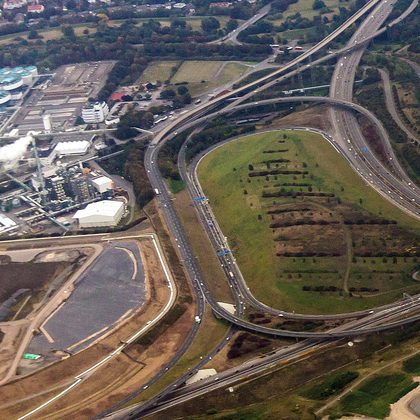
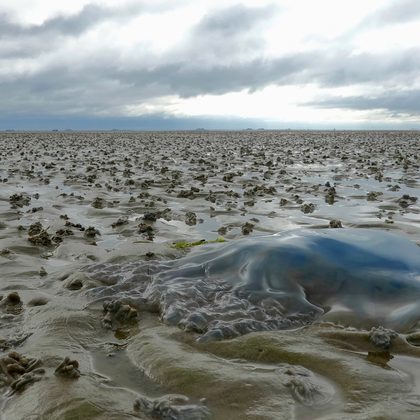
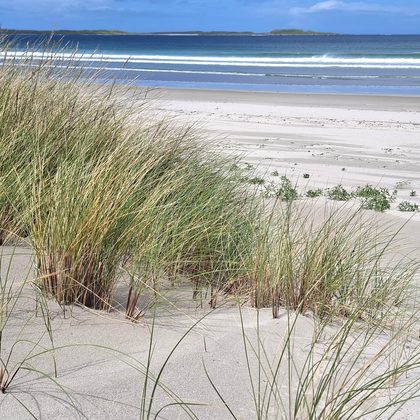
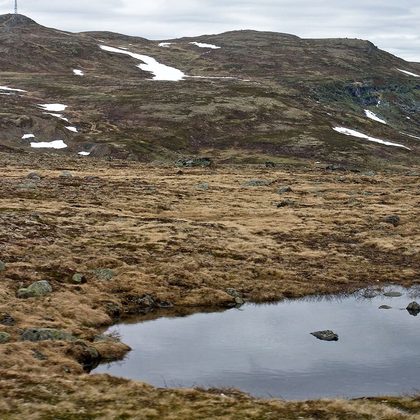
Rocky shores, groynes, piers, harbour quays, mussel beds and weed-covered tidelines. It levers with that wedge bill under stones, shells and stranded wrack, working systematically along a strip. Along the southern North Sea coast basalt dykes, locks and harbour moles are its favoured ground; it visits sandy beaches only where drift material has washed up.
Where the bird is most at home, classified with EUNIS — the European standard for habitats.

Range and movements
Breeds on the Arctic tundra and rocky coasts of Greenland, Svalbard, Scandinavia and Siberia. It winters along almost every rocky coast in Europe and Africa. Along the southern North Sea coast it is a faithful winter visitor to the Wadden dykes, the Delta works and the ports; in Iberia it sits on the Cantabrian rock coast and in the Galician rías.
- Resident
- Breeding (summer)
- Winter
- Passage
- dark = core range, pale = thinly spread
How and when to look
Walk a basalt dyke or harbour mole in October or January, preferably around low water when the stones are exposed. The birds are not shy and often allow a close approach. Look for movement: a Turnstone gives itself away by flipping shells and weed, not by its outline, which vanishes completely into the stones.
Conservation status
The world population is declining and the species is now listed as Near Threatened. On the breeding grounds the tundra is changing fast, while along the flyway feeding areas are lost to coastal defence, disturbance and shellfish harvesting.
Scientific name
Arenaria interpres | (Linnaeus, 1758)
Linnaeus described the species in 1758 as Tringa interpres; because it was later moved to another genus, the author and year stand in brackets. The genus Arenaria was introduced in 1760 by Brisson. Arenaria is from Latin arenarius 'inhabiting sand', from arena 'sand'. interpres is Latin for 'messenger' or 'interpreter': on Gotland Linnaeus took the Swedish word tolk to apply to this bird, but in the local dialect it means 'legs' and refers to the redshank. The specimen the first description was based on came from Gotland, Sweden.