All species › Waders, gulls and terns › Sandpipers and snipes › Red Knot
Red Knot | Calidris canutus
Kanoet | Correlimos gordo
The Knot occurs in large numbers: dense flocks over the tidal flats that change colour in unison. It shuttles between the high Arctic tundra and the Wadden Sea, even resizing its own gut on the way.

Click a thumbnail to switch the photo above.
Voice
Quiet for such an abundant bird: a low, grunting knut and, in flight, a soft disyllabic kwik-ik. A rising flock produces mainly the rush of thousands of wings. The song is given only on the tundra, so it is not heard in Europe.
Recording: Sonothèque ADVL — CC0 · xeno-canto
Identification
Dumpy, short-legged calidrid with a thick neck, a short straight black bill and olive-green legs. In breeding plumage brick red from face to belly, with black and rufous scalloped upperparts. In winter plain grey with a pale supercilium, neatly scaled flanks and a pale, finely barred rump; a narrow white wing bar shows in flight.
Confusion species
Dunlin is smaller, with a longer, slightly decurved bill and a black belly patch in summer. Bar-Tailed Godwit is far bigger and longer-billed. Grey Plover has black armpits and an obvious plover profile. The real difficulty is the vagrant Great Knot: bulkier, longer-billed and with a heavily spotted breast.
Habitat
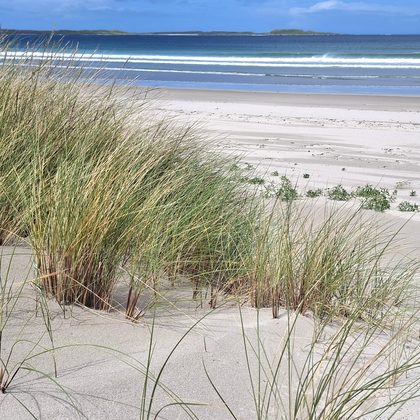
Extensive sandy and muddy tidal flats rich in cockles and small bivalves, where the birds locate shellfish by touch with the bill, plus beaches and estuaries. Roosts at high tide on saltmarsh, sandbanks and dykes, almost always in tightly packed flocks.
Where the bird is most at home, classified with EUNIS — the European standard for habitats.

Range and movements
Breeds on high Arctic tundra in Greenland, Arctic North America and Siberia, and the two populations do quite different things. Siberian birds from the Taimyr continue to the Banc d'Arguin in West Africa, refuelling in the Wadden Sea and the Bay of Biscay on the way; Greenland and North American birds stay in western Europe, moult in late summer in the Wash and the Wadden Sea, and return in spring by way of Iceland and northern Scandinavia. The tundra empties in three waves: females in mid-July, males a fortnight later, juveniles at the end of August. In Iberia it is much scarcer, with the highest numbers in the Galician rías, the Huelva estuary, the Bay of Cádiz and the Ebro delta.
- Resident
- Breeding (summer)
- Winter
- Passage
- dark = core range, pale = thinly spread
How and when to look
In Iberia, August and September on a rising tide at Doñana, Huelva or Cádiz, searching among flocks of other waders. On the Wadden Sea, reach a high-tide roost such as the Richel, the Boschplaat or the Balgzand two to three hours before high water and wait for the birds to be pushed in. In May they are in full rufous breeding plumage.
Conservation status
Near Threatened globally. Knots are vulnerable because they depend on a handful of very specific staging sites; mechanical shellfishing, disturbance at high-tide roosts and changing conditions on the Arctic breeding grounds as the climate warms are the main threats.
Scientific name
Calidris canutus | (Linnaeus, 1758)
Linnaeus described the species in 1758 as Tringa canutus; because it was later moved to another genus, the author and year stand in brackets. The genus Calidris was introduced in 1804 by Merrem. Calidris goes back to Ancient Greek kalidris or skalidris, a name Aristotle used for an unidentified grey waterside bird. canutus is traditionally linked to King Cnut, from the tale of him commanding the tide and the knot's habit of feeding along the tideline, though there is no historical foundation for this. Another explanation is that the name imitates the bird's grunting call. The specimen the first description was based on came from Sweden.