All species › Passerines › Indigobirds and whydahs › Pin-Tailed Whydah
Pin-Tailed Whydah | Vidua macroura
Dominicanerwida | Viuda colicinta
A small black-and-white bird with a coral-red bill, whose male trails four tail feathers of twenty centimetres behind him in summer — on a body of barely thirteen. The Pin-Tailed Whydah comes from Africa south of the Sahara; its European presence goes back to escaped cage birds. It builds no nest of its own: the female lays her eggs in the nests of small seed-eaters and leaves the young to the host. Those young carry, inside the gaping bill, exactly the same spots and pattern as the host pair's own chicks, and grow up among them without anything being turned out of the nest.

Click a thumbnail to switch the photo above.
Voice
A high, fast, squeaky chatter, tsip-tsip-chee-chee-chrrt, given from a wire or a dead twig and repeated in display above the female. In that display flight he hangs half a metre over her on rapidly quivering wings, tail streamers straight down, sinking and rising as though on elastic. Males weave in the bright rising calls of the small seed-eaters around them; once you have watched the display flight, you no longer hear the difference.
Recording: African Bioacoustics Community — CC BY-NC-SA 4.0 · Wikimedia Commons
Identification
Without the tail hardly bigger than a Blue Tit but far stockier, with a short, thick, vivid coral-red bill that stands out in every plumage. The breeding male is black on crown, back and wings, with a broad white wing panel, a white collar and entirely white underparts; from the middle of the tail project four narrow black feathers of twenty to twenty-two centimetres, together half as long again as the bird itself, so that in flight he looks nearly three times the length he does in winter. Females and non-breeding males are pale sandy brown, streaked dark above, with a striped head showing two dark crown stripes and a pale centre; the red bill remains, and it is then the only feature by which they can be identified with certainty.
Confusion species
A male in full tail can be confused with nothing else in Europe. The plain plumage is harder: the bird then resembles the small feral seed-eaters it travels with, such as the Common Waxbill, which has a red eye-stripe and a barred, reddish belly, and a young sparrow, which shows a horn-coloured bill and never that fierce coral red. Watch the head as well: the whydah has a crisply striped crown where sparrows have a plain one. Males halfway through their moult are the hardest — a half-black body under a dull striped head.
Habitat
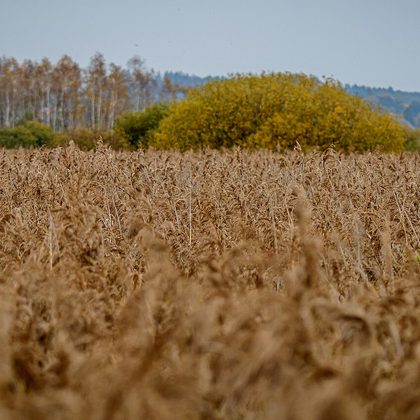
Open grassy ground with bushes and seeding herbs: rough banks and dykes along rivers and lagoons, field margins, fallow land, reed edges, and parks and gardens on the edge of built-up land — anywhere small seed-eaters are numerous, because everything turns on them. Feeds on the ground, hopping and scratching backwards in short jerks, on grass seed and spilt grain, with small insects added in the breeding season.
Where the bird is most at home, classified with EUNIS — the European standard for habitats.



Range and movements
Natively a bird of Africa south of the Sahara. In Europe it is firmly established in western Iberia, with its core around the Ria de Aveiro and the Barrinha de Esmoriz and records north and south of there along the whole west coast down to the Algarve. Elsewhere in Iberia it is a matter of scattered birds and the odd small cluster on the south and east coasts, with little yet known of sites held year after year. Its distribution follows that of the Common Waxbill, itself descended from escaped cage birds and present along every river in western Iberia — where that bird is missing, the whydah stops.
- Breeding (summer)
- Passage
- dark = core range, pale = thinly spread
How and when to look
In June or July drive the reed edges and meadows of the Ria de Aveiro or work round the Barrinha de Esmoriz, watching wires and the tops of bushes. A male in tail shows at hundreds of metres: the streamers drag so heavily that the flight is jerky and undulating, like a dart with a long feather. Find a party of Common Waxbills first and wait there; the whydah belongs with them and regularly chases the smaller birds up. Outside the summer there is little point in looking: without tail and without song, only a small striped bird with a red bill is left.
Conservation status
Not globally threatened (IUCN: Least Concern) and common in Africa. In Europe it is an alien bird going back to escaped cage birds, and a peculiar case: it depends on other birds to reproduce at all, and in Iberia its host, the Common Waxbill, is itself a feral introduction. As long as that holds, the whydah touches no native species directly. The concern lies in what it does elsewhere: in Africa and in North America it lays in the nests of a whole range of small seed-eaters rather than one, and whether it will ever take to a native bird in Iberia cannot be predicted. It is also aggressive at food and drives smaller birds off a feeding place. The Iberian population is small and local but slowly expanding; the species is tracked as an exotic and its trade is regulated.
Scientific name
Vidua macroura | (Pallas, 1764)
Pallas described the species in 1764 as Fringilla (macroura); because it was later moved to another genus, the author and year stand in brackets. The genus Vidua was introduced in 1816 by Cuvier. Vidua is the Latin word for 'widow'. macroura is Greek, from makros 'long' and oura 'tail', after the male's greatly elongated tail feathers. The specimen the first description was based on came from Angola.