All species › Passerines › Wagtails and pipits › Meadow Pipit
Meadow Pipit | Anthus pratensis
Graspieper | Bisbita pratense
The commonest pipit of north-west Europe: small, brown, streaked and at first sight without a single feature. Yet once you know it, it is the easiest of the group — not by its colour but by its voice and behaviour. It walks in meadow, heath and dune, springs up at the slightest disturbance with a thin, stuttering ist-ist-ist, flies jerkily a short way on and drops back into the grass. In October hundreds of thousands pass along the coast, and for the rest of the winter it walks on stubble fields, saltmarshes and dykes.

Voice
Sound matters more than plumage here. The call is a thin, high, sharp ist or seep, and the character is not the tone but the number: it is almost always repeated, two to four times in quick succession, in a hurried stuttering run that drifts away as the bird lifts. Around a nest, alarm turns it into a long series. That repetition is the sharpest division from Tree Pipit, which calls once, and from rock and Water Pipits, which give a single full note. The song is a parachute flight: the bird climbs from the ground, a post or a tussock at an angle to twenty or thirty metres on an accelerating tsip-tsip-tsip-tsip, then glides back down on stiffly spread wings with the tail raised, the notes slowing into a sweeter, falling sia-sia-sia-sia like a spring running down. It lands on the ground again. Song from late March into July, at its most persistent in April and May; the call all year, and over an autumn headland almost without a break.
Recording: Amadeo A. Pombo Eirín — CC BY-SA 4.0 · xeno-canto
Identification
Small and slight at 14–15 cm, with a fine pointed bill and dull brown to olive-brown, dark-streaked upperparts. The underparts are off-white to pale buff and streaked along their whole length — and this is the point on which the small pipits turn: on Meadow Pipit the streaks on the flanks are as long and as heavy as those on the breast, so the streaking reads as one continuous pattern from throat to belly. The legs are pale flesh to orange-pink, never dark. The hindclaw is long, fine and almost straight, longer than the hind toe itself; on a bird walking at close range, or in a telescope, that spur really is visible, and it is the best structural character the species has. The face is flat and expressionless: a narrow pale eye-ring, a vague pale supercilium and no bold pale spot on the rear ear-coverts. The outer tail feathers are white. It walks low and patiently, flicking the tail, and crouches flat before it flushes. In flight it looks light, nervous and undulating, with a long tail and no more than a pale edge to the trailing wing.
Confusion species
Tree Pipit is the real problem, and the difference comes down to four things. First the call, which settles it: Meadow Pipit gives a thin, high note repeated — two, three or more short ist notes run together in a hurried stutter — where Tree Pipit gives a single hoarse buzzing bzeet. Second the streaking: on Meadow Pipit breast and flank streaks are of one weight, on Tree Pipit the breast carries heavy black streaks and the flanks much finer ones. Third the hindclaw: long and straight on meadow, short and clearly curved on tree. Fourth the behaviour: Meadow Pipit begins its song flight from the ground and lands on the ground; Tree Pipit leaves a treetop and returns to one. Rock and Water Pipits are obviously bigger and heavier, with dark, almost black legs and a single full call rather than a stutter. Red-Throated Pipit — even without a red throat — has a streaked rump instead of a plain one, whiter braces on the mantle, blacker flank streaks and a long, thin, descending call. A juvenile Tawny Pipit is bigger, longer-legged and paler. Finally Skylark: also brown and streaked, but much bulkier, with a short crest, a heavy bill, a white trailing edge to the wing and a rippling, quite different call.
Habitat
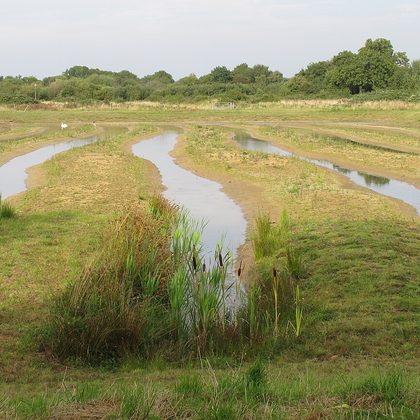
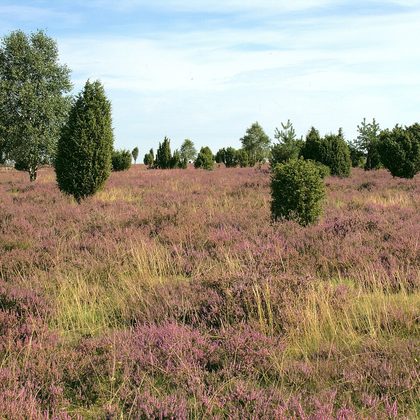
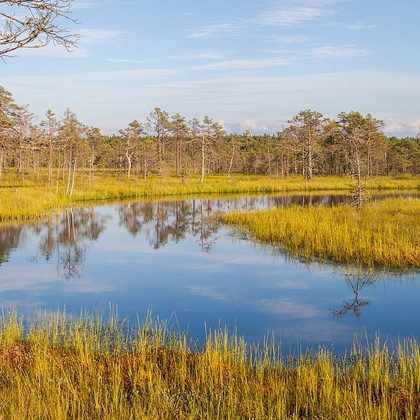
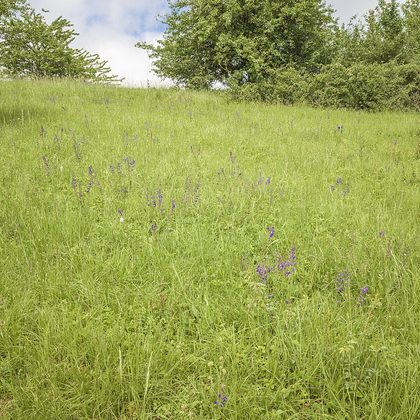
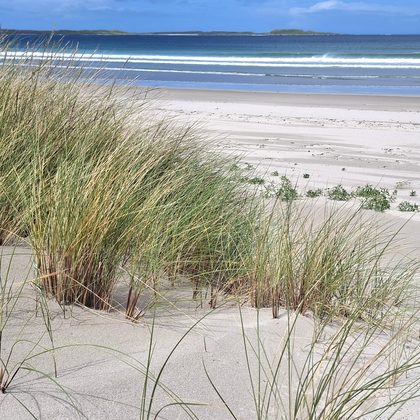
Open, low, treeless ground with a damp soil and plenty of insects. On the breeding grounds, in northern Europe, this means wet and damp grassland, peat meadows, raised bog and heath, machair, saltmarsh, young dune slacks and marram dunes, and alpine pasture above the treeline through to the whole tundra. The nest is a grass cup tucked into a tussock with a canopy of blades above it; the bird lands ten metres away and walks in, and rarely gives it away. Outside the breeding season, in the south of the map area, it shifts to stubble and fallow fields, closely grazed pasture and dehesa, saltmarsh and salt pans, rice fields, the drawn-down edges of reservoirs, golf links and roadside verges; in cold weather it concentrates in irrigated river plains, and in the evening it goes to roost in flocks in reedbeds and rush beds.
Where the bird is most at home, classified with EUNIS — the European standard for habitats.
Range and movements
Breeds from Iceland, the Faroes and the British Isles right across northern and north-western Europe into western Siberia, and south to the Alps, the Carpathians and, marginally, the Cantabrian mountains and the Pyrenees; the southern limit runs through the middle of western Europe. In north-western Europe it is among the most numerous breeders of open country: in the British Isles chiefly in the uplands of the north and west, in the Low Countries shifted from farmland to dunes, islands, heaths and new nature reserves. Northern and eastern birds move to western Europe, the Mediterranean and North Africa, which makes the Meadow Pipit one of the commonest visible migrants of autumn over the North Sea coast: on a good October morning a single watchpoint logs thousands. In the Mediterranean it is almost purely a winter visitor, and one of the most abundant: from early October to mid-March across the whole of Iberia, the Balearics and the northern Maghreb, densest in the Atlantic farmland, the Guadalquivir and Guadiana valleys, La Mancha and the rice fields of the Ebro, the Guadalquivir and the Levante.
- Resident
- Breeding (summer)
- Winter
- Passage
- dark = core range, pale = thinly spread
How and when to look
In April, in the north and west, go to a saltmarsh, a dune slack or a moor and sit down. The song flight runs all morning, and you will see exactly what the books describe: the climb from the ground, the accelerating squeaks, then that stiff-winged descent with the falling sia-sia-sia. To learn the split from Tree Pipit, find a place that holds both — the edge of a heath with scattered birches and pines — and use nothing but your ears: stuttered run against single buzz. Stand on a sea wall or coastal watchpoint at first light in mid-October, when they come over in parties of five to twenty, low and calling continuously; one morning of that fixes the call for good. In the Mediterranean any stubble or fallow will do from November to February, and in January at dusk a reedbed beside irrigated land, where they roost in dozens or hundreds.
Conservation status
Least Concern, though the verdict has gone back and forth: the IUCN listed Meadow Pipit as Near Threatened in 2015 because the European population — and Europe holds almost the whole world population — had fallen steeply over three generations, and returned it to Least Concern at the 2021 reassessment. The decline itself has not gone away. The causes all lie in farmland: early and frequent mowing, so that hardly any clutch hatches, lowered water levels, the loss of herb-rich margins and, above all, the collapse of the insect supply. On heath and in the dunes, grass encroachment through nitrogen also plays a part. In the dunes, on the Wadden islands and in new wet nature areas the species is holding up well.
Scientific name
Anthus pratensis | (Linnaeus, 1758)
Linnaeus described the species in 1758 as Alauda pratensis; because it was later moved to another genus, the author and year stand in brackets. The genus Anthus was introduced in 1805 by Bechstein. Anthus is the Latin word for a small bird of grasslands mentioned by Pliny the Elder. pratensis is Latin for 'of the meadow', from pratum 'meadow'. The specimen the first description was based on came from Sweden.