All species › Waterfowl › Ducks, geese and swans › Mandarin Duck
Mandarin Duck | Aix galericulata
Mandarijneend | Pato mandarín
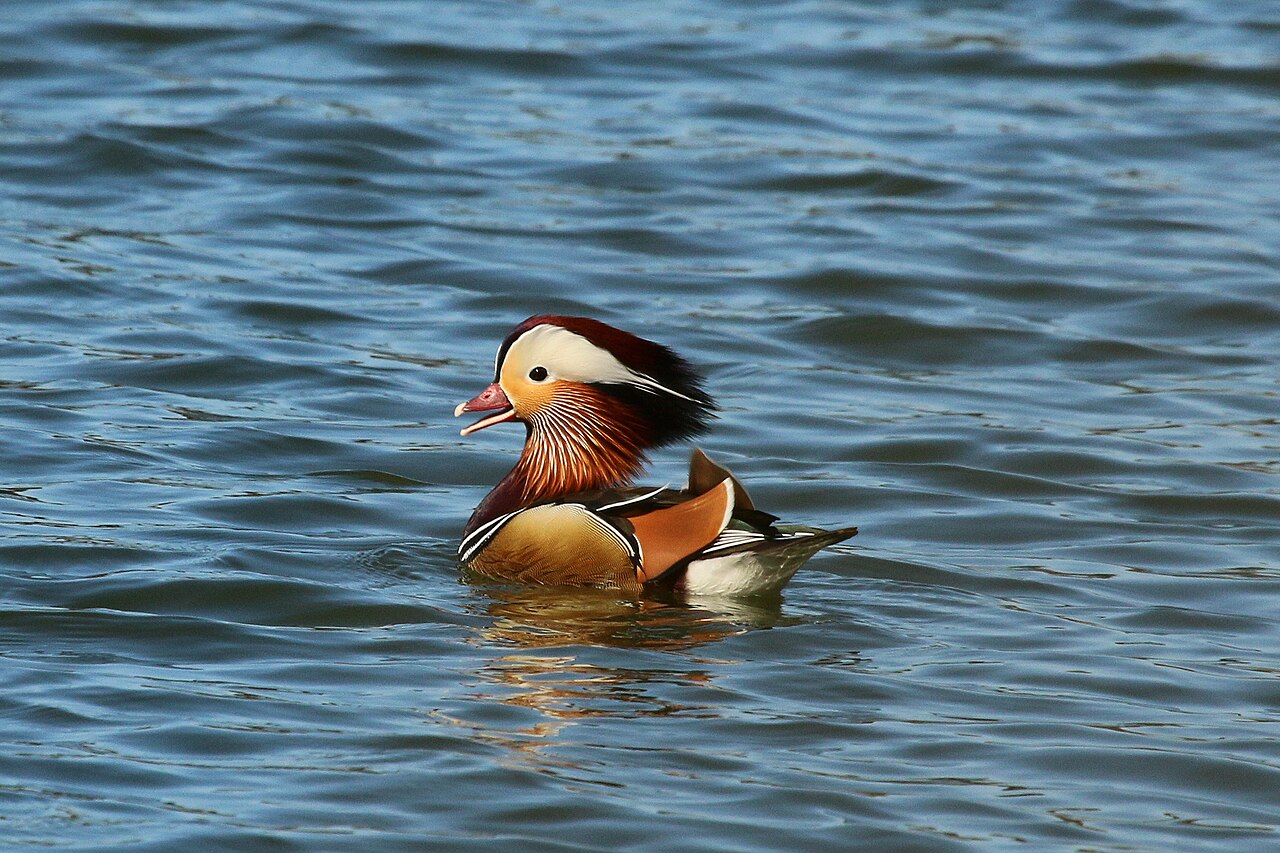
An introduced tree duck at home on wooded ponds and shaded streams. With his orange sail feathers, striped head and maroon breast, the drake is the most multicoloured duck on the continent.
Click a thumbnail to switch the photo above.
Voice
Silent for a duck. The displaying drake gives a short, rising whistle, hweek, while the female flushes with a sharp, plaintive ket. Heard mainly from March to May among small display parties on woodland ponds, and from females calling their ducklings together on the water.
Recording: Simon Gillings — CC BY-NC-SA 4.0 · Wikimedia Commons
Identification
The drake is unmistakable: orange whiskers, a maroon breast with white bars and two upright orange sail feathers on the back. The female is grey-brown with a white eye-ring drawn out behind into a fine pencil line, crisp white teardrops along the flanks and a grey bill with a pale nail. Eclipse drakes resemble females but keep the red bill.
Confusion species
Only the female causes trouble, and then with female Wood Duck. That bird shows a broad, teardrop-shaped eye patch and a scaly, diffusely blotched breast, while Mandarin has a narrow eye stripe and sharply defined flank spots. The bill nail is pale on Mandarin and dark on Wood Duck.
Habitat
Sheltered fresh water with overhanging trees: park lakes, old estate ponds, wooded streams and willow-lined ditches. Nests in tree holes and boxes, sometimes high above the water and well back from the bank. Outside the breeding season in small parties on quiet pools, rarely on large open water.
Where the bird is most at home, classified with EUNIS — the European standard for habitats.




Range and movements
Native to eastern Asia, from the Amur and Ussuri region through the east of the Asian mainland to the Japanese islands. Every European bird goes back to escaped collection stock, and the British Isles hold the largest population. In north-west Europe feral birds also breed on estates and along stream valleys, for instance on the Veluwe and in Twente. In Iberia only scattered escapes occur.
- Resident
- Breeding (summer)
- Winter
- Passage
- dark = core range, pale = thinly spread
How and when to look
April is the month: pairs sit early in the morning on branches over the water or along the edge of a park lake. Walk quietly past shaded banks and watch overhanging willows, since the birds sit tight in shadow and flush late. Look up at tree holes as well.
Conservation status
Not globally threatened (IUCN: Least Concern). In Europe the feral population is slowly increasing and the species is not regarded as damaging, since it barely competes with native ducks. In its native East Asian range it is declining through felling of mature riverside broadleaf forest, loss of nest holes and continuing trapping for the cage-bird trade.
Scientific name
Aix galericulata | (Linnaeus, 1758)
Linnaeus described the species in 1758 as Anas galericulata; because it was later moved to another genus, the author and year stand in brackets. The genus Aix was introduced in 1828 by Boie. Aix is the Ancient Greek word for a diving bird mentioned by Aristotle that can no longer be identified. galericulata is Latin, from galericulum, 'wig' or 'small cap', from galerum, 'cap', after the male's crest. The specimen the first description was based on came from China.