All species › Pigeons and doves › Pigeons and doves › Laurel Pigeon
Laurel Pigeon | Columba junoniae
Laurierduif | Paloma rabiche
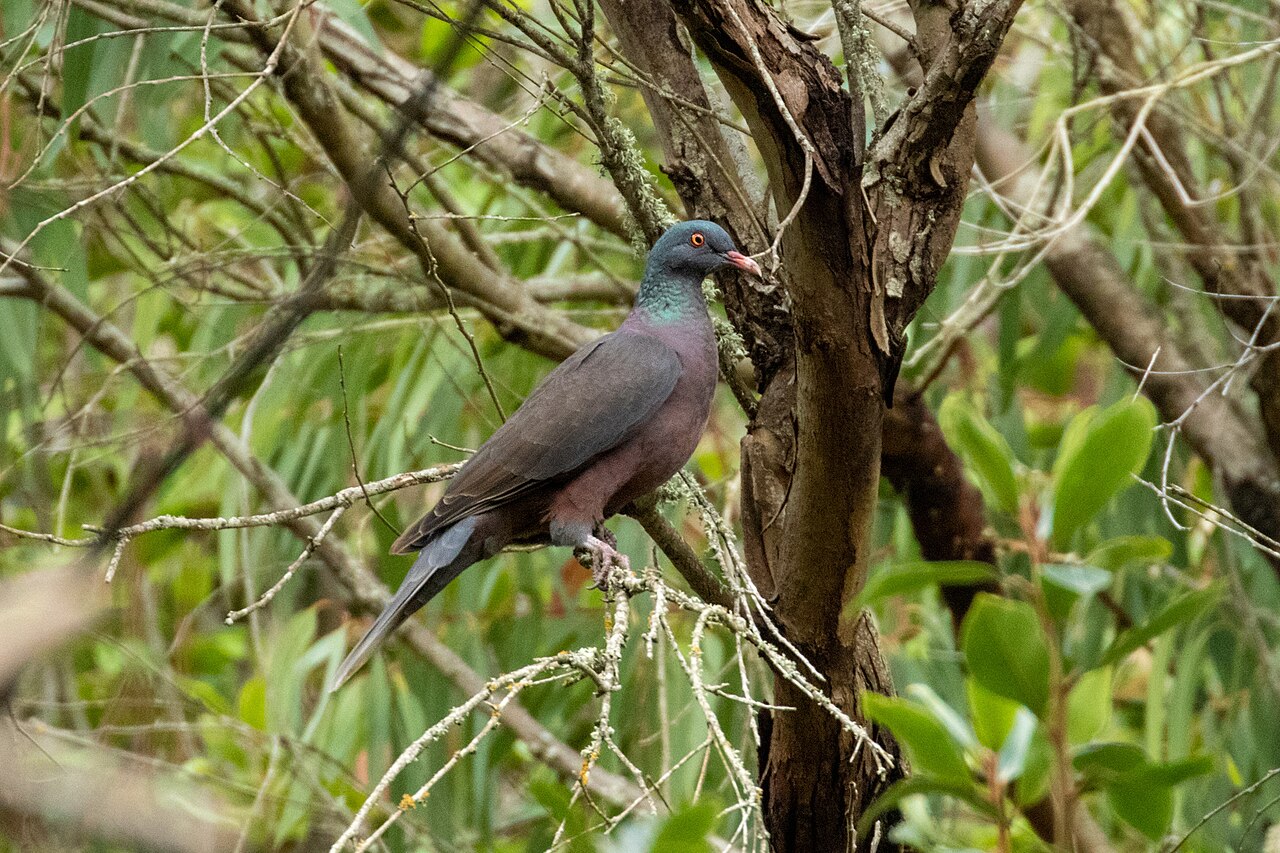
The Laurel Pigeon is the pigeon of the barrancos (steep, dry ravines in volcanic or mountainous terrain): a dark, red-brown-tinged bird that emerges from the cloud forest and glides straight across the gorge, with a pale tail tip that shows up from far away. It shares four Canary Islands with Bolle's Pigeon and is often confused with it.
Voice
A deep, hollow three-syllable coo, hoo-hoo-hooo, stressed on the last and longest note; it travels across the ravine but is very hard to place. Pairs also exchange a hurried, hiccuping series. Most vocal in the early morning of late spring. In display the bird climbs at an angle and glides down in a long shallow arc on stiff wings.
Recording: SonoNatura — CC BY-NC-SA 4.0 · Wikimedia Commons
Identification
Large and dark. The head and neck are grey with a green sheen that turns purple-red on the lower neck and mantle; the back is dark sepia-brown and the underparts red-brown to vinous. The tail settles it: pale grey, ending in a broad off-white terminal band that shows best from below. The bill is pink with a pale tip, the eye orange within a red orbital ring, the legs red. Juveniles are duller, lack the gloss and have a dark bill.
Confusion species
Bolle's Pigeon lives on the same four islands and in the same wood, and is the only serious pitfall. Take the tail first: on Laurel Pigeon the pale grey tail ends pale, in an off-white tip; on Bolle's the black tail ends dark, with the pale band set across the middle. Then take the colour: Laurel Pigeon is red-brown on back and breast, Bolle's slate blue-grey with no more than a purple wash. In flight Laurel Pigeon crosses open slopes and ravines while Bolle's stays under the canopy. The voice differs too: three deep hollow notes here, a rough rattle there. Common Wood Pigeon also occurs on these islands, but always shows a white neck patch and a white wing band.
Habitat
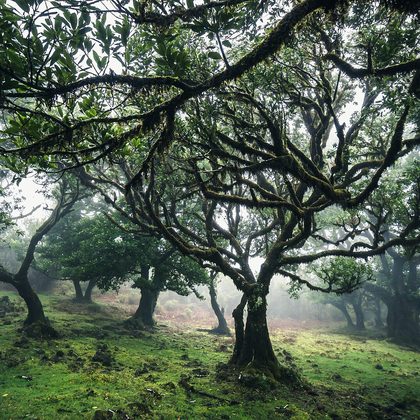
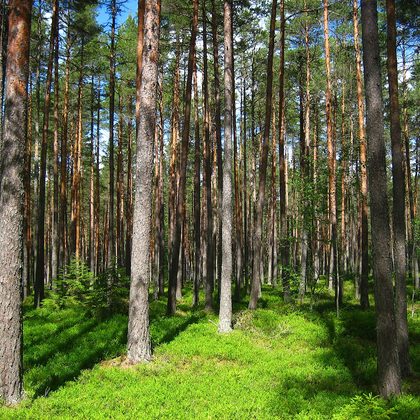
Laurisilva and monteverde (the humid laurel forest of Macaronesia) on the humid northern slopes, favouring the lower, warmer belt and steep, densely vegetated barrancos. It feeds in fruiting trees such as til (Canary laurel, Ocotea foetens, tall and dark-leaved) and viñátigo (Persea indica, with reddish twigs), but also uses pine woods and the fields and orchards along the bottom edge of the forest. It does not nest in trees: the nest sits on the ground, on rock ledges and under ferns in the wall of a ravine.
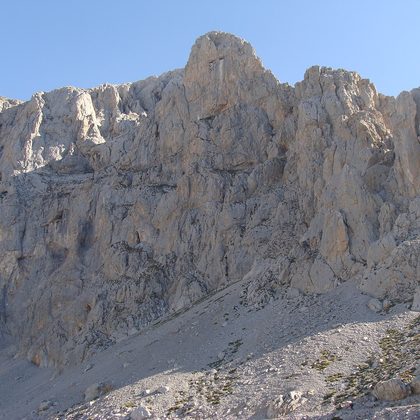
Where the bird is most at home, classified with EUNIS — the European standard for habitats.

Range and movements
Confined to the Canary Islands, and there to La Palma, La Gomera, Tenerife and El Hierro. La Palma holds by far the most; on Tenerife it is scattered through Anaga and Teno, on El Hierro it amounts to a handful. It occurs nowhere else on earth. The population runs to a few thousand birds and recent survey work has put it higher than the counts of the 1980s suggested.
- Resident
How and when to look
La Palma in April or May, in the first two hours after sunrise, from a viewpoint above Los Tilos or the Barranco de la Galga. Get high and look across the ravine rather than into the trees: the pigeons cross the open air, and the pale tail tip is the first and often the only feature you will get.
Conservation status
Near Threatened. The range is small and the forest fragmented, but numbers have risen since hunting was banned and the cloud forest protected. The main threat remains predation of eggs and chicks by rats and cats, because the nests are on the ground; illegal shooting still happens where the birds feed on cultivated land. The species is on Annex I of the Birds Directive and has had a recovery programme of its own.
Scientific name
Columba junoniae | Hartert, 1916
Hartert described the species in 1916 and placed it straight away in the genus where it still stands. The genus Columba was introduced in 1758 by Linnaeus. Columba is Latin for 'dove' and goes back to Greek kolumbos 'diver', from kolumbaō 'to dive, to swim'; classical writers used it of the rock dove for the swimming stroke of its wings in flight. junoniae derives from Junonia Mayor and Junonia Menor, old names for La Palma and La Gomera, the two islands where the laurel pigeon lives. The specimen the first description was based on came from La Galga, La Palma.