All species › Passerines › Thrushes › Eyebrowed Thrush
Eyebrowed Thrush | Turdus obscurus
Vale lijster | Zorzal cejudo
Eyebrowed Thrush is the smallest of the Siberian thrushes: a slate-grey head, an olive-brown back, a brilliant white supercilium and plain orange flanks. It breeds in the dense, damp taiga of central and eastern Siberia and heads in one movement for South-East Asia, wintering in the mountain forest of Borneo and the Philippines. Of the three it is the most predictable vagrant here: in almost every autumn one or a few appear along the North Sea coasts and on the British Isles in the last days of September and through October.

Voice
In the field it is heard mainly on migration: a thin, faintly nasal and slightly descending tseep or dzeeh, shorter and softer than the nocturnal call of a Redwing and without its sharp point. When disturbed it gives a short low tuk or chuk, like a Blackbird at dusk. The song, not to be heard in Europe, is short and simple: two to four clear whistles that bend upward like a question, tyoo-wee-tyoo, with a brief thin trill tacked on and long silences between phrases. The bird sings from a branch halfway up the canopy, usually in the first or the last light of the day.
Recording: Jochem Verweij — CC BY-SA 4.0 · xeno-canto
Identification
A small, slim thrush, smaller than a Song Thrush, short-tailed and with proportionately long, pointed wings. The head is slate-grey and the back olive-brown, and it is that colour break between head and body that registers at range. The head pattern is the main character: a long, clean white supercilium from the base of the bill to behind the eye, a short white line below the eye, and a white patch at the base of the chin, all three sharply cut against a dark grey face. In the male the head is darkest and the lores look almost black; the female is softer and browner throughout, with a whitish, faintly streaked throat. Breast sides and flanks are plain orange to rufous-orange, sharply bounded against a clean white belly and white undertail coverts. The underparts are otherwise unspotted; only young birds show some dark flecking on the breast. The underwing is grey, with no warm red and no pale band. The bill is yellow with a dark tip and the legs are yellowish-brown to orange.
Confusion species
Once the underparts are visible there is little scope for confusion with the other two Siberian thrushes: Black-throated and Dusky are both clearly bigger and heavier, carry black on throat, breast or flanks, and have a white belly without a trace of orange. Dusky Thrush also has the broad rufous wing panel that Eyebrowed lacks, and Black-throated is plain grey-brown from crown to tail. The real trap is American Robin, which likewise shows a grey head, orange underparts and a white belly stripe. But that bird is much bigger, carries the orange across the whole breast and belly instead of only on the breast sides and flanks, lacks the white supercilium, and has white eyelids and a white, heavily black-streaked throat instead. Eyebrowed differs from Song Thrush in its grey head, its supercilium, its unspotted underparts and its grey rather than buff-yellow underwing; from Redwing in orange rather than rust-red flanks, in the absence of breast streaking, and again in that grey underwing. The American Catharus thrushes, which can turn up in the same October weeks, are smaller and browner, with diffuse spotting across the breast, a pale band on the underwing and no orange on the flanks. The large spotted Asian thrushes, finally, show a broad black-and-white band across the underwing.
Habitat
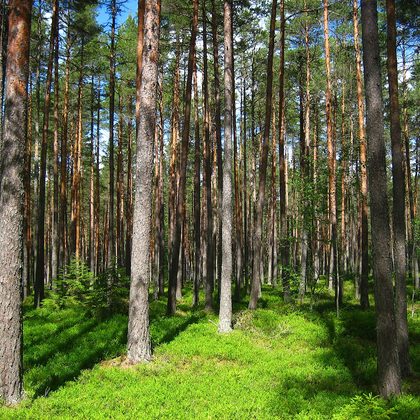
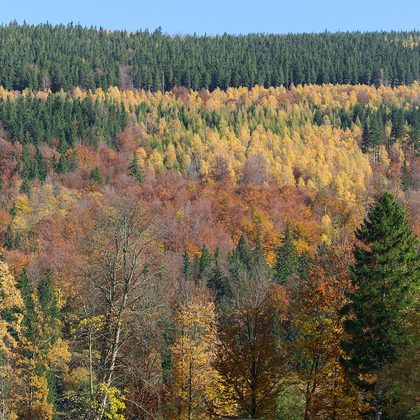
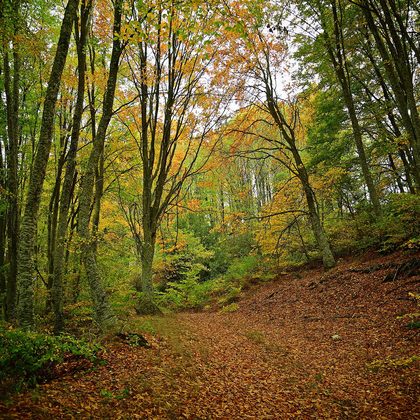
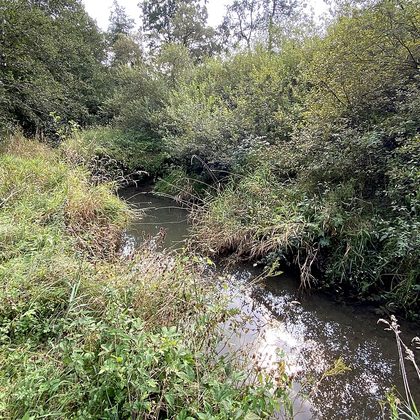
Breeds in dense, damp taiga: spruce and larch forest with a closed canopy and a thick shrub layer, birch and mixed woodland along rivers, and the willow and alder thickets of the valley bottoms. Unlike Dusky Thrush this is a bird of the forest itself rather than of the open treeline; it keeps high and hidden and on the breeding grounds is heard far more often than seen. In winter it uses montane and tall secondary forest in South-East Asia, in flocks in fruiting trees. The European vagrants sit in dune scrub, elder and hawthorn hedges and village gardens.
Where the bird is most at home, classified with EUNIS — the European standard for habitats.
Range and movements
Breeds from the Yenisei east to Kamchatka, Sakhalin and the northern Japanese islands, and winters from the north-east of the Indian subcontinent and southern China through Indochina to Borneo and the Philippines; on passage it is one of the commonest thrushes on the Japanese islands and the Korean peninsula. In Europe it is a rare but near-annual vagrant, with most records on the British Isles, in Scandinavia and along the North Sea coast, weighted firmly from late September to early November, plus a smaller run of birds in April and May.
How and when to look
Search the last week of September and the first half of October, and let the weather decide: the records coincide almost without exception with a blocking high over Scandinavia or eastern Europe that sets days of easterly wind across the North Sea — the same picture that delivers Yellow-Browed Warbler and Olive-Backed Pipit. Then work the cover on the Frisian islands: elder clumps, hawthorn scrub, the gardens and yards around the villages, the cemeteries. The bird sits still and fairly high in the bush and moves little. Look at the head first, because a brilliant white supercilium on a grey head shows even through leaves; then check the sharply bounded orange flank against the white belly. In a flock of Fieldfares or Redwings, look for one bird that is smaller and shorter-tailed than the rest.
Conservation status
Not globally threatened: the range is enormous and numbers are large, with the caveat that trends are poorly known because almost nobody counts in the Siberian taiga. On the flyway and in the winter quarters the species is more exposed. Thrushes are netted on a large scale in parts of South-East Asia, for trade and for the pot, and the montane forest in which Eyebrowed Thrush winters is shrinking. Unlike Black-throated and Dusky Thrush, its taxonomy is not in dispute: it has always been counted as a species in its own right and so has long had its own Red List assessment. For the region of this guide it is a vagrant and stays one; there is no part of the map where it appears regularly.
Scientific name
Turdus obscurus | Gmelin, 1789
Gmelin described the species in 1789 and placed it straight away in the genus where it still stands. The genus Turdus was introduced in 1758 by Linnaeus. Turdus is the ordinary Latin word for 'thrush'. obscurus is Latin for 'dark, dusky', after the subdued plumage. The specimen the first description was based on came from the forests beyond Lake Baikal.