All species › Passerines › Treecreepers › Eurasian Treecreeper
Eurasian Treecreeper | Certhia familiaris
Taigaboomkruiper | Agateador norteño
This is the difficult half of a difficult pair. In the British Isles there is no problem: only Eurasian Treecreeper occurs there, so a bird spiralling up an oak or a hedge needs no further thought. Cross the Channel and it gets harder: over most of the Continental lowlands Short-Toed Treecreeper takes the place of Eurasian Treecreeper, which withdraws into conifers and up into the mountains. In Iberia that split is geographic: Short-Toed Treecreeper occupies almost the whole peninsula, while Eurasian Treecreeper is confined to the high-mountain conifer and beech forests of the Pyrenees and the Cantabrian range — outside those two ranges the problem does not arise. Across its whole range, though, it is the treecreeper par excellence: it breeds from the British Isles to the Japanese islands and is one of the most widely distributed small birds in the world.
Voice
This is where the case is decided. The call is a thin, high, sibilant srreeh with a slight vibrato and a drawn-out quality — far more attenuated and piercing than the full tyoot of Short-Toed Treecreeper, and pitched high enough that older ears routinely miss it. There is also a fine tsee. The song runs two to three seconds and is clearly longer, higher and more musical than the short hard phrase of its twin: a thin cascade that falls away in pitch and curls upward into a closing figure at the end, Blue Tit-like in timbre. One caution belongs with it: in the overlap zone males of both species take up each other's phrase, and birds are documented that command both songs. The call is the more dependable of the two.
Recording: Jochem Verweij — CC BY-SA 4.0 · xeno-canto
Identification
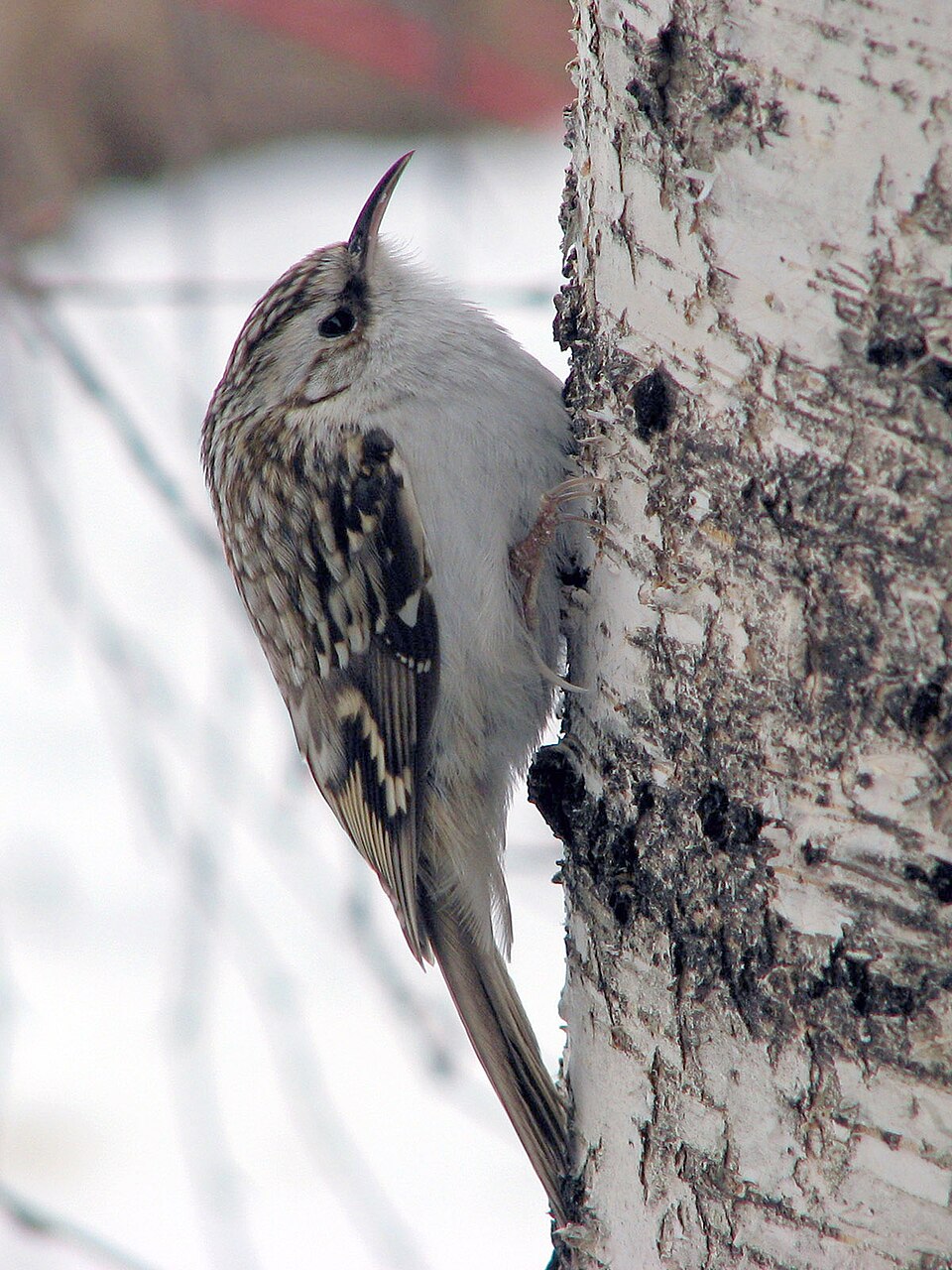
At any distance, a treecreeper and nothing more: small, mouse-like, brown and spangled above, pale below, with a long curved bill and a stiff pointed tail braced against the bark. Every difference from its twin is one of degree. The underparts are whiter and cleaner, without the dingy buff or brownish wash on flank and lower belly. The upperparts are warmer and more rufous in tone and more contrastingly spangled, the white spots standing out more sharply. The supercilium is a cleaner white, more crisply bounded, and runs noticeably further behind the eye; on the best birds the two brows look as if they nearly meet across the nape. The pale band across the primaries carries an obvious projecting step. The bill averages shorter and the hind claw longer.
Confusion species
In the British Isles there is no confusion species at all, and this freedom is worth using: it is the place to fix in the mind what a clean white belly and a long white supercilium actually look like, so the Continental comparison later has a baseline. Elsewhere everything turns on Short-Toed Treecreeper — see also its own species page. That bird is duller and greyer above, dingy to buff on flanks and lower belly, with a weaker and shorter supercilium, a flatter wing band, a longer bill and a shorter hind claw. None of those characters survive backlighting, rain or a high, shaded canopy, and a badly lit Eurasian Treecreeper can suggest every mark of a short-toed. In Iberia the rule of thumb is geographic before it is morphological: below the montane belt, and outside the Pyrenees and the Cantabrian range, a treecreeper is always short-toed; in the high-mountain conifers of those two ranges, listen before you note it down. Without a call or song a treecreeper elsewhere cannot be reliably identified as Eurasian — however white the belly looks. Nuthatch is heavier, blue-grey with rusty flanks, a black eye-stripe, a straight bill and no propping tail, and climbs head-down. Wren hops, is round and cocks a short tail.
Habitat
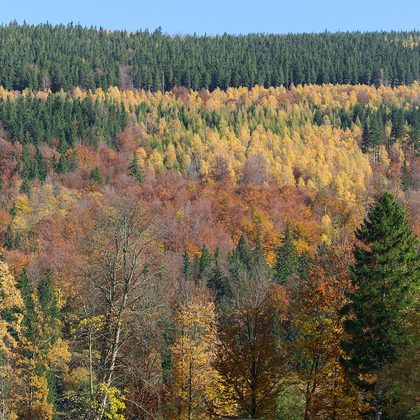
Conifer and mixed forest are its core: spruce and pine forest, old mossy spruce stands with plenty of dead wood, montane forest up to the treeline. Where Short-Toed Treecreeper is absent — in the British Isles and much of eastern Europe and Siberia — it also takes to broadleaved woodland, parks and gardens, which shows that it is not a matter of tree species but of who got there first. In central Europe it retreats to higher ground and leaves the lowlands to Short-Toed Treecreeper. The form that breeds in southern Limburg favours older mixed slope woodland with a shrub layer, dead wood and loose bark. As in its twin species, the nest is behind a loose plate of bark or in a crevice.
Where the bird is most at home, classified with EUNIS — the European standard for habitats.


Range and movements
From the British Isles across Scandinavia, the Baltic region, eastern Europe and Siberia to the Japanese islands, the Korean peninsula and northern China, with southern outliers in the Pyrenees, the Cantabrian Mountains, the Alps, the Carpathians, the Balkans, Anatolia and the Caucasus. A large part of that range lies far outside Europe. In the British Isles it is a widespread and largely sedentary resident, absent only from treeless uplands and the outer isles. In Iberia the population is small and mountain-bound, split between the Pyrenees — from Navarre to Catalonia — and the Cantabrian ranges, resident apart from altitudinal shifts in hard winters.
- Resident
- Breeding (summer)
- Winter
- Passage
- dark = core range, pale = thinly spread
How and when to look
Look for it where the odds are best and the comparison sharpest. In the Eifel, the Ardennes and the Vosges both species sing in the same valley, one down in the broadleaf woodland and the other up among the spruce.
Conservation status
Not globally threatened, and common to very common across its immense range in the taiga and mountain forests. In western Europe it is locally sensitive to the felling of old conifer forest and the removal of dead wood, and in the British Isles a slight decline has been reported that is probably linked to wet summers.
Scientific name
Certhia familiaris | Linnaeus, 1758
Linnaeus described the species in 1758 and placed it straight away in the genus where it still stands. He introduced the genus Certhia in that same work. Certhia is from Ancient Greek kerthios, a small tree-dwelling bird described by Aristotle and others. familiaris is Latin for 'familiar' or 'common'. The specimen the first description was based on came from Sweden.