All species › Waders, gulls and terns › Plovers and lapwings › Black-Bellied Plover
Black-Bellied Plover | Pluvialis squatarola
Zilverplevier | Chorlito gris
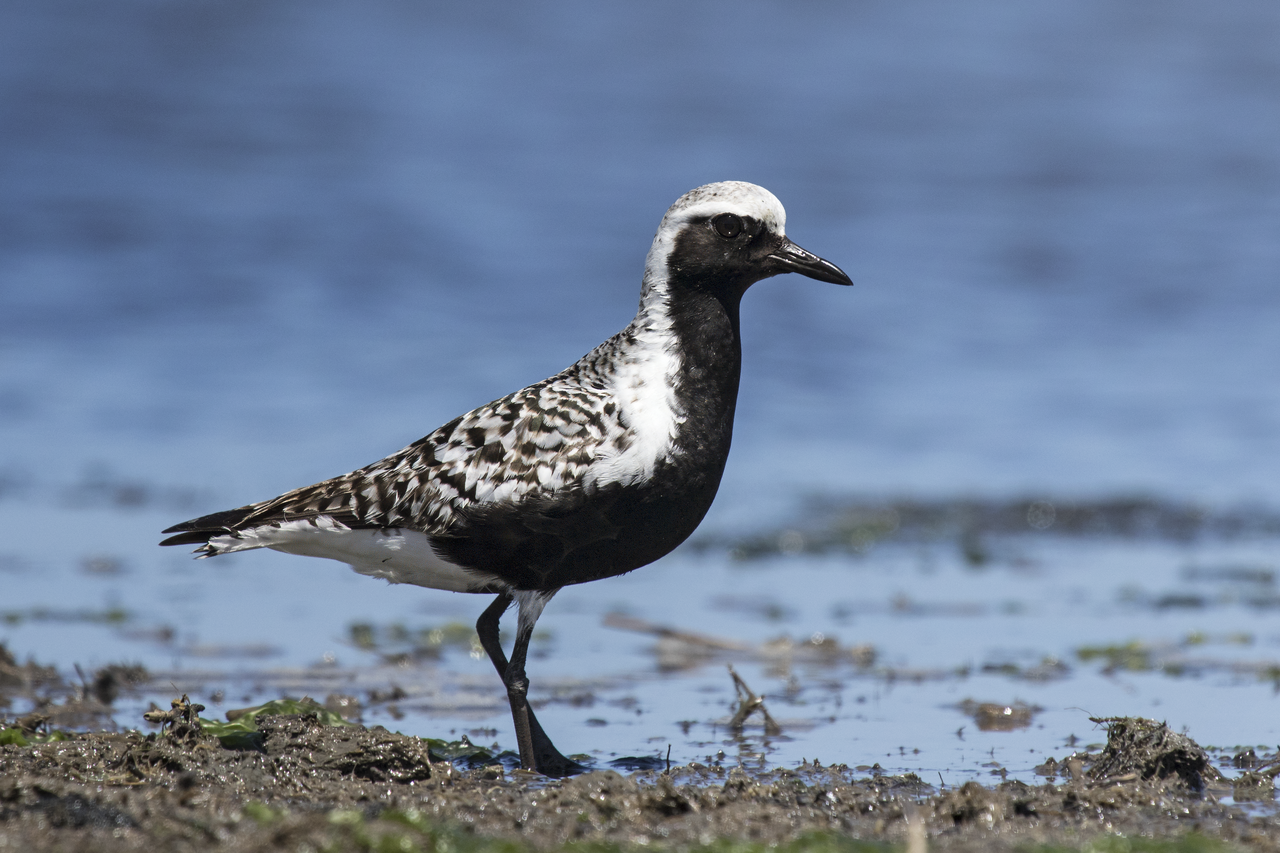
The big grey plover of the tidal flats, working the mud spread out and alone rather than in packed flocks. Its plaintive three-note whistle usually reaches you before the bird does.
Click a thumbnail to switch the photo above.
Voice
A plaintive three-syllable whistle with a clear dip in the middle, tlee-oo-ee. It carries far across the flats and betrays the species in darkness or thick fog. Heard throughout the winter half-year, particularly on a rising tide as birds shift from the flats to the high-tide roost.
Recording: Sonothèque ADVL — CC0 · xeno-canto
Identification
Heavily built plover with a thick black bill, large head and dark eye in a pale face. Breeding birds are scaled silver-grey and black above, with jet-black face and underparts broadly bordered white and a white undertail. In winter it is spangled grey with a pale supercilium and greyish breast sides. In flight a broad white wingbar, white rump and black axillary patches make it unmistakable.
Confusion species
Golden Plover is smaller, finer-billed and spangled gold, lacks the white rump and black armpits and has an all-white underwing. On standing winter birds the heavy bill and the cold grey rather than yellow ground colour decide it. If in doubt, wait for the bird to fly: the black axillary patch never lies.
Habitat
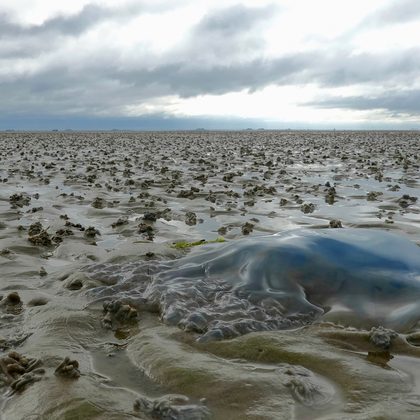
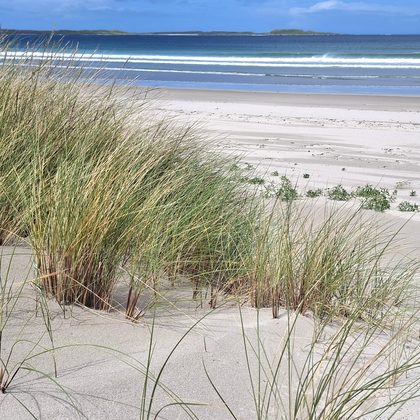
Almost exclusively a bird of the intertidal zone: mudflats, mussel beds, wide sandy beaches and estuaries. It feeds alone and widely spaced with the typical plover run-stop-peck, gathering only at high water on saltmarsh, groynes and sandbanks. Inland records are scarce and usually short-lived.
Where the bird is most at home, classified with EUNIS — the European standard for habitats.
Range and movements
Breeds on the Arctic tundra of Siberia, Alaska and Canada, and therefore nowhere in Europe. The southern North Sea coast is a key area: the Wadden Sea and the Delta hold large winter numbers. In Iberia it winters in the Galician rías, the Bay of Cádiz, the Ebro delta and Doñana, with passage along virtually the whole Atlantic coast.
- Resident
- Breeding (summer)
- Winter
- Passage
- dark = core range, pale = thinly spread
How and when to look
Pick a high-tide roost on the Wadden Sea in September or October and be in place two hours before high water, as the rising tide pushes birds to the edge of the flats. Sit with the sun behind you and wait. As they drop in they flash the black armpit, the moment that separates Grey from Golden Plover.
Conservation status
Vulnerable (IUCN: Vulnerable) since the 2024 Red List update, despite a population that is still numerous; the species is wholly dependent on a chain of intact tidal areas along the flyway. Land claim, port expansion and disturbance at high-tide roosts are the main risks, while sea-level rise may squeeze mudflats out of existence. On the breeding grounds the tundra is changing fast under warming.
Scientific name
Pluvialis squatarola | (Linnaeus, 1758)
Linnaeus described the species in 1758 as Tringa squatarola; because it was later moved to another genus, the author and year stand in brackets. The genus Pluvialis was introduced in 1760 by Brisson. Pluvialis is Latin for 'relating to rain', from pluvia 'rain', from the old belief that these plovers flocked when rain was imminent. squatarola is a Latinised form of sgatarola, a Venetian name for some kind of plover. The specimen the first description was based on came from Sweden.